

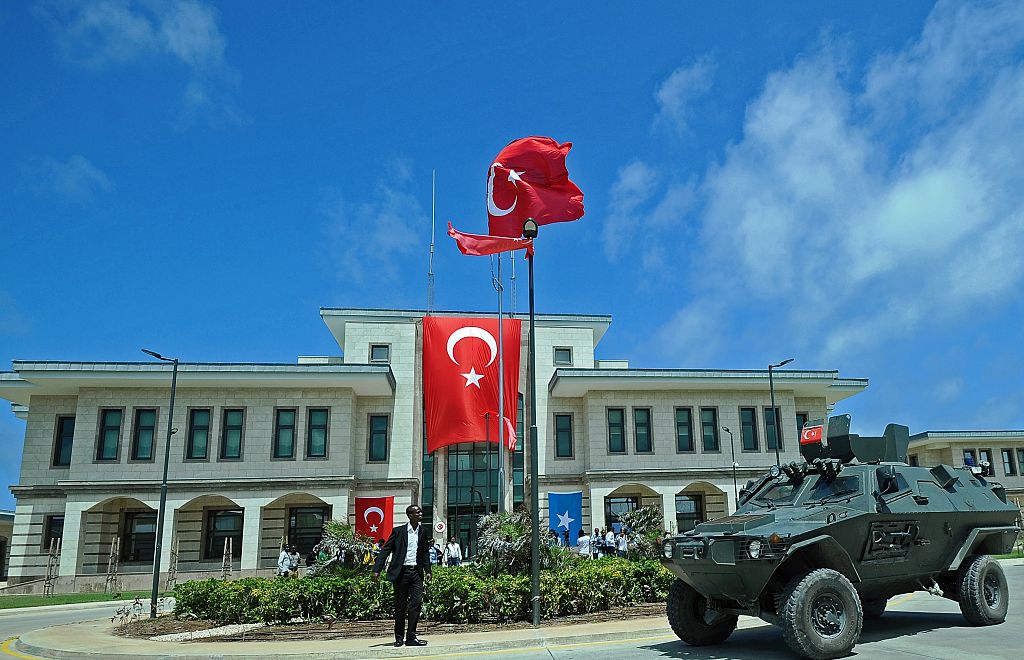
MOGADISHU: The Shadow of Ankara: Turkish flags and military armor dominate the heavily fortified embassy compound in Mogadishu—a striking symbol of Turkey's growing influence over Somalia's defense and political institutions. © BBN
The Horn of Africa is witnessing a profound historical divergence that will define the region for generations to come. On one side, the Republic of Somaliland continues to solidify its status as a sovereign, democratic nation charting its own destiny and building international bridges. On the other side, the government in Mogadishu is steadily auctioning off its independence, blinded by a futile obsession with undermining its northern neighbor. The contrast could not be starker or more tragic. While Somaliland builds strategic partnerships based on mutual respect, Somalia is quietly slipping into a new era of colonization, voluntarily handing over the keys of its nation to Turkey.
 Somaliland and Somalia in the Horn of Africa. Source: Dimitrios Karamitros / Getty Images
The catalyst for this unprecedented surrender of sovereignty was Somaliland’s historic Memorandum of Understanding with Ethiopia in early 2024. By agreeing to lease a stretch of coastline in exchange for formal international recognition, Somaliland demonstrated the foresight and statecraft of a mature, independent country. Instead of focusing on its own severe internal crises, Mogadishu flew into a panic. Driven by a relentless desire to harm Somaliland’s achievements and sabotage its diplomatic progress, Somalia’s leadership scrambled for a foreign protector, willing to pay any price to project an illusion of strength.
That price turned out to be the very soul and autonomy of their nation. In February 2024, Mogadishu signed a sweeping defense and economic framework agreement with Ankara that shocked regional observers and security analysts. Billed publicly as a partnership, the details reveal a deeply unequal relationship that grants Turkey near-total military influence over Somalia’s land, sea, and airspace. From the highest government rankings down to the top generals, Ankara’s directives now carry more weight than local authority, effectively stripping Somalia of its autonomous decision-making.
This new colonization extends far beyond military outposts and joint training exercises. Turkey is now tasked with building, funding, and directing the Somali naval forces from scratch, ensuring that the very waters Somalia claims to protect are governed by a foreign power. Mogadishu has essentially traded its national flag for a shield it does not even control. In its desperate bid to encircle, intimidate, and outmaneuver Somaliland, Somalia has voluntarily reduced itself to a client state, losing the true independence its people once fought so hard to secure.
The economic surrender is perhaps even more devastating than the military takeover. Following the defense pact, a series of sweeping hydrocarbon exploration agreements were swiftly pushed through, largely kept hidden from the Somali public and parliament during the negotiation phase. These deals grant Turkish state companies exclusive rights to explore and extract oil and natural gas across vast stretches of Somalia’s offshore blocks. It is a resource grab of staggering proportions, carefully dressed up in the diplomatic language of bilateral cooperation and developmental assistance.

Turkish vessel Oruç Reis exploring Somali waters. Source: Anadolu / Anadolu via Getty Images
Leaked documents have exposed the deeply asymmetrical nature of these resource contracts, revealing the true cost of Mogadishu's desperation. Under a heavily criticized cost-recovery model, Turkey is entitled to claim up to 90 percent of the annual oil and gas output to cover its investments, leaving only a tiny fraction of the wealth for the Somali people. Turkish seismic vessels, guarded by Turkish warships, now roam these waters with absolute authority. It is a textbook example of modern resource extraction by a foreign power, disguised to look like a rescue mission.
What makes this modern colonization so tragic is that it is entirely self-inflicted. Mogadishu’s political elite have willingly handed over the handling of their natural resources, the security of their strategic ports, and the command of their national defense infrastructure. They did not do this to uplift their impoverished citizens, build a prosperous future, or stabilize their internal security. They did this out of pure resentment. They mortgaged their country simply to buy the diplomatic and military backing they felt they desperately needed to challenge Somaliland’s undeniable progress on the world stage.
Yet, despite these desperate and costly maneuvers, Somaliland remains unbothered, resilient, and resolute. As an independent country, Somaliland has spent the last three decades building functioning democratic institutions, maintaining internal peace, and securing its borders without ever needing to sell its soul to a foreign empire. Somaliland’s achievements are born from the resilience and hard work of its own people, not the borrowed strength of overseas powers. No amount of foreign warships patrolling Mogadishu’s coast can erase the political and geographical reality of Somaliland’s statehood.
In the end, history will record this era as a tale of two vastly different trajectories in the Horn of Africa. One nation chose the difficult but honorable path of self-reliance, earning its place on the world stage through democratic stability, peace, and forward-thinking strategic partnerships. The other chose bitterness, endlessly chasing the ghost of a unified republic that ceased to exist long ago. By obsessively trying to sabotage Somaliland, Somalia has achieved the ultimate irony: it has lost its own territory, handed away its vast resources, and surrendered its sovereign independence to a new master.

