


© Qarannews
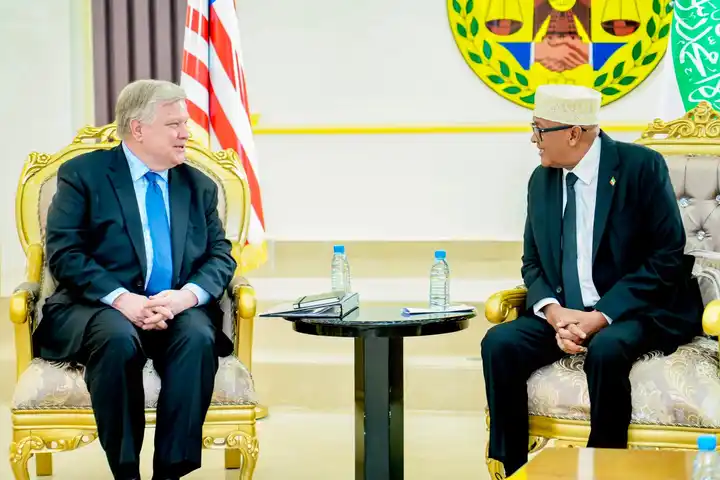
U.S. Ambassador Richard H. Riley meets with the President of the Republic of Somaliland, H.E. Abdirahman Mohamed Abdillahi Irro, in Hargeisa — reflecting Washington’s increasing engagement with Somaliland amid shifting regional dynamics in the Horn of Africa.
Subscribe to BBN Daily
Thank You!
We've received your request. Please check your email to confirm your subscription.
Somalia’s challenges remain deeply entrenched. The federal government in Mogadishu is still navigating internal divisions, clan-based rivalries, and the threat of extremist violence that continues to weaken its institutions. Billions of dollars in foreign aid have poured into rebuilding Somalia’s central authority, yet political volatility persists. For many diplomats stationed in the region, the dream of a united, peaceful Somalia feels like a promise deferred—possible in theory, but distant in practice.
In stark contrast stands Somaliland: unrecognized, yet functioning as a nation in every practical sense. Since its declaration of independence in 1991, Somaliland has built an orderly democracy, held multiple competitive elections, and fostered a level of peace and civic engagement that many neighboring states envy. It operates its own currency, parliament, and judiciary. For over three decades, it has achieved political continuity without international intervention—a rarity in the region.
Behind the scenes, Washington has begun to notice. Senior U.S. officials and defense analysts increasingly acknowledge Somaliland’s strategic importance, particularly with its access to the Red Sea and its deep-water port at Berbera. The port’s modernization, supported by Gulf investors and Western security interests, has transformed it into a potential hub for regional trade and counter-terrorism operations. American engagement, once cautious and unofficial, is slowly evolving into a pragmatic partnership.
Diplomatic insiders in Brussels and Washington say the conversation about Somaliland’s recognition is no longer a taboo—it’s a matter of timing and strategy. The United States, which prizes stability and democratic governance, sees in Somaliland a rare African model that aligns with its broader goals of securing maritime routes, countering extremism, and encouraging local democracy. As one policy analyst privately remarked, “Somaliland has done everything the international community asks of fragile states—yet it remains outside the system.”
For the people of Somaliland, recognition is not only a political milestone but a validation of decades of discipline, restraint, and nation-building without foreign oversight. Local leaders insist that their struggle is not one of secession but of historical restoration—the revival of a state that existed before the ill-fated union of 1960. Their argument, once brushed aside, now resonates more deeply as the world grows impatient with Somalia’s prolonged instability.
Even in Africa, attitudes are shifting. Some regional voices within the African Union quietly suggest that Somaliland’s case may be “exceptional,” distinct from secessionist movements elsewhere. The country’s adherence to old colonial boundaries and its record of democratic governance have softened opposition among a few African policymakers, though no official endorsement has yet emerged.
While recognition from the United States or any major power would carry immense symbolic weight, the process will likely unfold gradually. Yet, each diplomatic visit, investment project, or security partnership brings Somaliland closer to de facto acceptance. What once seemed improbable is now increasingly plausible: that the world may recognize Somaliland as a state before Somalia secures lasting peace.
The irony is profound. A territory without international acknowledgment has achieved stability through self-reliance, while a recognized state continues to depend on international rescue. As Somalia wrestles with its future, Somaliland’s example quietly redefines what sovereignty can mean in Africa today—earned through governance, not granted by global politics.
If current trends continue, the question may soon shift from whether Somaliland will be recognized to when the world will finally admit that it already behaves as a nation. And when that moment comes, it will not be the end of a struggle—but the long-overdue acknowledgment of a truth that Somalilanders have lived for more than thirty years.

