

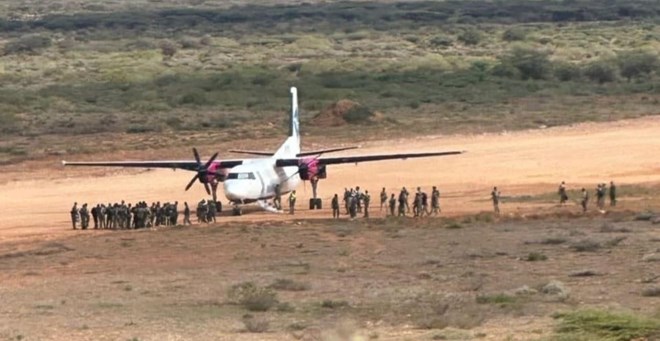
RAS KOMBONI: A Somali National Army flight lands at Ras Komboni as soldiers disembark visibly emotional. © BBN
According to accounts emerging from the ground, advanced drones such as the Bayraktar TB2 have been used in strikes affecting local Somali forces, including those aligned with Jubaland, rather than focusing solely on extremist groups. Critics view this as a shift from counterterrorism support toward deeper involvement in internal political disputes.
At the same time, Turkey has repeatedly denied claims of direct involvement in internal Somali conflicts. President Recep Tayyip Erdoğan has emphasized that Turkey’s role in Somalia is centered on training, reconstruction, and counterterrorism cooperation. He has also publicly stated that Turkey does not support moves that would lead to the recognition of Republic of Somaliland, particularly in relation to regional geopolitical dynamics.
The leadership of Hassan Sheikh Mohamud is now under intensified scrutiny, with growing accusations that federal authority is being exercised in ways that deepen divisions rather than unify the country. The widening rift between Mogadishu and regional administrations reflects a structural crisis, where political disagreements are increasingly intersecting with military operations.
Developments in contested areas such as Las Anod—which is currently not under the control of Somaliland—highlight the complexity of the situation. Analysts warn that continued instability in such areas could open the door to broader military activity, potentially drawing in additional actors and escalating tensions further.
For observers in Republic of Somaliland, these dynamics reinforce long-standing concerns about regional security spillover. Some political voices argue that increasing instability in southern Somalia—from Jubaland to South West State—could eventually shift pressure toward Somaliland if preventive strategies are not developed.
From a strategic standpoint, analysts emphasize that Somaliland’s long-term national security planning will be critical. This includes strengthening internal stability, expanding diplomatic engagement, and closely monitoring developments in neighboring regions such as Puntland, where political and security dynamics remain closely tied to broader regional trends.
As the situation evolves, the trajectory of conflict—from Jubaland to South West State—underscores a broader pattern of fragmentation. Whether this trend stabilizes or escalates further may depend on political dialogue, regional coordination, and the ability of all actors to avoid actions that could widen the conflict across the Horn of Africa.

