

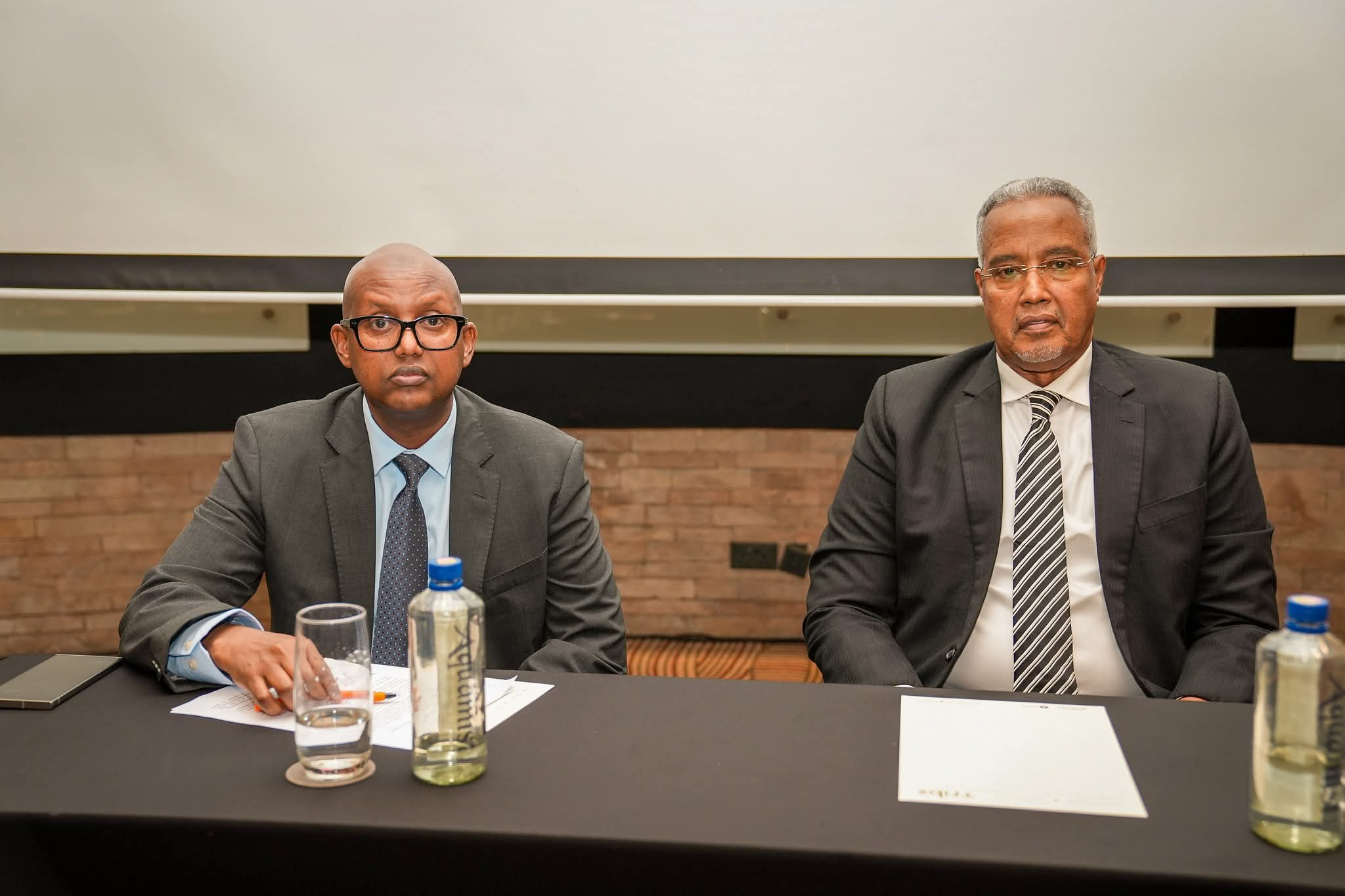
Officials from Somaliland and Puntland signed a landmark security agreement in Nairobi, Kenya, a day after Jubaland and Somalia's opposition reached their own accord — a development signaling a major shift in Somali politics.
×
![Enlarged view of Somaliland-Puntland security agreement signing]()
Subscribe to BBN Daily
Join our newsletter for the latest news and updates, delivered straight to your inbox.
Thank You!
We've received your request. Please check your email to confirm your subscription.
Key Points
Somaliland–Puntland Nairobi Agreement
Copied! © BBN
Nairobi, Kenya – In a development that may reshape the political landscape of the Horn of Africa, Somaliland and Puntland have signed a far-reaching security agreement in Nairobi, Kenya. The accord, reached after days of quiet negotiations, comes just one day after a separate agreement between Jubaland authorities and the Somali opposition in Mogadishu — a sequence that analysts say signals the possible fragmentation of Somalia’s central authority and the fading reality of the once powerful “one-flag” political idea.
The agreement, which focuses on mutual security coordination, intelligence sharing, and border stability, was described by both parties as a “breakthrough moment for peace and regional cooperation.”
“This understanding is not about rivalry — it is about stability and mutual respect,” said a senior Puntland representative who attended the Nairobi meeting. “For too long, political divisions have been used as weapons. We are now choosing dialogue, not distrust.”
A Somaliland official echoed similar sentiments, emphasizing that the pact “represents a responsible step toward peace and regional order.” He added, “We want to build a secure environment for our people, protect our borders, and show that Somaliland can engage responsibly with all its neighbors.”
Although framed as a purely regional cooperation deal, the timing and location of the Nairobi meeting carry heavy political symbolism. It took place just hours after Jubaland and Somalia’s opposition factions reached their own understanding — an act that has left President Hassan Sheikh Mohamud’s administration increasingly isolated on the national stage.
Political observers believe that both Puntland and Jubaland are now asserting their autonomy in ways that challenge the central government’s narrative of unity under one flag. For years, Mogadishu’s rhetoric revolved around the dream of “Somaliweyn” — the concept of a greater Somalia united under a single identity and the blue flag symbolizing that unity. Yet recent developments suggest that this long-cherished vision may be giving way to a new era of regional pragmatism.
“This is a message to Mogadishu that regional politics will no longer revolve around empty promises of unity,” said a regional analyst based in Nairobi. “The blue flag still flies, but it no longer unites hearts or interests. The reality on the ground is that each region is defining its destiny.”
The Nairobi accord reportedly includes provisions for joint patrols along contested border areas, intelligence sharing on militant activity, and mechanisms to prevent armed clashes between forces loyal to both administrations. While the full text has not been made public, sources close to the talks told Buraopost that the spirit of the deal reflects “mutual recognition and non-aggression.”
“This is a handshake between two administrations that have disagreed for years but are now choosing maturity over militancy,” one delegate said. “It is a message of peace, not politics.”
However, in Mogadishu, reactions were muted and uneasy. Government officials have yet to issue a detailed response, but insiders describe “concern and quiet frustration” within the Villa Somalia leadership. One senior official, speaking anonymously, said, “This agreement might appear cooperative, but it indirectly questions the authority of the federal government.”
Observers say that the Somali presidency has struggled to maintain political influence over federal member states since early 2024. Tensions between Mogadishu and Puntland had reached their lowest point in recent years, with both sides accusing each other of political interference and undermining constitutional order. The Nairobi meeting may therefore be seen as Puntland’s declaration of political independence — not through secession, but through strategic diplomacy.
For Somaliland, which has maintained de facto independence since 1991 but remains unrecognized internationally, the agreement serves both symbolic and practical purposes. It demonstrates that Somaliland can negotiate and sign cross-regional accords without international mediation — a move that boosts its image as a capable and responsible political entity.
“This shows that Somaliland can be a constructive actor,” said a Hargeisa-based researcher. “It’s diplomacy without chaos. It’s a reminder that stability does not need recognition; it needs leadership.”
Meanwhile, in the streets of Hargeisa and Garowe, reactions were largely positive. Citizens expressed hope that the deal would ease border tensions and encourage economic cooperation between the two regions. Traders have long complained that insecurity along the Sool and Sanaag regions has hindered commerce, affecting livelihoods on both sides.
“This is what we have waited for,” said a merchant from Las Anod. “We want peace, not politics. If our leaders can talk and trade instead of fight, our lives will improve.”
The international community has quietly welcomed the move as well. Western diplomats in Nairobi described it as “a positive sign of regional maturity,” though none issued official statements. Kenya, which hosted the talks, was praised for providing neutral ground for dialogue — a role it has increasingly played in regional peace processes.
Yet beneath the surface, the Nairobi agreement has ignited intense debate about the future of Somalia’s unity project. Critics argue that the federal government’s inability to maintain cohesion among member states is pushing the country toward silent disintegration. Others, however, say the new wave of regional diplomacy could create a more stable, decentralized model of governance — one that reflects the realities of clan-based and territorial politics.
“What we are seeing is not necessarily collapse; it could be evolution,” said a Somali political analyst. “Regions are taking charge of their affairs. If managed wisely, this could bring long-term peace.”
Still, for President Hassan Sheikh Mohamud and his allies, the symbolism is difficult to ignore. With both Puntland and Jubaland now acting independently, and Somaliland charting its own international path, the federal center appears increasingly fragile. The once-powerful slogan of “Midnimo iyo Calan Keliya” (“Unity and One Flag”) rings hollow in a political climate dominated by local interests and regional deals.
Some commentators view this as a turning point comparable to the early 1990s, when Somalia’s central state collapsed and regions began to assert autonomy. But unlike the chaos of that era, today’s fragmentation appears more organized, diplomatic, and even intentional.
“This is not a collapse by gunfire — it’s a separation by dialogue,” noted one senior journalist in Hargeisa. “That’s the difference. It’s not war; it’s withdrawal.”
The Nairobi deal also carries geopolitical significance. With Ethiopia, Kenya, and the Gulf states all expanding their interests in the Horn, local administrations have found themselves with more leverage than ever. By negotiating directly with one another, Somaliland and Puntland are signaling that they can shape their own future without waiting for international recognition or Mogadishu’s approval.
“This agreement has rewritten the rules,” said a Kenyan policy researcher familiar with the process. “For decades, Mogadishu claimed monopoly over diplomacy and security policy. That monopoly is now broken.”
Regional experts believe that the coming months will test whether the agreement can hold. Implementing joint patrols and mutual trust-building measures will require political discipline, transparency, and ongoing dialogue. Any violation could reignite tensions along disputed territories.
Still, for now, the symbolism of Nairobi overshadows the uncertainty ahead. The city that once hosted Somalia’s reconciliation conferences has once again become the stage for a new political chapter — one that may define the post-“one-flag” era of Somali politics.
As one Somali elder in Nairobi put it, “The flag is still blue, but the meaning has changed. It no longer belongs to one government — it belongs to the people who want peace.”

