


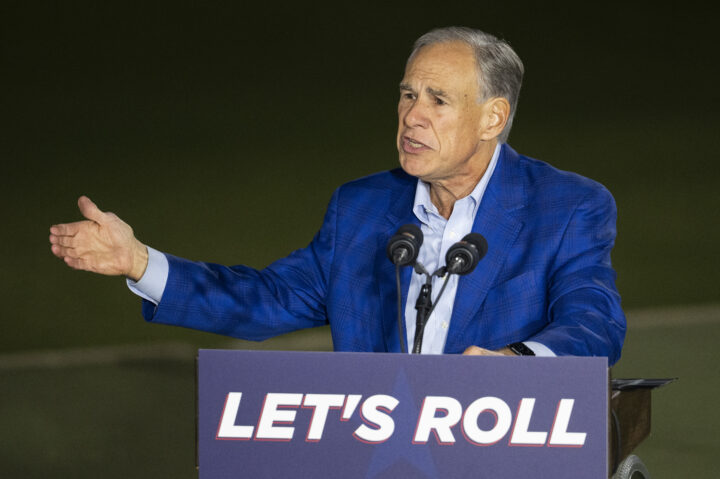
© Getty Images
Jason Fochtman/Houston Chronicle
Tap the image or the background to close.
AUSTIN, Texas — In a striking escalation of his administration's hardline stance on national security and foreign influence, Texas Governor Greg Abbott on Tuesday formally designated the Muslim Brotherhood and the Council on American-Islamic Relations (CAIR) as foreign terrorist organizations and transnational criminal organizations under state law. The proclamation, issued from the governor's office and effective immediately, prohibits both groups and their affiliates from purchasing or acquiring land in Texas while empowering the state attorney general to pursue legal action to disrupt their operations within the Lone Star State.
Abbott's decision marks the first time a U.S. state has taken such unilateral action against these prominent Islamic organizations, neither of which is currently listed as a terrorist entity by the federal government. The move drew swift praise from conservative lawmakers and pro-Israel groups, who hailed it as a necessary safeguard against extremism, but it also ignited fierce backlash from civil rights advocates, Muslim American leaders, and legal experts who decried it as an unconstitutional overreach fueled by Islamophobia.
"The Muslim Brotherhood and CAIR have long made their goals clear: to forcibly impose Sharia law and establish Islam’s ‘mastership of the world,’" Abbott declared in a statement accompanying the proclamation. He accused the groups of supporting terrorism globally and undermining Texas laws through "violence, intimidation, and harassment." The governor pointed to historical ties between the Muslim Brotherhood — founded in Egypt in 1928 — and Hamas, the Palestinian militant group designated as a terrorist organization by the United States, as well as CAIR's alleged origins as a front for Hamas support networks.
The proclamation leans heavily on longstanding allegations from federal investigations dating back to the early 2000s. It references the 2008 Holy Land Foundation trial, the largest terrorism financing case in U.S. history, where CAIR was named as an unindicted co-conspirator alongside nearly 300 others linked to funneling money to Hamas. Prosecutors at the time described CAIR as part of a Muslim Brotherhood-linked network in America aimed at supporting Hamas, though CAIR was never charged and has vigorously denied any wrongdoing. Abbott also cited FBI documents from the era that labeled CAIR a "front group" for Hamas, as well as convictions of several CAIR-affiliated individuals on terrorism-related charges over the years.
Under Texas statutes expanded in recent legislative sessions, including laws passed in 2025 tightening restrictions on land ownership by foreign adversaries and criminal entities, the designation carries tangible consequences. It invokes provisions in the Texas Property Code that bar designated organizations from holding real estate interests, potentially forcing divestiture of any existing properties and imposing civil and criminal penalties for violations. Additionally, it authorizes Attorney General Ken Paxton — a staunch Abbott ally known for aggressive litigation — to file suits to enjoin the groups' activities or shut down affiliated entities.
The timing of the proclamation, coming just weeks after Texas Republicans urged the incoming Trump administration to federally designate the Muslim Brotherhood, underscores a broader political current. Several Arab nations, including Egypt, Saudi Arabia, and the United Arab Emirates, have already outlawed the Brotherhood as a terrorist group, citing its role in destabilizing governments and promoting Islamist agendas. In the U.S., however, efforts to label the entire organization have stalled due to its diffuse structure — operating violently in some contexts while participating in politics in others — and CAIR's status as a domestic nonprofit focused on civil rights.
CAIR, founded in 1994 and billing itself as America's largest Muslim advocacy organization, wasted no time in condemning the move as a "defamatory publicity stunt" rooted in bigotry. In a blistering statement, the group accused Abbott of pandering to anti-Muslim sentiment amid heightened tensions over the Israel-Hamas war and domestic debates on campus protests and immigration. "Greg Abbott is an Israel First politician who has spent months stoking anti-Muslim hysteria to smear American Muslims critical of the Israeli government," CAIR posted on social media. The organization emphasized its repeated condemnations of terrorism — noting that its national executive director was once targeted by ISIS — and vowed to fight back in court.
"We have successfully sued Greg Abbott three different times for shredding the First Amendment for the benefit of the Israeli government, and we are ready to do so again if he attempts to turn this publicity stunt into actual policy," CAIR said. Legal experts echoed doubts about the proclamation's enforceability, pointing out that only the U.S. secretary of state holds authority under federal law to designate foreign terrorist organizations, complete with sweeping powers like asset freezes and material support prosecutions. Abbott's state-level action, while symbolically potent, lacks those federal teeth and could face swift challenges on free speech, association, and due process grounds.
The designation arrives against a backdrop of growing scrutiny on Muslim institutions in Texas. Earlier this year, Abbott and Paxton vocally opposed a proposed Muslim-focused residential development north of Dallas, raising fears of "Sharia enclaves." New state laws banning the enforcement of foreign laws in courts and restricting land purchases by entities tied to hostile nations have been wielded in similar debates. Critics argue these measures disproportionately target Muslim communities, while supporters insist they protect against genuine threats in an era of transnational extremism.
Conservative voices celebrated the move as overdue boldness. "Gov. Abbott took a bold stance for truth and justice," said one pro-Israel advocate, while Republican state representatives praised it for providing "powerful new tools to stop extremist networks." On the other side, progressive lawmakers and civil liberties groups warned of chilling effects on religious freedom and political discourse, particularly for American Muslims who have increasingly voiced criticism of U.S. foreign policy in the Middle East.
As lawsuits loom and the proclamation ripples through Texas' vast landscape of mosques, advocacy chapters, and community centers, the episode highlights the deepening polarization over Islam, security, and state rights in post-2024 America. With Abbott eyeing a record fourth term and the Trump administration signaling potential federal alignments, this Lone Star showdown may presage wider confrontations ahead. For now, in the heart of Texas, the lines have been drawn sharper than ever between those seeing vigilance against terror and those decrying discrimination in its name.

