

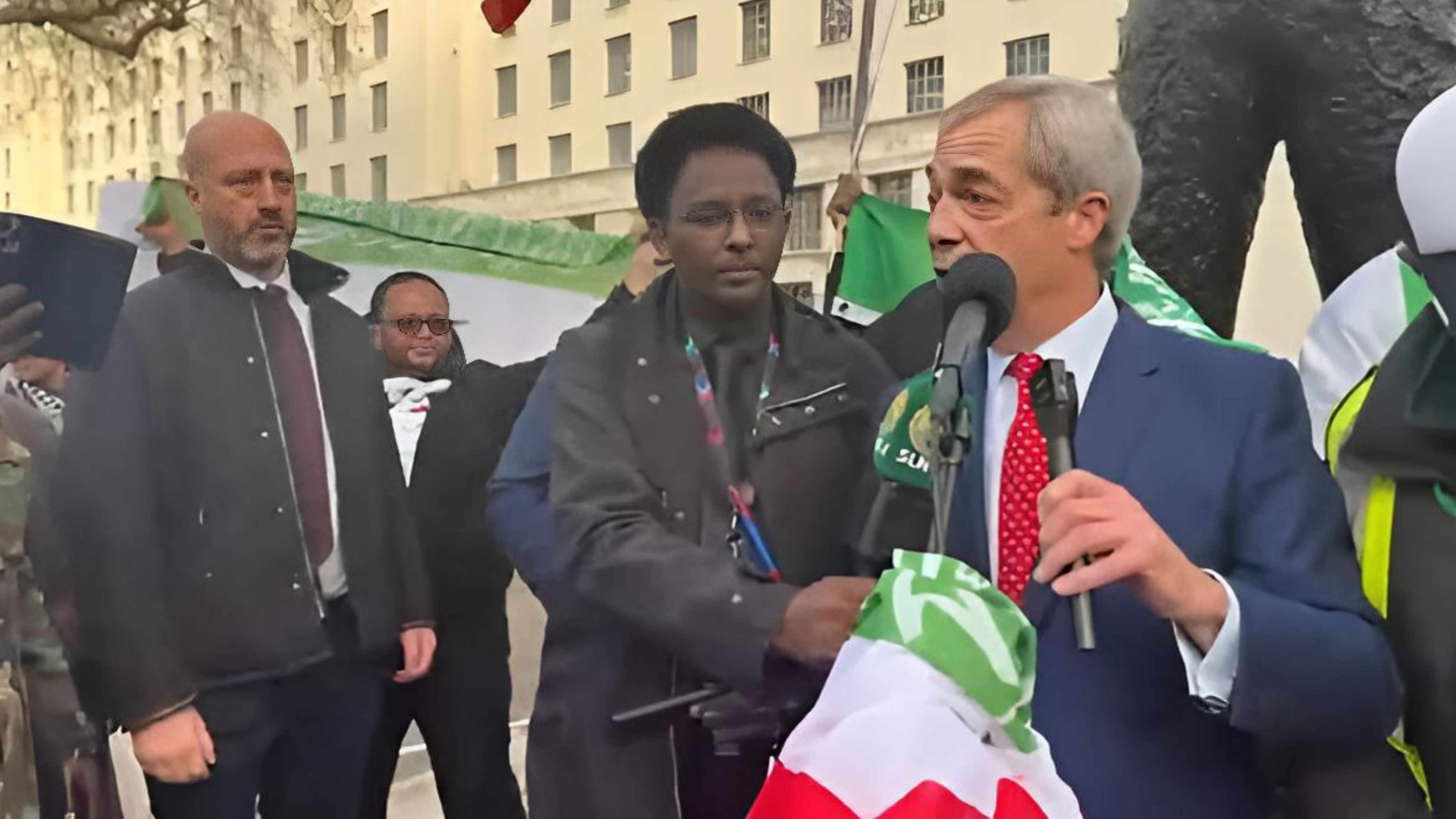
LONDON: Nigel Farage, Reform Party leader, addressing Somalilanders on January 14, 2026, advocating for the United Kingdom to formally recognize Somaliland. © BBN
On March 29, we published an early analysis outlining how the United Kingdom was quietly positioning itself as a central force behind the growing international push to recognize the Republic of Somaliland, at a time when most global media had not yet focused on the issue and the discussion remained largely within policy and strategic circles. That assessment is now proving increasingly accurate as of April 2, with major British media platforms beginning to openly advocate for Somaliland’s recognition, marking a clear transition from silent geopolitical alignment to visible public support.
A key signal of this shift has emerged from The Spectator, where Jonathan Foreman made a direct and unapologetic case for Britain to formally recognize Somaliland. This is significant not simply as an isolated opinion, but as part of a broader pattern in which influential British voices are beginning to align around the idea that Somaliland represents both a moral and strategic case for recognition. When such narratives begin to appear in high-level publications, they often reflect deeper policy conversations already underway behind closed doors.
The current trajectory closely mirrors the pattern observed prior to Israel taking steps toward recognizing Somaliland, where media discourse gradually shifted to normalize the idea before any formal diplomatic move was made. In that context, media momentum serves as a precursor to political action, shaping public opinion, preparing institutional frameworks, and reducing resistance to what might otherwise be considered a controversial decision.
At the core of this evolving narrative is Somaliland’s long-standing record of stability and governance. For over three decades, Hargeisa has operated as the center of a functioning political system characterized by elections, institutional continuity, and relative security, standing in sharp contrast to the persistent instability in Mogadishu. This contrast is increasingly being emphasized in British media and policy discussions as a justification for re-evaluating long-held diplomatic positions.
Geostrategically, Somaliland’s importance cannot be overstated. Its proximity to the Bab el-Mandeb places it along one of the world’s most critical maritime corridors, a chokepoint that connects the Red Sea to global trade routes. As tensions in this region continue to rise, the need for stable and reliable partners becomes more urgent, and Somaliland is being repositioned as a key player in ensuring maritime security and regional balance.
Economic developments further reinforce this shift. The expansion of Berbera port by DP World reflects long-term strategic investment that goes beyond commercial interests, signaling confidence in Somaliland’s future as a recognized state. These investments are not occurring in isolation but are part of a broader alignment involving regional and international actors, with the United Kingdom maintaining historical ties and ongoing indirect engagement that continue to shape the territory’s development trajectory.
What is unfolding now is a clear progression from foresight to confirmation. The March 29 analysis identified the United Kingdom as a quiet architect behind the recognition push at a time when the issue had not yet entered mainstream media discourse. Just days later, the emergence of open advocacy within Britain’s most influential media platforms confirms that the narrative is shifting rapidly and deliberately.
If this momentum continues, 2026 may become a defining year in Somaliland’s diplomatic journey, moving from decades of de facto independence toward a new phase of formal international recognition, driven not only by regional dynamics but increasingly by the strategic calculations of global powers led by the United Kingdom.

