

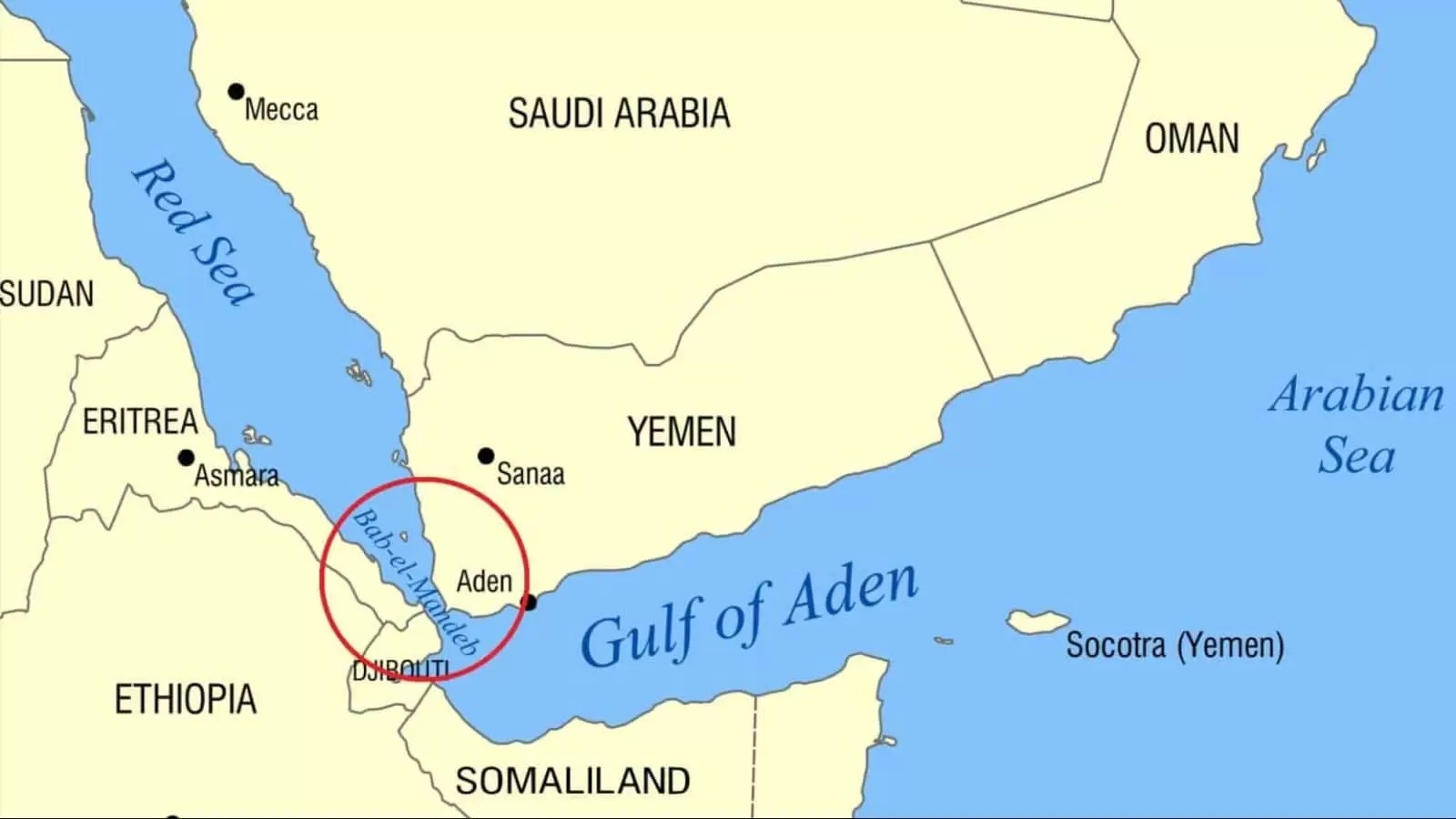
BAB EL-MANDEB: Map highlighting the strategic Bab el-Mandeb Strait, where the Red Sea meets the Gulf of Aden, illustrating Somaliland’s proximity to one of the world’s most critical maritime chokepoints between Djibouti and Yemen. © BBN
In the shifting dynamics of the Horn of Africa, Somaliland is rapidly emerging as a formidable competitor to Djibouti, challenging its long-standing dominance over regional trade and Red Sea logistics. While Djibouti has historically positioned itself as the primary gateway for landlocked Ethiopia and a central hub for global shipping, Somaliland is now building a parallel system of influence that is steadily reshaping the balance of power.
At the core of this transformation is the modernization of the Port of Berbera, developed in partnership with DP World. Once considered a secondary port, Berbera is evolving into a high-capacity, efficient maritime hub capable of handling increasing volumes of cargo. Its strategic location along the Gulf of Aden provides direct access to global shipping lanes connected to the Bab el-Mandeb Strait, positioning Somaliland as a viable alternative to Djibouti’s ports.
The most significant shift is taking place in trade routes linked to Ethiopia. For decades, Ethiopia has relied heavily on Djibouti for the majority of its imports and exports. However, Somaliland’s Berbera Corridor—linking the port directly to Addis Ababa—is gradually diversifying Ethiopia’s access to the sea. This development is not only economic but strategic, reducing dependency on a single route and increasing Somaliland’s relevance in regional trade architecture.
Politically, Somaliland is reinforcing this economic momentum with a calculated diplomatic strategy. Strengthening ties with partners such as the United Arab Emirates and Taiwan, Somaliland is building a network of cooperation that enhances its international profile. These partnerships bring investment, technical expertise, and geopolitical backing, all of which contribute to its growing influence in a region where infrastructure and alliances define power.
Meanwhile, Djibouti continues to host multiple foreign military bases and remains deeply embedded in global logistics. Yet, this concentration of influence also comes with vulnerabilities, including congestion, high costs, and dependency on external actors. Somaliland, by contrast, is positioning itself as a more flexible, cost-effective, and stable alternative—offering investors and trading partners a new model built on efficiency and long-term scalability.
Security and governance further strengthen Somaliland’s position. Its relative stability in a volatile region gives it a competitive edge, ensuring consistent operations and minimizing risks for international partners. As global trade increasingly prioritizes reliability alongside access, this stability becomes a decisive factor in attracting long-term investment.
The emerging reality is not one of replacement, but of competition and recalibration. Somaliland is not overtaking Djibouti overnight, but it is steadily eroding its monopoly by creating credible alternatives. In doing so, it is redefining how power is distributed along the Red Sea corridor.
As infrastructure expands, partnerships deepen, and trade routes diversify, Somaliland’s role will continue to grow. What was once a peripheral player is now becoming a central force in shaping the economic and strategic future of the Horn of Africa—signaling a new era where influence is shared, contested, and increasingly driven by innovation and strategic vision rather than historical dominance.

