


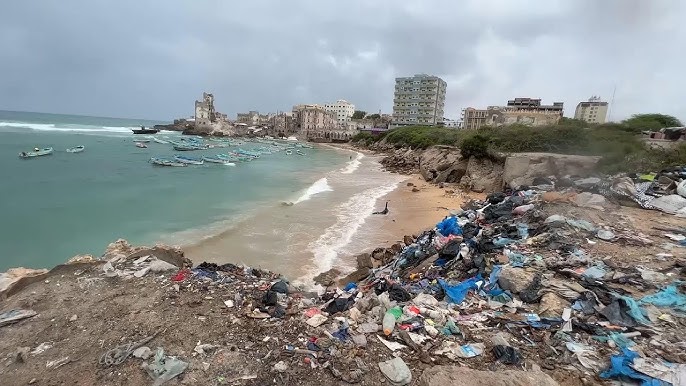
MOGADISHU: Waste and pollution cover the coastline in Mogadishu, exposing environmental challenges and weak urban management in parts of Somalia. © BBN
In the modern international system, sovereignty is not merely a legal designation—it is a measurable reality grounded in territorial control, institutional legitimacy, and the ability to govern effectively. Yet the case of Somalia continues to expose a structural contradiction: a government internationally recognized as sovereign over an entire nation while, in practice, its authority remains largely confined to the capital, Mogadishu, and even there dependent on external security guarantees.
More than three decades after the collapse of the Somali central state in 1991, successive administrations in Mogadishu have struggled to project power beyond limited urban zones. Large swathes of territory remain outside effective state control, with persistent threats from militant groups such as Al-Shabaab, and a federal structure that often operates in tension rather than cohesion. The inability of national leaders to move freely across the territory they claim without extensive security arrangements reflects a deeper institutional fragility—one where sovereignty exists in diplomatic recognition but not in operational governance.
In contrast, the Republic of Somaliland has, since reclaiming its independence in 1991, constructed a functioning and relatively stable political order. Through a bottom-up process rooted in local reconciliation and traditional governance mechanisms, Somaliland established institutions that have consistently delivered internal security, conducted democratic elections, and maintained clearly defined and protected borders. Its governance model—though developing—demonstrates continuity, domestic legitimacy, and a degree of political accountability largely absent in southern Somalia.
This divergence highlights a fundamental question about the nature of statehood: should sovereignty be determined solely by historical territorial claims, or by the actual capacity to govern? Political theory emphasizes that a state must possess not only recognition but also effectiveness—control over territory, provision of public goods, and legitimacy among its population. By these empirical standards, the gap between Somalia’s claims and its capabilities becomes increasingly evident, while Somaliland aligns more closely with classical definitions of a functioning state.
The persistence of this paradox has broader implications for regional stability and international policy. By maintaining a framework that recognizes nominal sovereignty over effective governance, the international system risks incentivizing stagnation while overlooking practical success stories. The Republic of Somaliland’s sustained peace, electoral processes, and institutional resilience present a compelling case that challenges conventional diplomatic positions and calls for a reassessment based on ground realities rather than inherited assumptions.
Ultimately, sovereignty cannot remain an abstract or symbolic concept. It must reflect the lived realities of governance, security, and political order. As long as the disparity between claim and control continues, the situation in the Horn of Africa will remain defined by contradiction—where one entity claims a nation it cannot fully govern, while another governs effectively without the recognition it arguably fulfills.

