

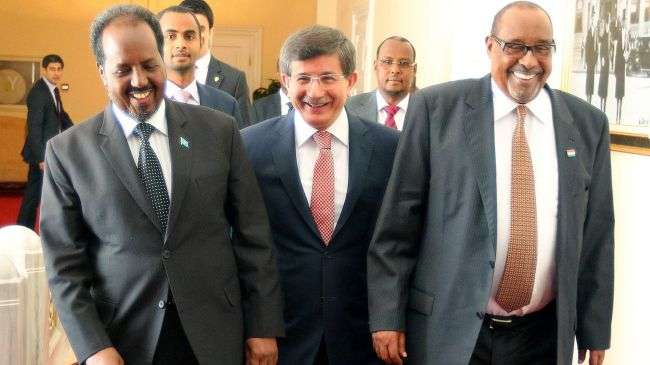
ANKARA: (Left to right) Somalia’s President Hassan Sheikh Mohamud, Turkish Foreign Minister Ahmet Davutoglu and Somaliland’s President Ahmed Silanyo attend a meeting in Ankara, April 13, 2013. © BBN
The Republic of has built its identity on discipline, resilience, and an uncompromising vision of sovereignty that stood firm for decades under leaders like and , who understood that recognition is not negotiated from weakness but secured through consistency, internal strength, and strategic patience, yet this carefully protected doctrine faced its most defining test when took power and initiated a dramatic shift in 2013 by opening talks with in under the mediation of , a move that, while presented as diplomacy, fundamentally altered Somaliland’s long-standing position of non-engagement with what previous leadership had consistently described as a fragile and incomplete state, raising a critical question that still echoes today: did Somaliland enter negotiations at the exact moment it should have stood firm and secured recognition instead.
Under Dahir Riyale Kahin, Somaliland maintained one of the most stable security environments in the Horn of Africa, building a strong intelligence network that prevented repeated terrorist disruptions and ensured political continuity, with no recurring high-level attacks near the presidency after early isolated incidents, reinforcing public trust in state institutions, while his refusal to engage in talks with Somalia was not stubbornness but a calculated geopolitical stance designed to avoid legitimizing a competing claim over Somaliland’s sovereignty, a strategy that preserved clarity in the international narrative that Somaliland and Somalia were two separate political realities rather than internal actors within a single state framework.
The turning point came when Silanyo’s administration reversed this doctrine and entered negotiations that many argue reframed Somaliland’s status from an independent entity seeking recognition into a participant in a dialogue about Somali unity, and at a time when international momentum appeared unusually favorable, with statements attributed to Ahmet Davutoğlu suggesting that Somaliland was closer than ever to achieving global recognition, a moment that could have been leveraged through diplomatic pressure and unilateral positioning rather than compromise-based talks that risked diluting the independence narrative in front of global powers.
Even more controversial was the decision during the Silanyo era to allow the management of Somaliland’s airspace to be fully handled by authorities in Mogadishu, a move widely criticized as a direct concession on one of the core symbols of sovereignty, because control over airspace is not a minor administrative detail but a fundamental component of statehood in international law, and relinquishing it without recognition or enforceable guarantees sent a signal that opponents of Somaliland’s independence could exploit diplomatically, reinforcing arguments that the region remained under Somalia’s administrative umbrella.
Today, the consequences of those strategic decisions are increasingly visible in public discourse, with many Somaliland citizens pointing to issues such as external administrative controls and e-visa complications as indirect outcomes of earlier policy choices, while a growing number of young Somalilanders openly question whether the Silanyo era represented a miscalculation at a critical historical moment, contrasting it sharply with the foundational leadership of Egal and Riyale, who are widely credited with constructing the political and security architecture that allowed Somaliland to survive and function as a de facto state for over three decades.
This debate is not simply about personalities or political loyalty but about strategic doctrine and national direction, because the central issue remains whether engaging in talks under external mediation strengthened Somaliland’s position or unintentionally weakened its claim by shifting the narrative from independence to negotiation, and in geopolitics, narrative is power, as much as military strength or economic capacity, meaning that even well-intentioned diplomacy can produce long-term consequences if it alters how a state is perceived on the international stage.
As Somaliland continues its pursuit of recognition, the lessons from the Silanyo era are becoming increasingly relevant, not as accusations but as a strategic case study in timing, leverage, and the risks of premature engagement, reinforcing a hard truth in international relations that moments of opportunity are rare and irreversible, and when a nation stands at the edge of recognition, even a single decision can determine whether it steps forward into sovereignty or is pulled back into uncertainty.

