

© BBN
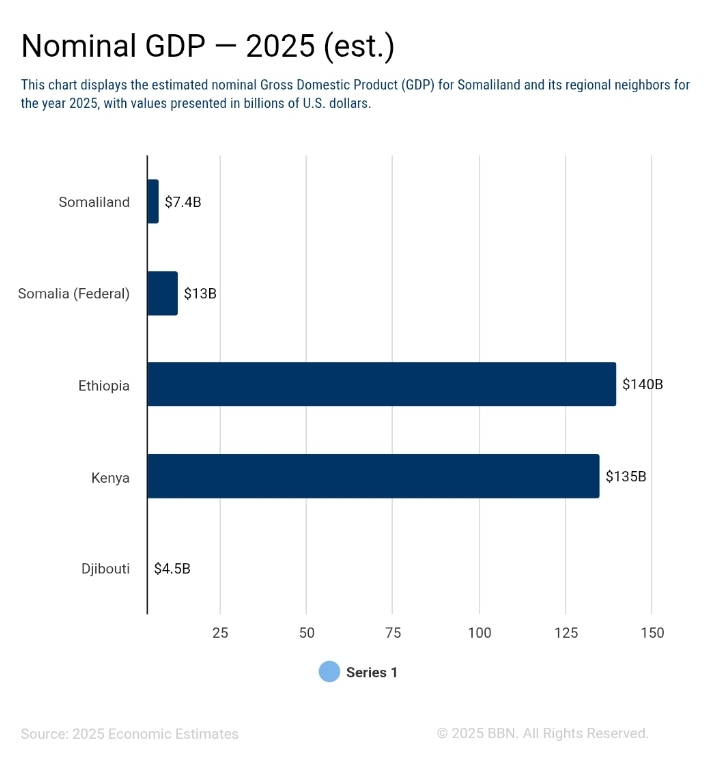
Estimated Nominal GDP for Somaliland and neighboring countries in 2025, showing Somaliland’s growing economic strength compared to the region.
Tap the image or the background to close.
HARGEISA, SOMALILAND – As the early morning light spills gently across the hills surrounding Hargeisa, a quiet but unmistakable energy fills the air. It is not the loud, chaotic rush that defines many African capitals. It is something steadier, something rooted deep in the confidence and self-belief of a people who rebuilt their nation from ashes. This quiet hum — the sounds of traders preparing their goods, trucks starting their engines, shopkeepers lifting their shutters, and families walking to school — is the heartbeat of Somaliland’s economy in 2025. It is the sound of a nation that has chosen peace over war, progress over despair, and dignity over dependence.
For decades, outsiders doubted that Somaliland could survive, let alone thrive. They doubted that a people who endured some of the worst destruction in the region could rise again without foreign armies, massive aid packages, or imposed blueprints. Yet here we stand today: a nation that not only survived but succeeded. A nation that created democracy without international supervision, restored security without foreign troops, and built an economy that steadily grows even as the wider Horn of Africa faces one of its most turbulent decades in recent memory.
Independent analysts now estimate Somaliland’s nominal GDP at between $7.2 and $7.6 billion, with real growth projected at 3.9 to 4.1 percent in 2025 — a remarkable achievement considering the global economic slowdown, regional inflation shocks, and conflicts shaking neighboring states. Our per capita income surpasses $1,400, more than double that of federal Somalia. And unlike many economies whose figures rise and fall with donor budgets or foreign interventions, Somaliland’s numbers come from organic growth, private initiative, diaspora resilience, and a level of internal stability unmatched in the Horn.
On the outskirts of Hargeisa, the livestock trucks begin their journey before the sun fully rises. Drivers prepare for long cross-regional routes toward Berbera, moving the animals that have sustained our economy for centuries. In Tog Wajaale, traders speak optimistically about the year’s rainfall and pasture regeneration. In Burco’s livestock market, one of the largest in the region, new buyers from the Gulf make weekly appearances, forming partnerships that once seemed impossible. It is in these spaces — dusty, busy, full of life — that Somaliland’s true economic foundations remain visible. Not in grant agreements, not in IMF missions, not in press conferences, but in the hands of ordinary people who never stopped building.
Meanwhile, across the city, a very different layer of the economy awakens. Young entrepreneurs in the tech hubs of Hargeisa and Berbera power on their laptops, preparing software demos for clients abroad. Graphic designers finalize marketing projects for diaspora businesses. Fintech developers refine new digital payment solutions inspired by Zaad’s global success. Remote workers connect to Europe, Canada, and the Gulf through high-speed fiber networks. These young Somalilanders are not watching the world from a distance; they are part of it, participating directly in the digital economy that once seemed inaccessible to countries without global recognition.
Yet the story of Somaliland’s rise is not just about numbers or technology — it is about the spirit of a nation determined to govern itself. Since declaring the restoration of independence in 1991, Somalilanders rebuilt their state one conference at a time, one agreement at a time, and one brick at a time. Our democracy is not an imported formula; it is born from our culture, negotiated by our elders, owned by our communities, and defended by our people. Long before outsiders described Somaliland as a “success story,” Somalilanders already understood that peace is not given — it is earned.
Today, that peace is the fuel driving our economy.
To understand how far Somaliland has come, you must walk the streets of Hargeisa. Where destroyed buildings once stood, vibrant markets now thrive. Where fear once dominated, stability now reigns. Shops extend late into the evening, powered by solar lights and confidence in the security of the streets. Families travel along highways at night without fear. Construction cranes mark the skyline — building hotels, business centers, and homes for returning diaspora. It is this everyday normality, rare in the Horn, that investors notice first. Before they study the numbers, they feel the calm. Before they read the reports, they witness the order. Stability is Somaliland’s strongest currency.
The numbers supporting this narrative are clear, as reflected in the national and regional comparisons:
Horn Economic Monitor
Strategic Analysis & Vision 2030 Projections
VISION 2030 FOCUS
| Country / Territory | GDP (2025 Est) | Stability Index | Click for Details |
|---|---|---|---|
| Somaliland | $7.6 Billion | High | View Vision |
| Ethiopia | ~$140 Billion | Mixed | |
| Kenya | ~$135 Billion | Stable | |
| Fed. Somalia | $13.0 Billion | Fragile | |
| Djibouti | $4.5 Billion | Stable |
Tap any country row to see economic forecast.
Somaliland shows steady, organic growth.
The Path to $20B (Vision 2030)
At the center of this progress is Berbera Port — the jewel of Somaliland’s infrastructure. What was once a modest harbor has transformed into a competitive regional logistics hub after DP World’s investment of over $450 million. The new quay, cranes, container yard, and free economic zone have reshaped both the coastline and the country’s economic potential.
Standing at the edge of the port at midday, watching the towering ships being loaded and unloaded, one understands the magnitude of the transformation. The port is not just a gateway for goods — it is a symbol of Somaliland’s future. Customs revenues have surged 21 percent since 2021. Export volumes continue to rise. And Ethiopia, long reliant on Djibouti, now channels an increasing share of its trade through Berbera — a partnership solidified by the historic 2024 Memorandum of Understanding between the two nations.
But the true miracle of Somaliland’s economy lies not in ports, livestock, or remittances — though all are vital — but in the people. The resilience of our traders, the discipline of our pastoralists, the ambition of our youth, and the unity of our elders form the backbone of national progress. Across Somaliland, one message echoes: we built this ourselves, and we will continue to build it, no matter the obstacles.
Even the challenge of non-recognition, which has cost Somaliland an estimated $1.2 billion every year in missed investment and concessional financing, has not stopped the nation’s growth. Instead, it strengthened our self-reliance. Without access to IMF loans, Somaliland balanced budgets through discipline and customs revenue. Without World Bank infrastructure funding, Somaliland relied on diaspora partnerships and private investors. Without a seat at international financial institutions, Somaliland innovated local solutions — from mobile money dominance to community-funded development.
And now, the winds of diplomacy are shifting. From Addis Ababa to Washington, Riyadh to Abu Dhabi, and even Jerusalem, conversations about Somaliland’s status have intensified. The world is beginning to see what Somalilanders have always known: recognition is not a favor — it is a correction of history.
If the world recognizes Somaliland, doors will open. But even if recognition takes time, Somaliland will continue forward. Because the nation’s progress does not depend on external approval; it depends on its people.
As one elder in Burao told me at sunrise while preparing a shipment of camels destined for Berbera: “The world doubted us, but we never doubted ourselves. Somaliland was built by our hands. And our hands will take it far.”

