

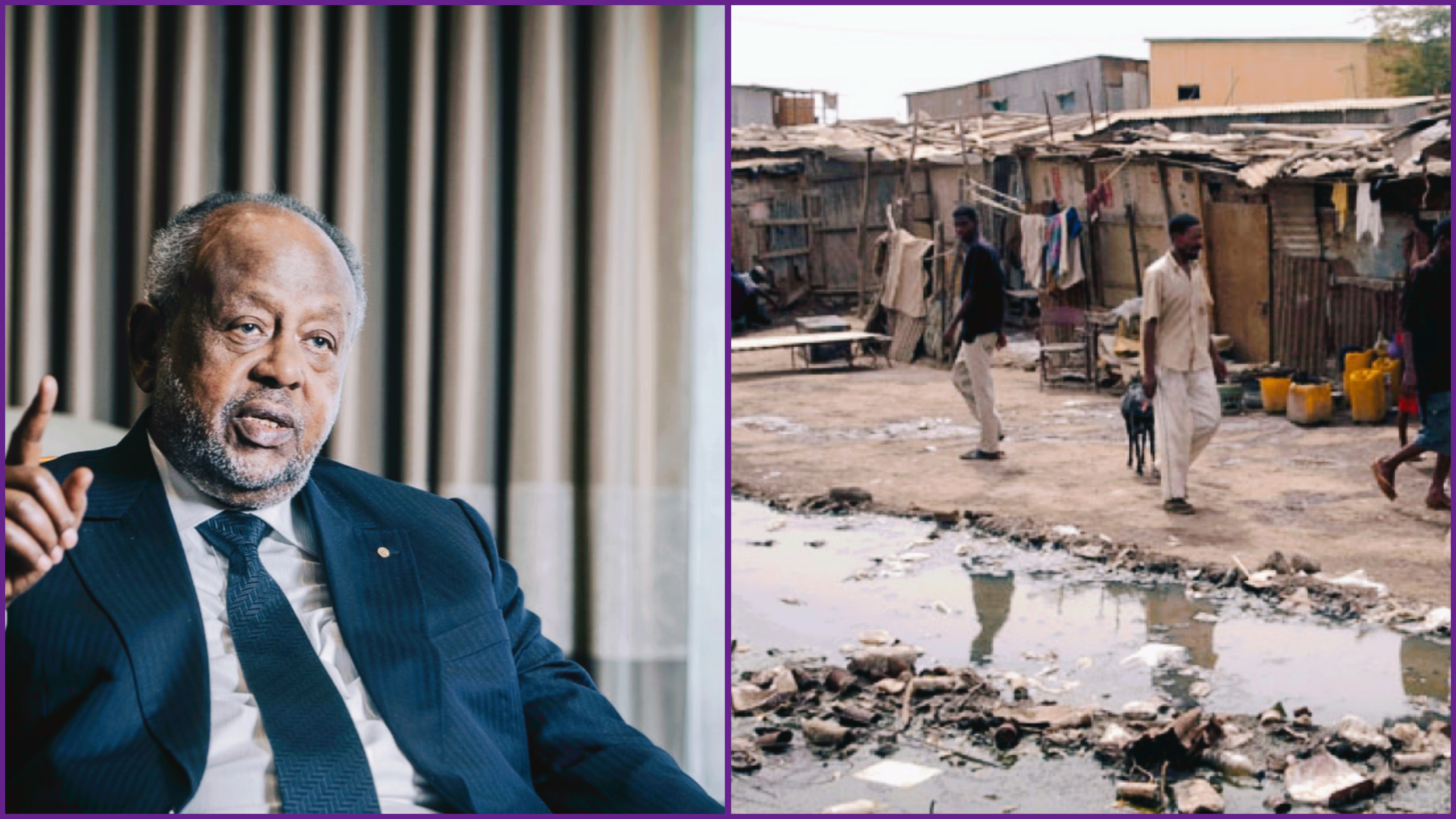
Left: Djibouti’s long-serving president Ismail Omar Guelleh during an official interview in Djibouti City. Right: Residents walk through a rundown neighborhood on the capital’s outskirts, where poverty and neglect remain despite the country’s strategic wealth.
Tap the image or the background to close.
Subscribe to BBN Daily
Thank You!
We've received your request. Please check your email to confirm your subscription.
President Ismail Omar Guelleh, known simply as IOG, has ruled since 1999. He inherited power from his uncle, Hassan Gouled Aptidon, who led the country after independence from France in 1977. What began as a promise of continuity turned into an era of control so deep that few today can imagine Djibouti without Guelleh’s name attached to it. “He has become part of the air,” said one university student in Balbala, a poor suburb of Djibouti City. “You breathe the same president every day, but nothing changes in your life.”
Across the dusty streets of the capital, it is easy to spot signs of modernity: gleaming office blocks, new ports financed by China, and paved roads stretching toward Ethiopia. On paper, Djibouti looks like a success story — a stable country in a turbulent region. But beyond the façade, ordinary Djiboutians speak of something else: inequality, corruption, and a government that seems more interested in pleasing foreign powers than its own people.
“We are sitting on gold, but our pockets are empty,” said a local taxi driver who has worked the streets for over twenty years. “Every day, I pass the American base, the Chinese base, the French base. They all pay millions to the government, but we never see it. My rent keeps rising, my children can’t find work, and the price of bread has doubled.”
Foreign military bases are the crown jewels of Djibouti’s economy. Camp Lemonnier, the United States’ only permanent base in Africa, pays more than $60 million a year in rent. China’s massive naval base, just a few kilometers away, is its first overseas military facility. France, Japan, and Italy also maintain troops there. Altogether, these bases make Djibouti one of the most militarized countries in the world. Yet the money from these arrangements rarely trickles down. Instead, it circulates among the ruling elite and government-linked businesses.
Many Djiboutians accuse the government of turning the country into a marketplace for foreign armies rather than a home for its citizens. “We are not free,” said a young teacher from Tadjoura, who asked not to be named for fear of retaliation. “We live between soldiers and silence. You can’t criticize, you can’t ask questions, you can only survive.”
The fear of speaking openly is rooted in experience. Human rights groups have repeatedly documented cases of arbitrary arrests, media intimidation, and the harassment of opposition figures. Journalists who criticize the government often find their newspapers shut down or their credentials revoked. Political activists disappear quietly into detention, sometimes for months. The government denies all accusations, insisting that Djibouti enjoys peace and order unmatched in the region. But the price of that peace, critics say, is the suffocation of freedom.
A former civil servant who worked in the Ministry of Finance described the system as one built on loyalty rather than merit. “You do not rise by talent here,” he said. “You rise by obedience. Those who question decisions are removed or sidelined. The same families control the contracts, the same names appear in the tenders, and the same people get rich.”
Corruption, while whispered about, has become a daily reality. Business permits, construction contracts, and even education scholarships are often distributed through personal connections or political favor. International donors quietly express concern, but few are willing to challenge Guelleh’s administration openly. Djibouti’s position at the mouth of the Red Sea makes it too important to upset. For Western powers, stability matters more than reform. “They see Guelleh as a partner in counterterrorism,” said a regional analyst based in Nairobi. “As long as he keeps the ports open and the bases safe, they look the other way.”
Inside Djibouti, the picture is different. Youth unemployment is estimated to be above 50 percent. Many graduates spend years without stable work, depending on relatives abroad or informal street jobs. “I finished my degree five years ago,” said Samira, a 27-year-old economist who sells mobile phone cards in the city center. “I applied for government jobs again and again. Nothing. If you don’t know someone inside, you are invisible.”
Economic inequality is visible everywhere. The central districts of Djibouti City are home to air-conditioned offices, foreign banks, and expensive cafes catering to diplomats and contractors. But on the city’s outskirts, in neighborhoods like Balbala and PK12, life remains harsh. Power outages are frequent, water is scarce, and families often live in cramped shelters made from metal sheets. In these areas, resentment toward the government simmers quietly. “They tell us Djibouti is developing,” said a mother of four. “But only their Djibouti — not ours.”
President Guelleh’s long rule has been maintained through a mix of control and calculation. The constitution has been amended several times to extend term limits. Each election since 1999 has produced predictable results, with Guelleh claiming overwhelming victories amid allegations of irregularities and opposition boycotts. The president’s supporters describe him as a guardian of stability in a dangerous neighborhood. His critics call him an aging autocrat who refuses to let the nation breathe.
In the 2021 election, Guelleh won more than 97% of the vote after major opposition parties withdrew, citing harassment and censorship. International observers described the atmosphere as calm but tightly controlled. Few citizens expect real change in future polls. “The ballot box here is like a sealed box,” said a university professor. “You can put your paper in, but the result is already written.”
Despite these frustrations, Djibouti has avoided the violent upheavals seen elsewhere in the Horn. There are no civil wars, no insurgent movements threatening the capital. For many, that is Guelleh’s greatest political achievement. Yet, stability without progress has its own dangers. As the cost of living rises and opportunities vanish, more young people are leaving. Thousands of Djiboutians have crossed into Ethiopia or tried to reach Yemen by sea, despite the risks. Some seek jobs, others simply want freedom. “We are tired of waiting,” said a 19-year-old student preparing to migrate. “Our president is older than our dreams.”
Guelleh’s government has invested heavily in infrastructure, mostly financed by Chinese loans. The new Doraleh Multipurpose Port and a railway to Addis Ababa have been showcased as symbols of modernization. But debt levels have soared, and critics worry that the country’s future revenues are already mortgaged. “They talk about development,” said a local economist, “but it’s debt development. The contracts are secret, the figures unclear. When you dig deeper, you see that Djibouti’s sovereignty is shrinking, not growing.”
At the same time, Guelleh’s inner circle continues to consolidate control. His family members hold influential positions in politics and business. His wife, Kadra Mahamoud Haid, is widely regarded as one of the most powerful figures behind the scenes, managing key appointments and economic projects. For many Djiboutians, this feels less like a republic and more like a dynasty. “The system is built around one family,” said a government employee quietly. “Even if Guelleh retires, someone with his name will replace him.”
The regime’s survival has also depended on its ability to maintain good relations with global powers. Djibouti’s neutrality allows it to host both U.S. and Chinese troops, even as those two rivals compete elsewhere. This balancing act earns Guelleh diplomatic leverage — and financial rewards. But it also makes his government indispensable to foreign governments, who often prefer continuity over democracy. As one Western diplomat admitted privately, “No one wants to push Djibouti too hard. We all need access to the ports.”
For ordinary citizens, that geopolitical importance brings little comfort. The cost of living has risen sharply in recent years, driven by imported inflation and the country’s dependence on foreign goods. The national currency, pegged to the U.S. dollar, has helped control inflation but done little to stimulate local production. The economy remains narrow, relying heavily on services, ports, and rents from foreign militaries. Agriculture is minimal, industry is limited, and water scarcity continues to hinder growth. “We are dependent on everyone but ourselves,” said a retired teacher. “Even our stability is rented.”
Public frustration occasionally boils over into protests, but the government responds quickly. Demonstrations are rare, and when they occur, police presence is overwhelming. In 2021, when a series of protests erupted in Djibouti City over rising food prices and unemployment, security forces arrested dozens. State media described the events as “isolated incidents.” The message was clear: dissent would not be tolerated.
The human cost of this climate of control is harder to measure. Many citizens live in quiet fear, avoiding political discussions even among friends. “We have learned to stay silent,” said a young man in the capital. “You don’t talk about politics, not in taxis, not in tea shops. The walls have ears.” This culture of self-censorship has seeped into every corner of society, creating what one journalist called “a democracy without a voice.”
Still, there are glimmers of resilience. Djibouti’s youth, connected through social media and inspired by movements abroad, continue to demand better governance. Some quietly document abuses; others use art, music, and poetry to express dissent. “We can’t march, but we can speak through stories,” said a young filmmaker. “One day, people will listen.”
As President Guelleh enters his third decade in power, questions about succession are growing louder. He is now in his late seventies, and speculation swirls about who might follow him. Some insiders mention his son-in-law or trusted security chiefs; others fear a vacuum that could destabilize the country. But many Djiboutians say they no longer care who replaces him — they simply want a future that feels theirs. “We are not asking for miracles,” said Samira, the young economist. “We just want a government that listens.”
For now, the façade of stability holds. Foreign troops remain, ships continue to pass through Djibouti’s ports, and international partners praise the country’s reliability. Yet beneath the surface, the cracks are widening. Poverty, youth frustration, and political fatigue form a dangerous mix. “When you silence people for too long,” warned a local activist, “eventually silence becomes a storm.”
Djibouti’s story is one of potential betrayed by power. It could have been the Singapore of Africa — a hub of trade, technology, and education. Instead, it has become a fortress of control, where development serves the few and democracy remains suspended in theory. The government calls it stability; the people call it stillness. After more than 30 years of Ismail Omar Guelleh’s rule, Djibouti stands not as a nation moving forward, but as one held still — caught between the promises of geography and the weight of dictatorship.
In the end, the country’s most valuable resource may not be its location or its foreign bases, but the quiet endurance of its people — those who wake each morning under the same ruler, still believing that someday, the silence will finally break.

