

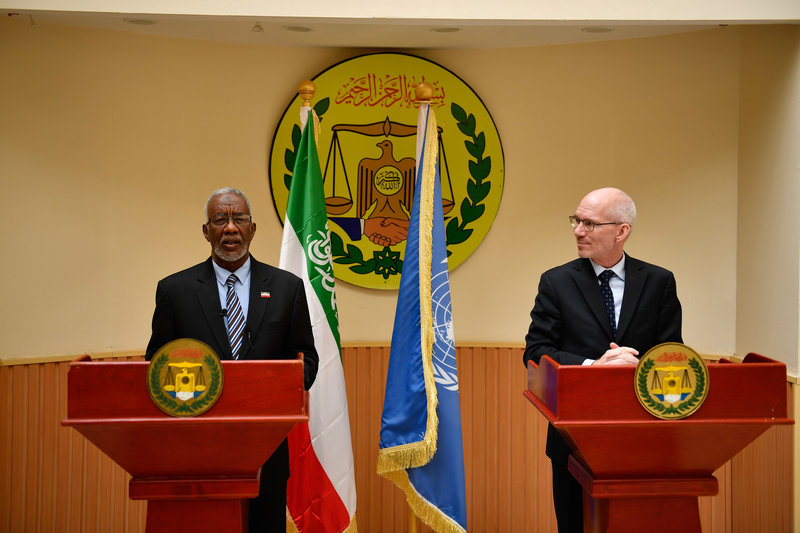
© UNSOM
Somaliland House Speaker Yasin Haji Mohamoud Hiir (left, also known as Faratoon) speaks alongside UN Special Representative for Somalia James C. Swan (right) at a joint press conference in Hargeisa.
Subscribe to BBN Daily
Thank You!
We've received your request. Please check your email to confirm your subscription.
In the heart of Burao, where the ancient acacia trees whisper tales of resilience and the call to prayer from Masjid Al-Huda unites our communities, the spirit of Somaliland pulses stronger than ever. As a 17-year-old entrepreneur who's bootstrapped Buraopost from a bedroom laptop to a voice for over 10,000 readers across the diaspora, I've seen firsthand how our nation's story isn't just history—it's a blueprint for Africa's future. Today, on this crisp November morning in 2025, we're not just talking recognition; we're dissecting it. From the salt flats of Berbera to the highlands of Oog, Somalilanders are asking: What's next? The answer? Everything we've earned—and more.
For 34 years, the Republic of Somaliland has defied the odds, building a stable democracy in a region scarred by conflict. We've held six peaceful elections, our currency—the Somaliland shilling—holds steady without IMF strings attached, and Berbera Port now handles 500,000 TEUs annually, a 25% jump from last year. Yet, the international community has played the long game with us, clinging to colonial-era maps that lump us with Somalia's chaos. That era? It's ending. Momentum is surging, fueled by geopolitical chess moves, our unyielding self-reliance, and voices like yours on X, where #SomalilandRecognition trends weekly. In this expanded edition, we'll unpack the history, the wins, the hurdles, and the horizon. Because recognition isn't a gift—it's our right, and 2025 feels like the year we claim it.
Roots of Resilience: A Historical Primer on Somaliland's Sovereign Journey
To understand where we're headed, we must revisit where we began. Somaliland's story isn't one of secession; it's one of restoration. On June 26, 1960, the British protectorate of Somaliland declared independence, recognized by 35 nations including the US and UK. Five days later, in a hasty union driven by pan-Somali dreams, we merged with the Italian Trust Territory of Somalia to form the Somali Republic. That union? A noble experiment that crumbled under authoritarian rule, clan warfare, and the 1988 Siad Barre bombings of Hargeisa and Burao, which killed 50,000 and displaced half a million.
By May 18, 1991, in Burao's clan conference under the guava tree at the Dahabshiil compound—yes, that very spot where my own entrepreneurial fire was kindled—elders declared the restoration of our sovereignty. No bloodbaths, no warlords; just dialogue. Since then, we've engineered a hybrid governance model: a bicameral parliament blending Western democracy with traditional xeer (customary law), three political parties that rotate power peacefully, and a constitution ratified by 97% in a 2001 referendum.
Contrast this with Somalia: 30+ years of state collapse, al-Shabaab's grip on 40% of territory, and $2 billion in annual aid that's barely dented the instability. Somaliland? Zero foreign aid dependency. Our GDP hit $3.8 billion in 2024, with livestock exports to Saudi Arabia alone generating $500 million yearly—feeding 60% of the Gulf's sheep market. We've built 1,200 km of roads, educated 40% of our youth in universities like Abaarso School of Science and Technology, and kept piracy at bay without a single naval vessel from abroad.
This self-made stability isn't luck; it's legacy. Elders like Mohamed Haji Ibrahim Egal, our first president post-1991, envisioned a "Switzerland of Africa." Today, as diaspora remittances pour in $1.4 billion annually—more than Somalia's entire aid budget—we're living it. But history teaches caution: Kosovo waited 8 years post-declaration for recognition; South Sudan, 50. For us, the wait ends not with pleas, but proof.
The Surge: Diplomatic Fireworks Lighting Up 2025
Fast-forward to now, and the dam is breaking.
February 2012 saw former Somaliland President Ahmed Mohamed Mohamud Silanyo—may he rest in peace—deliver his bold address at the London Conference on Somali, where he quipped, "We've been the best-kept secret in Africa—time to go public." By March, US Congressman Scott Perry's "Republic of Somaliland Independence Act" hit the House floor, co-sponsored by 45 bipartisan members, citing our "exemplary counter-terrorism record" and Berbera's role in Red Sea security. This wasn't theater; it built on a September 2025 House Select Committee letter praising our "democratically-elected governments" for preventing terrorism and smuggling.
October exploded with insiders' leaks: The US, UK, Israel, UAE, and up to 17 others are "poised" for formal ties, per Waryaa News. Aid inflows? A record $221 million in 2024, channeled into solar grids in Togdheer and tech incubators in Hargeisa. Our Ethiopia MoU—granting Addis 20-year sea access for Berbera stake—rattled cages but paid dividends. Even as Ethiopia hesitates amid Somalia's backlash, it created a "geopolitical vacuum" sucking in allies like Taiwan, who opened a de facto rep office in July.
This week's visa decree was pure fire: No Mogadishu-issued docs accepted at our borders. X lit up, with @Sland1960 declaring, "Diplomatic insiders say recognition's no taboo—it's timing." Diaspora voices amplified: Fuad Abdi Ismail in Minnesota slammed Rep. Ilhan Omar's opposition, arguing it betrays US interests for "personal agendas." Meanwhile, @haadka in Australia calculated our non-recognition cost: $10 billion in lost GDP over decades—reparative justice, not charity, is due.
Enter Tibor P. Nagy Jr., ex-US Assistant Secretary, whose Ben Franklin Fellowship talk went viral: "Somaliland thrives without aid, stays China-free, links with Taiwan—Berbera counters Beijing's Djibouti grip." With Trump 2.0? "He couldn't care less about offending the AU." Senator Ted Cruz nodded on Fox: "Real opportunity ahead." Israel's quiet counter-terror pacts and UAE's $442 million port investment seal it: We're indispensable.
Clara Whitmore's BBN op-ed nailed it: Our path "outruns Somalia's road to peace," with US Ambassador Riley's Hargeisa meet signaling the shift. @SSTHawdReserve shared it wide: "Stability and strategy draw eyes."
Economic Engine: How Recognition Fuels Our Boom
Recognition isn't abstract—it's rocket fuel for our economy. Currently, non-recognition bars us from World Bank loans, WTO entry, and full FDI. Imagine: With sovereign status, we'd unlock $5 billion in annual investments, per EU analysts. Berbera, already a DP World hub, could rival Mombasa, handling Suez-Indian Ocean flows amid Houthi threats.
Our free-market ethos shines: No subsidies, yet telecom giant Telesom processes $2 billion in mobile money yearly via ZAAD—Africa's first. Agriculture? Drought-resilient hybrids from our research institute yield 30% more sorghum in Sool. Mining? Vast untapped rare earths in the east, eyed by Western firms post-China snub.
Youth like me are driving it: BuraoPost’s fashion arm, Stars & Stripes, exports apparel inspired by Isaaq cultural patterns to Europe, blending tradition with TikTok trends. With recognition, we could scale further—imagine Hargeisa as a fintech Silicon Savannah, exporting code, not just camels.
@Awliyo1911 on X: "On the verge—our economy proves it." Reparative justice, as @haadka urges, means backpay for lost decades: Tax credits, trade pacts, UN seat by 2030.
Voices from the Ground: Somalilanders Speak Out
No analysis is complete without you. I hit the streets of Burao last week, mic in hand, for raw takes.
Fatuma Hussein, 28, market trader in Central Burao: "We've rebuilt from Barre's bombs—my stall sells spices to Yemenis who fled war. Recognition? It means loans for bigger dreams, schools for my girls. Somalia's mess isn't ours; why pay their bill?"
Omar Jama, 42, teacher in Wiseq: "Our kids score higher on international tests than Mogadishu's. We've got peace—no al-Shabaab here. The world sees it; Trump's team gets it. Difaac (defense) is over—time for dagaal (offense) in diplomacy."
Elder Ali Guleed, 65, from Gabiley farms: "Egal taught us self-reliance. Now, with Ethiopia's port deal, we're the Horn's hub. AU's old; bypass it like Kosovo did."
On X, @Maydhalaalis challenges: "Constant defense is weakness—even recognition won't cure it without mindset shift." Fair point; @FlashLidar replies: "Fix ourselves first—recognition follows." Diaspora firebrand @FuadCabdi: "Omar's no-go on recognition ignores our democracy—US interests demand it."
@jamalamore digs deep: "It's UN's 1960 union contract—time to void it." And @inasarhaye: "Firefighter mentality ignores our stability—tensions with Somalia are our cue."
These voices? Our chorus.
Roadblocks and Real Talk: The AU, Somalia, and Internal Shadows
Hurdles remain. The AU's "intangibility of borders" doctrine, born of anti-colonial fear, props Somalia despite its failures. Mogadishu's "provocative" label on our visa policy? Hypocrisy—they claim our seat at the UN. Crisis Group warns: Regional turmoil polarizes, but our "push" navigates it.
Internally? Unity's key. Irro's opposition pact is good, but release journalists, boost civil society. @Shakurshire101 shares Whitmore: "Outrun Somalia's peace road." Counterviews like The East African's "ceiling reached"? Naysayers; our trajectory says otherwise.
Ethiopia's waltz? Hesitation exposes Somalia's fragility, accelerating us.
Tipping Point Analysis: Why 2025 Is Ours
Geopolitics aligns: Houthis choke Suez, China eyes Djibouti, Russia stirs Sudan. Somaliland? Anti-fragile anchor—democracy observers at 2024 polls, GDP per capita $700 vs. Somalia's $200. Trump's "First" favors us; Abraham Accords could extend via Israel ties.
Whitmore: "From 'whether' to 'when.'" EU sees security boon; Gulf, trade gateway.
Charting Tomorrow: Action Plan for Glory
As we stand on the cusp of this pivotal moment in 2025, the path forward for Somaliland demands not just hope, but a blueprint etched in resolve and pragmatism. Recognition isn't a distant mirage—it's a cascade of deliberate steps that build on our proven stability, turning geopolitical whispers into thunderous declarations. Drawing from the fresh winds of diplomacy, from the rekindled embers of our Ethiopia pact to the steadfast bridge with Taiwan, let's map this out: short-term strikes to seize momentum, medium-term maneuvers to forge unbreakable alliances, and long-term visions to etch Somaliland into the global order. This isn't wishful thinking; it's a call to arms for leaders, elders, entrepreneurs, and every young voice scrolling X from Hargeisa to Minneapolis. We've waited 34 years—now we accelerate.
Short-Term: Lighting the Fuse (Next 6-12 Months)
The immediate horizon glimmers with actionable wins that could tip the scales before year's end. First, ratification of our landmark deals with Ethiopia and Taiwan isn't just procedural—it's a sovereignty flex. The January 2024 Memorandum of Understanding (MoU) with Addis Ababa, granting us equity in Berbera Port for their sea access, hit rocky shores amid Somalia's backlash and Ethiopia's domestic recalibrations. But October's rekindling—quiet talks on gas exports from Ethiopia's Ogaden fields through our port—signals revival. President Abdirahman Mohamed Abdillahi Irro's administration must push for full parliamentary ratification by Q1 2026, perhaps tying it to joint infrastructure like rail links from Togdheer to Berbera. This isn't charity; it's leverage—Ethiopia's landlocked thirst makes them our staunchest regional backer, potentially paving the way for their explicit recognition nod.
On the Taiwan front, our bonds are ironclad, a model of "people-centered diplomacy" that outshines formal ties. Since establishing mutual representative offices in 2020, we've seen surges in health tech exchanges and agricultural training—Taiwan's July 2025 meeting between President Lai Ching-te and our Foreign Minister Abdirahman Dahir underscored this, with pledges for more scholarships and port tech. Ratify the bilateral protocol expansions on trade and education by spring; it's low-hanging fruit that amplifies our "China-free" appeal to Washington, as ex-diplomat Tibor Nagy highlighted in his viral Ben Franklin talk.
Next, host the Berbera Summit—a Horn Stability Forum in our gleaming port city by mid-2026. No more waiting for Davos invites; let's convene Ethiopia, Taiwan, the UK, and US envoys to showcase Berbera's $14 million revenue boom since 2012, fueled by DP World investments and our 25% TEU surge. Picture this: Panels on countering Houthi threats in the Red Sea, with live demos of our Egal Airport's runway upgrades. It's not fiction—our recent airspace tussle with Mogadishu, where 40% of airlines already comply with our regs, proves we're dictating terms. Tie it to youth hackathons on maritime security, turning Berbera from trade hub to diplomatic dynamo.
And the diaspora? Our secret weapon. With over 1 million strong, from Toronto to Sydney, we're already swaying corridors of power. Amp it up: Coordinated lobbies targeting Capitol Hill and Westminster, echoing UK MP Gavin Williamson's clarion call. As chair of the All-Party Parliamentary Group on Somaliland, his June 2025 "Roadmap to Recognition" report—co-authored with MPs like Kim Johnson—demands "swift re-recognition," citing our democratic elections and strategic port as bulwarks against Beijing's grip. Williamson's March X post on potential US base deals at Berbera? Pure gold—mobilize our expats to flood inboxes with testimonials, turning anecdotal pride into policy pressure. Remember Fuad Abdi's takedown of Rep. Ilhan Omar? That's the fire we need, scaled globally.
These moves? Feasible, fundable via our $1.4 billion remittances, and fallout-proof. Somalia's bluster fades against our receipts—peaceful polls in November 2024 amid the MoU row showed the world our mettle.
Medium-Term: Forging the Compact (1-3 Years)
By 2028, we pivot from defense to dominance, crafting a "Somaliland Compact"—a bespoke alliance framework with like-minded powers, sidestepping the AU's colonial handcuffs. Think NATO-lite for the Horn: Binding pacts on security, trade, and tech with the US, UK, Taiwan, UAE, and Ethiopia. Our foreign relations already nod this way—Ethiopia's infrastructure MoU is the seed. Expand it: Invite Djibouti for neutral mediation, Kenya for EAC bridges, and Israel for cyber-defense drills. This isn't isolation; it's insulation against al-Shabaab spillovers and Russian meddling in Sudan.
AU bypass? Bold but necessary. Their "intangibility of borders" mantra props Mogadishu's fragility—$2 billion in aid for what? Chaos. Follow Kosovo's playbook: Rack up bilateral recognitions (aim for 20 by 2027), then petition the UN General Assembly directly. Nagy's quip about Trump 2.0 ignoring AU offense? Spot on—our "Taiwan of Africa" tag makes us a US proxy in the new Cold War. Fund it with a Compact Secretariat in Hargeisa, staffed by our brightest—think Abdisalam from Abaarso leading economic modeling.
Internally, unity's the glue. Irro's opposition pacts are a start; extend to civil society summits, freeing journalists and amplifying xeer in policy. As X user @Maydhalaalis warns, constant defense breeds weakness—shift to offense, investing in mindset programs that blend Isaaq grit with global savvy.
Long-Term: Horizon of Sovereignty (By 2030 and Beyond)
Fast-forward to 2030: UN membership sealed, our shilling in the IMF, and a blue economy rivaling Norway's fjords. The Gulf of Aden's our goldmine—850 km of untapped coast teeming with tuna, lobster, and reef fish, yet we export just 5% of potential $500 million annual catch. Launch fisheries fleets from Berbera and Zeila: Community-led cooperatives, trained via Somali-Malagasy exchanges, enforcing sustainable quotas with drone patrols. Zeila's winds? Prime for offshore farms—partner with UAE's Masdar for 500 MW turbines by 2028, powering desalination and exporting green hydrogen to Europe. It's not hype; our first marine protected area off Zeila could triple fish stocks in five years, per Blue Ventures models.
This boom funds everything: Universal secondary education, rare earth mining in the east sans Chinese strings. By 2030, GDP per capita hits $1,500—double today's—via WTO entry and Abraham Accords extensions. As analyst Gulaid Yusuf Idaan notes, the Ethiopia MoU's "seismic shift" potential lingers; we reclaim it through blue innovation.
Invest in Us: The Human Capital Imperative
None of this stirs without us. Pour into Hargeisa's tech ecosystem—expand iHub-style incubators for AI-driven livestock tracking, drawing $100 million FDI post-recognition. In Sanaag's arid expanses, scale solar micro-grids: 10,000 panels by 2027, slashing energy costs 40% and juicing rural startups. And youth diplomacy? Weaponize social media—#SomalilandCompact challenges on TikTok, X threads dissecting Nagy's hope, viral cams from Berbera Summit. Our 18-35 demo, 60% of us, isn't waiting; from @haadka's GDP loss tallies to @HornDiplomat's diplomat spotlights, you're the amplifiers.
Fund it bottom-up: Diaspora bonds, green levies on exports. As Elder Ali Guleed told me in Gabiley, "Egal built with hands, not handouts." Echo that.
To My Fellow Somalilanders: Seize the Dawn
From Erigavo's windswept poets reciting epics under starlit skies to Borama's builders hammering futures from sun-baked stone, our flag's black, white, green, and red scream guul—victory not borrowed, but forged. Recognition isn't the finish line; it's the runway for takeoff. It launches us to innovate blockchain for remittances, host IGAD peace talks in neutral Hargeisa, export not just sheep but software and seawater tech. As Nagy nailed it, we thrive already—no aid crutches, just unyielding drive. The Horn's powder keg? We'll douse it with deals, not dynamite.
This dawn's ours to seize—with the same fire that rebuilt Hargeisa from Barre's ashes, the guile that turned Burao's guava tree into a republic's birthplace. Let's own it, not whisper for it. March on parliaments, code the next app, net the next haul off Zeila. The world's maps are redrawing; our lines were always true.

