

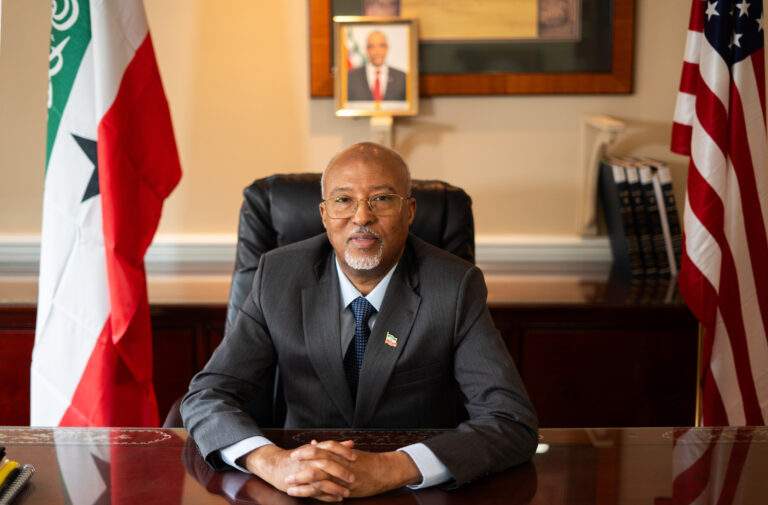
Somaliland's representative in Washington, D.C., Bashir Goth, sits between the flags of Somaliland and the United States in his office in Alexandria, Va. (Washington Diplomat)
In a sweeping move that could reshape the geopolitics of the Horn of Africa, the U.S. Senate has passed the FY2026 National Defense Authorization Act (NDAA) with historic language that opens the door for an American presence in Hargeisa, direct engagement with Somaliland’s authorities, and expanded defense cooperation between Washington and the breakaway region. The Senate’s approval of the bill, which now moves toward reconciliation with the House, marks perhaps the boldest signal yet from the U.S. federal government that Somaliland may be emerging from diplomatic limbo.
This shift is not merely symbolic. Embedded within the NDAA’s pages are provisions that authorize a U.S. office in Somaliland’s capital, mandate direct contact between U.S. agencies and Somaliland leaders, and offer a legislative framework for deeper security cooperation. What was once a fringe policy discussion now appears to have been elevated to the main stage of U.S. defense and foreign policy. The passage comes after years of incremental steps by Congress that increasingly treated Somaliland not as an afterthought but as a strategic partner.
The Senate’s version of the FY2026 NDAA authorizes policies for Department of Defense programs, military construction, and national security functions, and includes newly inserted language enabling the establishment of a representative U.S. presence in Hargeisa and direct liaison with Somaliland’s government. In doing so, the Senate has diverged from the long-standing U.S. posture of strictly recognizing Somalia’s federal government as the sole interlocutor in the region. The NDAA’s executive summary frames the global environment as “the most dangerous threat environment since World War II,” and calls for strong partnerships and alliances in contested regions — a backdrop against which the Senate’s inclusion of Somaliland stands out as a strategic recalibration.
This legislative move also aligns with earlier congressional efforts. In previous sessions, the House passed amendments to the NDAA that required the State Department to study diplomatic options and the Department of Defense to assess defense cooperation with Somaliland. Meanwhile, the Somaliland Partnership Act previously passed the Senate Foreign Relations Committee, though it stalled before full enactment. That bill underscored Somaliland’s strategic value — citing advantages in maritime access via Berbera, countering regional malign influence, and supporting U.S. objectives in the Horn and Red Sea corridors. The latest NDAA codifies much of that prior rhetoric into actionable language.
For Somaliland, long seeking international recognition and formal engagement, the Senate’s action feels like vindication. Its leaders have long argued that the territory is stable, democratic, and reliable compared to the often-turbulent politics of southern Somalia. In particular, Somaliland’s control over the Port of Berbera and its strategic location on the Gulf of Aden have made it a point of interest for powers seeking influence in maritime routes and Red Sea access. The U.S. has historically approached Somaliland through the lens of “pragmatic engagement” rather than formal recognition — but that posture now appears on the cusp of transformation.
Somaliland’s diplomatic efforts already include hosting a representative office from Taiwan in Hargeisa, a symbolic move of parallel significance given Taiwan’s own unique status in global diplomacy. The new NDAA language could pave the way for a comparable U.S. presence — one that might initially operate under a “representative office” or liaison arrangement, rather than a full embassy asserting formal sovereign recognition.
Yet the road ahead is far from straightforward. The Senate’s version of the NDAA must be reconciled with the House’s version, which, while supportive of robust defense funding and modernization measures, may not currently include identical Somaliland provisions. If those provisions survive the conference committee, the next hurdle lies at presidential approval, and then actual implementation by State, Defense, and regional U.S. commands.
In parallel, significant diplomatic, legal, and regional risks loom. Any U.S. move toward formal or semi-formal offices in Somaliland will inevitably provoke strong objections from Mogadishu, which continues to assert sovereignty over the entire territory. The Somali federal government is likely to interpret such engagement as a breach of Somalia’s territorial integrity and could escalate diplomatic or political retaliation. African Union and regional blocs may respond unfavorably, perceiving the U.S. steps as tacit recognition of Somaliland’s independence. Neighboring states, too, will monitor how far the shift extends, particularly given the ideal of respecting existing borders in Africa.
In Washington, the State Department and administration officials have long hedged on recognition of Somaliland, citing concerns about undermining relations with Somalia, destabilizing precedence for other separatist movements, and complicating U.S. strategy in the Horn. For years, congressional pressure has pushed ahead of executive appetite. But by embedding Somaliland language in the NDAA, Congress is signaling that this inspection is no longer just a side matter but central to its strategic thinking. Whether the executive branch follows is now the main question.
If fully implemented, a U.S. office in Hargeisa could serve multiple roles: facilitating bilateral trade, investment, development, intelligence and counterterrorism cooperation, military liaison functions, and logistics support. It would allow U.S. agents, diplomats, and military personnel to meet directly with Somaliland’s leadership — bypassing the long-standing practice of routing all engagement through Mogadishu. It could also help in coordinating regional security operations, maritime surveillance, and intelligence sharing in the volatile Gulf of Aden and Red Sea corridors.
Somaliland would gain somewhat from formal access to U.S. technical assistance, training, capacity building, and institutional support. It might attract new foreign investment, closer economic ties, and increased international legitimacy. The presence of U.S. personnel could bolster Somaliland’s security infrastructure and deterrence posture, especially given threats from militant groups operating in the wider Somali region, such as al-Shabaab and its affiliates.
Yet, the U.S. must tread carefully. The legal status of such a representative office would need to be codified without implicitly or explicitly recognizing Somaliland as an independent state. Diplomats may need to be structured as “liaison offices,” and operations may be limited to certain functions. The careful legal architecture upfront can prevent open diplomatic ruptures with Mogadishu while allowing meaningful engagement.
Regionally, Somalia’s federal authorities will likely resist and protest. They could attempt diplomatic counters through blocs such as the African Union or the Intergovernmental Authority on Development (IGAD). There is potential for political and security backlash within Somalia, including efforts to reassert federal control, parliamentary motions condemning U.S. engagement, or severance of cooperation. Some regional powers might view the U.S. move as destabilizing precedent.
Internationally, this could provoke reactions from other foreign actors active in the Horn — China, Russia, Turkey, the Gulf states, and Iran among them. Each is attuned to shifting U.S. influence, particularly near strategic maritime chokepoints. A U.S. presence in Somaliland could be interpreted as a bid to counterbalance Chinese, Russian, or Turkish footprints in East Africa — especially in ports and infrastructure investments.
Critics of U.S. recognition of Somaliland argue that such a move would unsettle fragile states, give credence to separatist movements elsewhere, and destabilize a region already prone to conflict. Some analysts caution that the institutional capacity and political maturity of Somaliland — while superior to many neighbors — may still face internal limits, clan dynamics, disputed territories, and external pressures. The U.S. would need to calibrate its support carefully to avoid overcommitment in a fragile context.
Assuming the house and Senate reconcile the NDAA language successfully, the next months will test whether U.S. agencies can operationalize the vision. Initial steps may include identifying a location for a small U.S. liaison office in Hargeisa, deploying diplomatic and security staff, establishing protocols for engagement, and integrating the office with AFRICOM and State Department East Africa desks. The Defense Department may begin feasibility assessments, security planning, and staff assignments. Legal drafting will be needed to ensure that the office operates under defined status agreements.
For the people of Somaliland and the broader Horn of Africa, this signals a new era. After decades of de facto independence and persistent efforts for recognition, Somaliland may finally see direct engagement from one of the world’s leading powers. This is not automatic recognition, but it is a far cry from ignoring the territory altogether. For many in Hargeisa, the passage of this NDAA may feel like a long-awaited turning point in their long quest for international legitimacy and security partnership.
The U.S. Senate’s passage of the FY2026 NDAA with Somaliland provisions is both bold and fraught. It reflects a strategic pivot toward leveraging stability in the Horn, countering regional rival influence, and anchoring U.S. presence in key maritime corridors. But it also invites legal, diplomatic, and security challenges that will test the limits of U.S. foreign policy, regional stability, and the very nature of sovereignty in East Africa. If this initiative is sustained and enacted, the ripple effects could remake the map of influence in the Horn — and perhaps redraw lines of engagement between Washington and one of Africa’s most contested regions.
This moment, more than symbolic, may be the beginning of a new chapter in U.S.–Somaliland relations — one where Hargeisa becomes a direct interlocutor in Washington’s strategic calculus rather than a footnote in Mogadishu’s diplomacy.

