

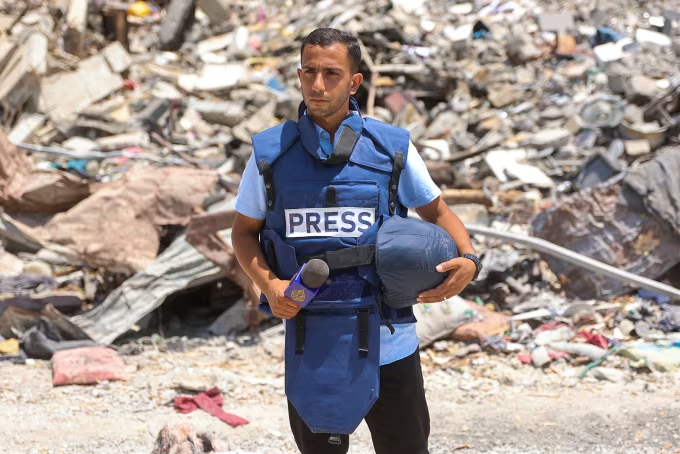
Mourners in Gaza hold images of Al Jazeera journalist Anas al-Sharif, killed in an Israeli airstrike in August 2025.
×
![Enlarged view of mourners in Gaza honoring Anas al-Sharif]()
Israel and Hamas reached a temporary ceasefire on October 8, 2025, after U.S.-brokered negotiations in the Egyptian resort city of Sharm El-Sheikh. The agreement, described by U.S. and Egyptian officials as a first phase toward ending the war, was designed to allow humanitarian aid into Gaza and begin a series of hostage and prisoner releases after nearly two years of devastating conflict that started in October 2023. Within hours of the announcement, a surge of online tributes spread across social media platforms, particularly X, commemorating Al Jazeera journalist Anas al-Sharif, who was killed in an Israeli airstrike on August 10, 2025.
For many people inside and outside Gaza, the ceasefire announcement was not only a moment of fragile hope but also a moment of remembrance. Al-Sharif’s name trended globally on X, accompanied by his final words and footage from his last reports. The Palestinian journalist had become a symbol of frontline reporting during the conflict. His coverage from northern Gaza—often from bombed neighborhoods and refugee shelters—was among the most widely shared in the world during the height of the war. He was 29 years old when he was killed in a targeted airstrike that also claimed the lives of several of his colleagues: Mohammed Qreiqeh, Ibrahim Zaher, Mohammed Noufal, and Moamen Aliwa.
Al-Sharif first gained international attention in January 2025 during a brief truce when he appeared live on air without his protective vest or helmet, saying he wanted to “feel like a human being, not just a reporter waiting for death.” That moment became iconic among many who followed the war, especially as the death toll among journalists continued to rise. By October 2025, more than 222 journalists had been killed in Gaza since the conflict began—most of them Palestinians. Al Jazeera accused Israel of deliberately targeting its journalists, calling his killing an “assassination,” a claim echoed by human rights groups and United Nations experts.
The temporary ceasefire reached in Sharm El-Sheikh followed intense U.S. diplomatic efforts involving Egypt, Qatar, and Turkey. It includes provisions for halting military operations, releasing hostages and detainees in phases, and allowing aid trucks to cross into Gaza to address acute shortages of food, fuel, and medicine. Israeli troops were to withdraw to specific lines while negotiations on a more permanent settlement continued. Washington has described the deal as a humanitarian breakthrough, but analysts caution that implementation will be fragile. Similar truces in previous conflicts have collapsed quickly, either through disputes over prisoner exchanges or renewed military escalation.
As aid trucks began to queue at Gaza’s border crossings, the digital space turned into a memorial. Users shared photos of Anas al-Sharif reporting from destroyed neighborhoods, videos of his final broadcasts, and excerpts from a message he recorded before his death: “If these words reach you, know that Israel has succeeded in killing me and silencing my voice. Do not forget Gaza… and do not forget me in your sincere prayers.” Many posts carried the hashtags #AnasAlSharif and #PressNotTargets, transforming the ceasefire announcement into a global moment of collective mourning.
International press freedom groups have warned that Gaza has become one of the deadliest places in the world for journalists. Reporters in the enclave have had to work without reliable electricity, safety guarantees, or evacuation routes. Foreign media are largely barred from entering, which has made local journalists the primary witnesses of the war’s human toll. With communications often disrupted and hospitals destroyed, many reporters continued filing stories from their phones in makeshift shelters, aware they were targets.
The memory of al-Sharif has come to represent more than just the life of one journalist. For many, he symbolizes an entire generation of Palestinian reporters documenting a war under siege conditions. His death underscored the peril journalists face when their presence threatens competing narratives in wartime. The Committee to Protect Journalists and the United Nations have repeatedly called for an independent investigation into his killing and the broader pattern of journalist deaths in the conflict, but no such probe has yet been launched.
While the ceasefire has provided a temporary pause in the violence, the road ahead remains uncertain. Key points of contention include the sequencing of hostage and prisoner exchanges, the monitoring of ceasefire lines, and the future governance of Gaza once the truce period ends. Humanitarian organizations warn that the enclave’s infrastructure is in ruins, with tens of thousands of homes destroyed and most of the population displaced. Even if the truce holds, rebuilding Gaza will take years, and the scars of war are far deeper than the rubble on its streets.
The outpouring of tributes to al-Sharif reflects a widespread fear of erasure. In conflicts where access is restricted and narratives are contested, killing journalists is often seen as a way to silence inconvenient truths. For many Gazans, the memory of Anas al-Sharif ensures that their suffering and resilience will not vanish when the news cycle shifts. His final words have been shared millions of times in the hours following the ceasefire announcement, transforming him into a lasting voice for a population that has endured unimaginable loss.
As night fell on Gaza after the ceasefire announcement, the border crossings echoed with the sound of aid trucks for the first time in months. Inside the enclave, families emerged from shelters in cautious relief. Outside, on millions of screens, a journalist’s voice and face circulated with renewed intensity. The guns may have gone quiet, at least for now, but the story he told lives on, demanding to be remembered. Anas al-Sharif is no longer on the ground to report this moment, but his legacy is woven into the history of a war that continues to shape global headlines.
The ceasefire may mark a turning point in the 20-month conflict, but it also stands as a reminder of its immense cost—not only in civilian lives but also in the lives of those who dared to document it. For many, honoring Anas al-Sharif is part of ensuring that Gaza’s story is not erased from the world’s conscience.

