BBN Investigation: 70% Risk of Collapse Facing Somalia’s Federal Government, Higher Than the Siad Barre Era
By -BBN - Investigation Desk 🔎
10/11/2025 05:22:00 am
0
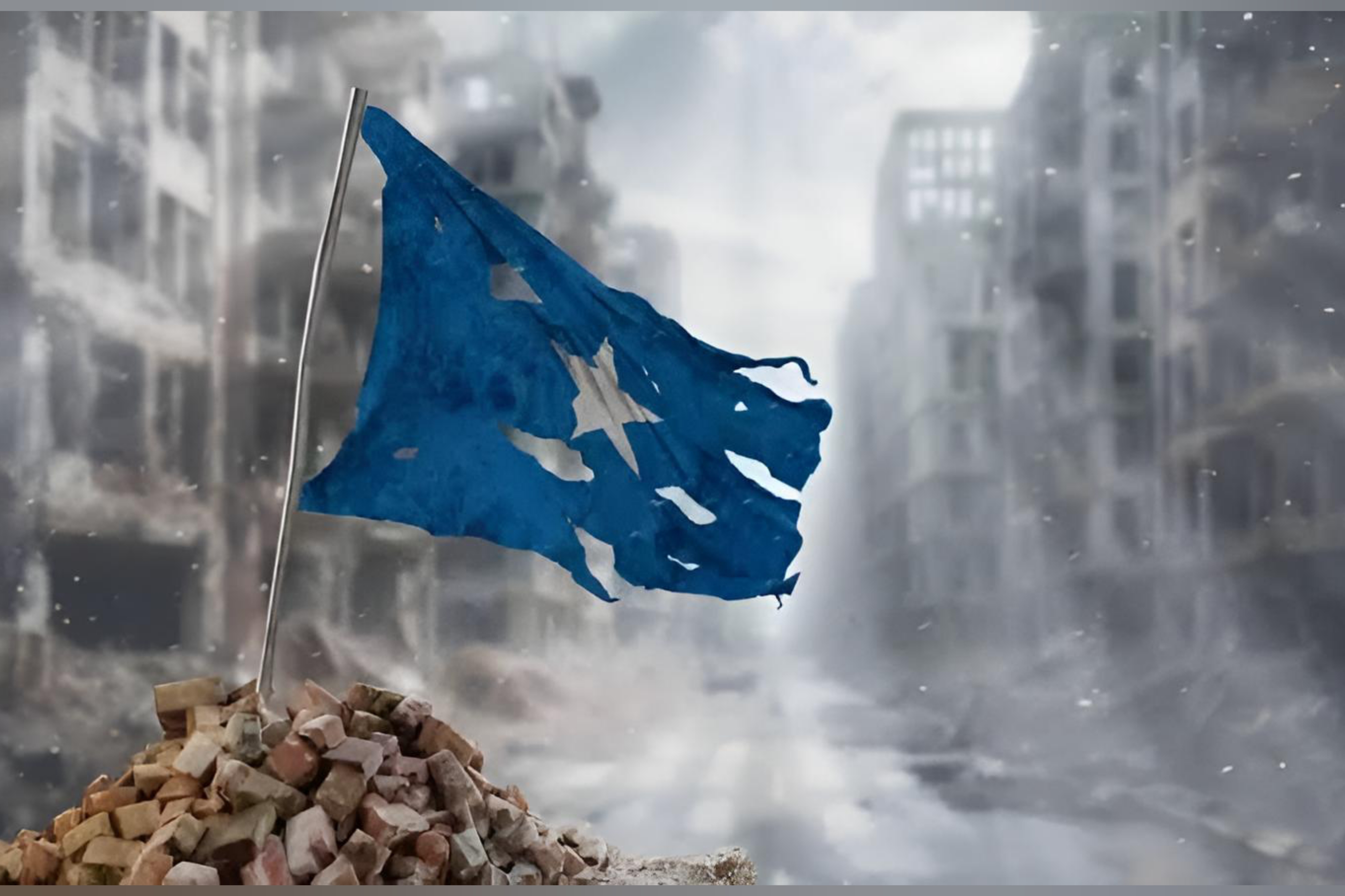
A tattered Somali flag stands amid ruins — a haunting symbol of political decay, insecurity, and the deep fractures threatening the Federal Government's survival.
×
Abdirahman Abdilahi Ali
CEO, BBN (Buraopost Newsletter)
Founder and publisher; leads editorial strategy and investigative oversight.
Sakariye Abdilahi Jama
Head, BBN Investigation Desk
Lead investigator and conflict analyst with deep field experience.
MH
Mona Hassan Jama
Senior Researcher — Burao
Field reporter focused on rural governance and human stories.
XI
Xayatt Abdi Ismail
Investigative Journalist — Hargeisa
Political analyst and investigative specialist on federal dynamics.
Our investigation — the result of six months of field interviews, document review, and analysis of open-source reporting and international assessments — concludes with a stark judgment: based on converging indicators across politics, security, economics, and social cohesion, there is a substantial (we assess it at roughly 70%) likelihood that Somalia’s current federal government will experience a severe systemic collapse within the medium term, defined for this study as the next five years. By “severe systemic collapse” we mean a breakdown of central governmental authority in Mogadishu that produces a power vacuum on the scale of the early 1990s — not necessarily an identical pathway, but comparable in its national reach, the unmooring of institutions, and the sharp deterioration of security, humanitarian conditions, and international engagement.
That 70% figure is not a headline number plucked from thin air. It is the product of a mixed-methods assessment: quantitative trend signals (rising violent incidents, shrinking administrative reach, and lagging revenue collection), qualitative field reporting (interviews with officials, regional leaders, civil-society actors, and displaced families), and structural comparison with the drivers that produced the fall of the Siad Barre regime in 1991. We treat the Siad Barre collapse as both cautionary precedent and partial analogue — similar in some critical fault-lines (fractured state-society relations, military politicization, resource scarcity) but different in others (higher degree of international engagement, presence of multilateral missions, and a more developed, if fragile, federal architecture). Our goal here is not to be alarmist for its own sake but to lay out, in sober and sourced terms, why the risk is high, how it could unfold, and what would be required to avert it.
At the heart of the risk are four interlocking dynamics. First, the contest over political legitimacy and the shape of federalism has become acute. The 2012 provisional constitution intended to balance federal authority with member-state autonomy; today, contested amendments and unilateral moves by both Mogadishu and several member states have widened the legitimacy gap. Most visibly, Puntland’s refusal to accept recent constitutional changes and its withdrawal from certain federal processes underscores a deepening rift between core regions and central authorities — a gap that, if allowed to harden, would hollow out the political foundation of the federation and make coordinated national responses to crises far more difficult. This contest is not abstract; it undermines cooperation on security deployments, revenue-sharing, and electoral arrangements, all of which are necessary to sustain a functioning national government.
Second, security remains a constant and virulent pressure on state authority. Al-Shabaab continues to operate as both an insurgent force and a shadow governance structure across swathes of rural Somalia. The group’s ability to strike high-profile targets — including attacks in Mogadishu and operations against prisons and convoys — demonstrates persistent capability and intent to undermine state legitimacy. Recent incidents, including complex assaults on government facilities and recurrent urban attacks, highlight that the government’s monopoly on force remains contested. Even where the state can respond militarily, those responses are often uneven, costly, and politically polarizing; the very need to lean heavily on international partners for counterinsurgency and security support introduces dependencies that complicate sovereignty and public confidence. The recent prison siege and other incidents remind us that security gains are fragile and reversible.
Third, social cleavages — chiefly clan fragmentation and resource-driven local conflicts — are resurging in intensity and scale. Our field teams documented escalations in localized clan wars over grazing land, water, and disputed territory; these conflicts are intensifying under the stress of climate shocks, population displacement, and competition for scarce state resources. Where the state is absent or slow to respond, local militias and informal authorities fill the vacuum, entrenching alternative power structures that can outlast any temporary ceasefire. International analyses and humanitarian assessments warn that clan conflicts will remain an accelerant of instability in the years ahead unless resolved through meaningful, inclusive local and national mechanisms. Those warnings square with what our reporters observed in central regions and the peripheries of major towns: when political bargains break down, violence becomes the default mode of dispute resolution.
Fourth, economic fragility and governance deficits create a chronic inability for the state to deliver services and earn the consent of citizens. Even with promising developments — including recent debt-relief arrangements and renewed access to international financial systems — domestic revenue mobilization, public-sector capacity, and the equitable distribution of aid and investment lag behind the needs of an expanding population and an economy battered by decades of conflict and climate shocks. Debt relief provides breathing space, but it does not by itself construct administrative capacity or heal political fault-lines; unless economic gains translate into visible improvements in services, livelihoods, and secure tenure, public frustration can harden into delegitimization of governing institutions. The combination of fiscal squeeze and poor service delivery has historically accelerated regime crises, and it remains a potent risk here.
Taken together, these dynamics create what scholars call “compound fragility”: each weakness amplifies the others. A crisis of political legitimacy weakens security cooperation; security shocks reduce fiscal revenue and increase humanitarian demand; economic strain intensifies local competition over resources and deepens clan grievances; and the accumulation of these stresses erodes the state’s binding institutions. Such systemic interactions are precisely what turned popular unrest and elite contestation into full-scale collapse during the fall of the Siad Barre era — a cautionary template that remains instructive today even as the context and actors differ.
But collapse is not inevitable, and the paths that lead away from collapse are clearer than they are often credited: inclusive political settlement; credible, locally rooted security strategies; pragmatic fiscal reforms; and international partnerships that prioritize Somali ownership over imposed solutions. Our reporting identified specific pressure points where intervention could reduce the 70% risk materially. These include: immediate, mediated talks to rebuild confidence between Mogadishu and the principal federal member states (not merely technical negotiations over procedures, but substantive deals on security, revenue-sharing, and constitutional modalities); a credible decentralization timetable backed by transparent electoral calendars and third-party monitoring; a rapid expansion of community-based dispute-resolution and transitional justice mechanisms to quell local clan wars; and a focused economic package that links debt relief and international assistance to measurable improvements in basic services and public employment.
Yet there is an uncomfortable asymmetry at work. Many international partners appear to be treating recent gains — incremental economic re-engagement, occasional security successes, and diplomatic milestones — as signs of durable state-building. Our interviews with donors and diplomats in Mogadishu revealed a palpable optimism that political processes can be managed incrementally. But optimism without political traction risks reproducing the “stability myth”: a narrative that masks underlying fault-lines until they rupture suddenly, as happened in 1991. The international community’s role must be more triangulated: not simply funding and training, but sustained political facilitation that incentivizes national elites to bargain for compromise and that strengthens local resilience to shocks.
Comparing the present moment to the Siad Barre collapse requires careful nuance. Siad Barre’s downfall was precipitated by a convergence of state repression, economic mismanagement, and an organized armed opposition that coalesced into a national rebellion. Today’s Somalia differs in the multiplicity of power centers (federal states, urban administrations, private militias), the institutional imprint of a federal constitution (however contested), and the presence of regional and international actors invested in preventing total collapse. These differences matter: they make a replay of 1991 in identical form unlikely. Yet the fundamental mechanisms that drove Barre’s unravelling — loss of elite cohesion, erosion of military loyalty, and a collapse of the social contract — are visible in embryonic form now. The 70% assessment recognizes both the moderating factors and the alarming parallels: enough present risk factors exist, and their interactions are sufficiently dangerous, that the possibility of a collapse comparable in severity and scope to the earlier one cannot be dismissed.
Our investigation uncovered several plausible collapse scenarios, varying by trigger and pace. One rapid scenario starts with a major security breach in Mogadishu — for example, a large-scale coordinated assault on government installations or an attack that targets senior political figures — that catalyzes panic among elites and fractures security command cohesion. In such a scenario, regional administrations might close ranks locally, national supply lines could be interrupted, and external partners might hesitate or miscoordinate, leaving a governance vacuum for insurgents and local strongmen to fill. A slower-burning scenario involves incremental delegitimization: stalled reforms, repeated electoral delays, and a string of local conflicts that undercut the federal government’s narrative of competence, culminating in a cascading withdrawal of support from key constituencies and institutions.
Importantly, collapse is not a single binary outcome; it can be partial, regionalized, and asymmetric. Somalia could experience a prolonged “federal hollowing” where Mogadishu remains the formal capital but loses effective control over large territories; or it could devolve into multiple competing polities reminiscent of the fragmented 1990s. The human consequences in either case would be catastrophic: mass displacement, renewed famine cycles in the countryside, disrupted trade and remittance flows, and a spiking humanitarian emergency that would outstrip international capacity to respond promptly.
There are also internal resilience factors that could blunt these trajectories. Civil society organizations, diaspora networks, and local administrations have in recent years demonstrated remarkable adaptability — maintaining essential services, mediating clan disputes, and funding local initiatives where the center faltered. Our team spoke to community elders who described pragmatic, homegrown mechanisms for managing scarce water resources and preventing revenge cycles after violent incidents. These are not panaceas, but they are critical building blocks for a decentralized resilience architecture that can prevent localized shocks from becoming systemic failures.
Transparency about methodology is essential when making an assessment of this magnitude. Our 70% figure combines indicator-based scoring (security incidents per quarter, fiscal shortfall trajectories, governance legitimacy indices, and humanitarian caseloads) and scenario-weighted expert elicitation (interviews with Somali political figures, security analysts, regional diplomats, and humanitarian operators). Where possible, we cross-checked field testimony against international reporting and institutional analyses. We have also been conservative in our estimates where evidence is contradictory; on balance, the preponderance of signals pushes our assessment toward the elevated-risk side.
What, concretely, would reduce the assessed risk in a meaningful way? First, a time-bound, internationally supported mediation process that yields a public pact between Mogadishu and the major member states over power-sharing and the sequencing of electoral and constitutional steps. Second, a national security strategy that blends professionalization of the security forces with localized stabilization efforts and community policing, reducing the reliance on centralized counterinsurgency alone. Third, a fiscal compact that ties international finance to measurable decentralization deliverables and that expands domestic revenue through transparent taxation and anti-corruption measures. Fourth, a humanitarian-development nexus plan that addresses displacement, drought response, and livelihoods in an integrated manner — stabilizing communities most at risk of turning to violence for survival.
We do not underestimate the political difficulty of these measures. They require elite bargains that dilute simple majoritarian control and that ask winners to cede leverage for a broader public good. They also require donors and regional powers to shift from short-term, tactical interventions toward patient, domestically anchored political facilitation. That is hard work; but it is precisely the hard work that can prevent the calamity we outline.
There are also urgent red flags policymakers should watch for as immediate indicators of accelerating collapse risk: a breakdown in presidential–prime ministerial cooperation that cascades into cabinet paralysis; a major fissure between the military leadership and political authorities; a rapid withdrawal of international financial pledges that fuels state payroll crises; and a widening coalition of federal member states openly refusing to recognize central decisions. Each of these is not determinative alone, but together they form a dangerous compound signal that the federation is entering an irreversible crisis phase.
Finally, a direct historical comparison: Siad Barre’s fall offers both lessons and warnings. Barre’s regime fell not only because of military defeat in the field, but because the ruling coalition unraveled — clans that once supported the center withdrew loyalty, regional ambitions reasserted themselves, and the international community misread the speed of events. Today’s Somali leaders, civic actors, and international partners must treat those lessons as active imperatives: build inclusive coalitions before crises erupt; avoid zero-sum constitutional impositions; invest in credible, locally legitimate security arrangements; and ensure that economic gains translate into visible improvements in the lives of ordinary Somalis.
Our investigation does not pretend to be determinative. Probability assessments are not prophecy; they are tools to marshal attention and prioritize preventive action. The 70% figure is a judgment call grounded in evidence and field reporting — high enough to merit urgent, coordinated responses, but not so high as to render action pointless. Indeed, the very existence of clear, actionable policy levers means that political will can move the needle decisively.
In closing, this report is both a warning and a call to responsibility. Somalia stands at a fragile inflection point. The choices made by Somali leaders, local power-brokers, and the international community over the coming months and years will determine whether the country consolidates a workable federal order or slides into fragmentation with all of the human suffering that implies. Our team recommends immediate, focused mediation; a security reset that emphasizes local legitimacy; fiscal reforms linked to service delivery; and a humanitarian-development program that protects the most vulnerable while reducing incentives for violent competition.
We publish these findings with evidence, sources, and humility. Somalia’s fate is not preordained. The high-risk assessment should not be read as resignation but as an urgent prompt: to act now, deliberately and together, to secure a future where governance binds rather than divides.
BBN Investigation Desk Note (Isolated)
BBN Investigation Desk
Verified
Buraopost Newsletter — investigative and analytical unit based in Burao, Somaliland
Editor’s Note:
BBN is the short name for Buraopost Newsletter. The investigative team that produced this report is formally titled the BBN Investigation Desk. All research, reporting and editorial review for this investigation were conducted in Somaliland by the BBN Investigation Desk under the editorial standards of Buraopost.
Guided by our editorial policy—truth, accountability, and the defense of Somaliland’s sovereignty—Buraopost operates independently of political parties, foreign governments, or partisan interests. Each BBN investigation follows strict verification and editorial-review processes to ensure accuracy, impartiality, and public value.
Abdirahman Abdilahi Ali
Author
CEO, Buraopost / BBN
Founder and publisher; leads editorial strategy and investigative oversight.
Sakariye Abdilahi Jama
Author
Head, BBN Investigation Desk
Lead investigator and conflict analyst with deep field experience.
MH
Mona Hassan Jama
Author
Senior Researcher — Burao
Field reporter focused on rural governance and human-interest investigations.
XI
Xayatt Abdi Ismail
Author
Investigative Journalist — Hargeisa
Political analyst and specialist on federal dynamics and civil-military relations.