

Samsul Said/Bloomberg
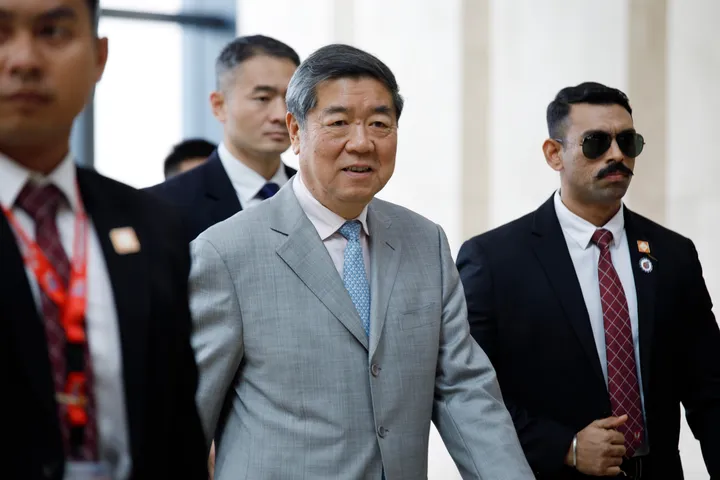
He Lifeng in Kuala Lumpur on Oct. 25. 2025.
Tap the image or the background to close.
The negotiations, staged in Malaysia’s capital and hosted at the iconic Merdeka 118 complex, bring together U.S. Treasury Secretary Scott Bessent and China’s Vice-Premier He Lifeng, along with top trade negotiators including Li Chenggang. The meeting signals a mutual desire to stabilise economic relations during a time of rising global geopolitical tensions.
Both nations face mounting domestic and external pressures. The U.S. is grappling with supply-chain vulnerabilities, inflation, and competition in sectors such as semiconductors and rare earths. China, meanwhile, seeks resilient access to global markets amid slowing growth and tensions with multiple trading partners. These talks therefore carry not just bilateral, but global economic stakes.
According to a U.S. Treasury spokesperson, the opening day of talks concluded on a positive note: “They have been very constructive, and we expect them to resume in the morning.” Although no formal agreement was announced, the tone suggests both sides are seeking at least a temporary de-escalation of trade hostilities.
Key agenda items under discussion include Chinese controls on rare-earth exports, U.S. demands for market access and intellectual-property protections, and potential coordination on supply-chain resilience. Both countries are also expected to explore a joint statement of economic cooperation and possible tariff relief in selected sectors.
Investors and markets are closely watching the outcome. Easing of trade friction could lead to supply-chain realignment, increased investment flows, and improved global economic sentiment. Conversely, a collapse in trust could reignite tariff wars, export controls and strategic decoupling away from China. The markets have already priced in some optimism following comments from both sides.
The summit between Trump and Xi, scheduled for next week on the margins of the Asia‑Pacific Economic Cooperation (APEC) meeting, adds urgency. Political analysts say that any breakthrough or public commitment at that level could shape the trajectory of global trade architecture for years. The Malaysia talks therefore serve both as preparation and as a test of bilateral willingness.
In trade forums and diplomatic circles, both Washington and Beijing are portraying the engagement as part of a “reset” in relations — although neither is willing to concede major ground. U.S. officials emphasise that “constructive” does not mean “complacent”; the U.S. remains prepared to impose tariffs or export controls if necessary. Chinese officials, likewise, frame the talks as part of their broader “dual circulation” strategy — strengthening domestic capacity while engaging globally.
Regional hosts such as Malaysia see a diplomatic dividend. Kuala Lumpur’s hosting of the talks underscores South-East Asia’s increasing role as an intermediary in U.S.–China relations; it also aligns with its ambition to serve as a trade and diplomatic hub in the Indo-Pacific.
Observers emphasise that while immediate outcomes may be modest, the tone and mechanics matter. A de-escalation now could help avoid an all-out trade war that many fear could tip the global economy into recession. Meanwhile, if substantive breakthroughs are achieved, they could pave the way for cooperative frameworks in technology, climate-friendly trade and supply-chain diversification.
For now, the talks continue. Both sides will reconvene tomorrow, prior to the Trump–Xi meeting, with negotiators working behind closed doors. Whether this signals the beginning of sustained rapprochement or merely a tactical pause remains to be seen — but the fact that both sides opted to meet in person and publicly label the discussions “very constructive” suggests that the door to compromise is open.

