

Saxafi Media
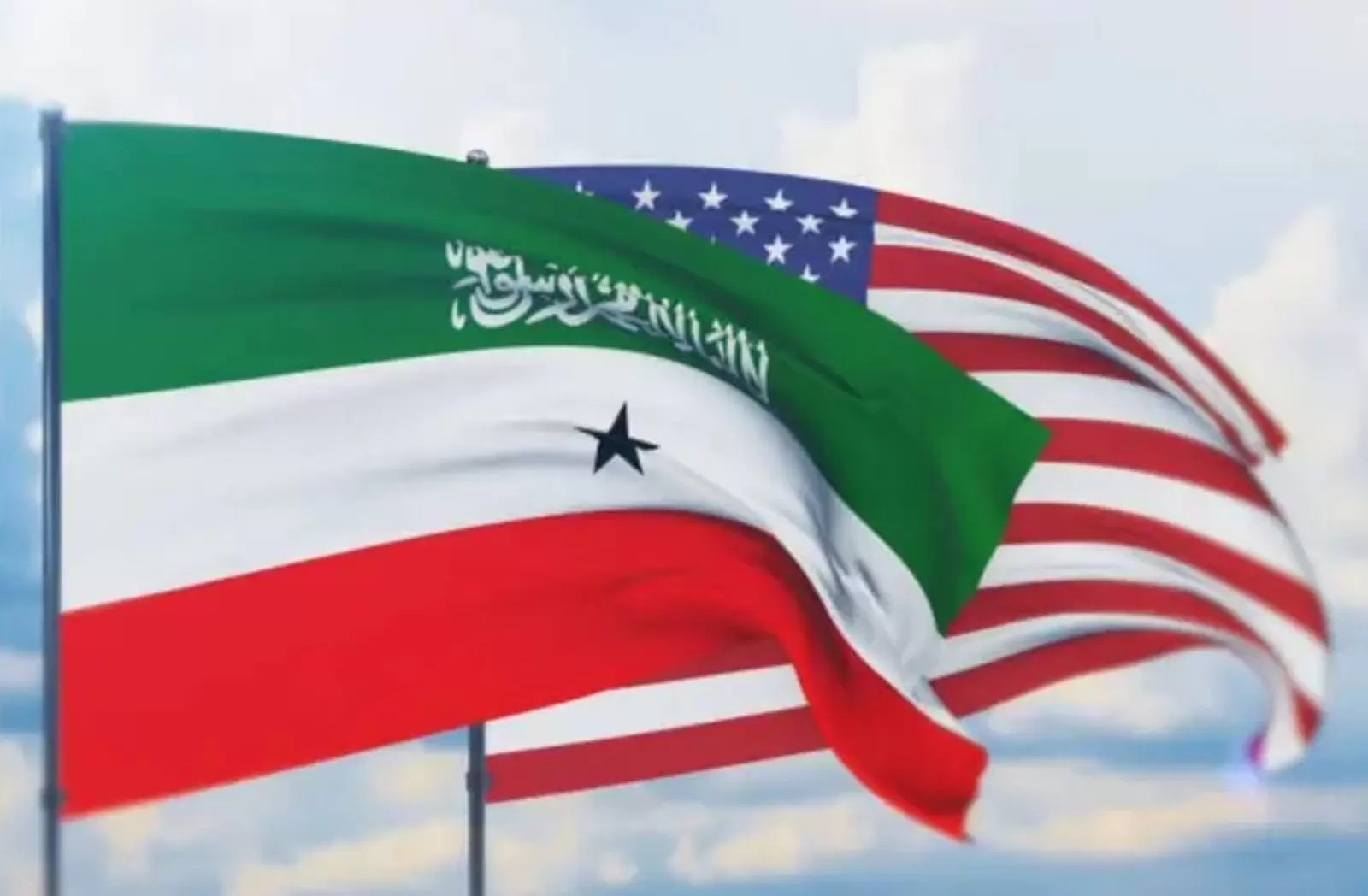
The national flags of Somaliland and the United States fly side by side, symbolizing growing calls for stronger diplomatic relations and U.S. recognition of Somaliland’s sovereignty.
Tap the image or the background to close.
Subscribe to BBN Daily
Thank You!
We've received your request. Please check your email to confirm your subscription.
The appeal, directed to the U.S. President Donald J. Trump and American policymakers, emphasizes Somaliland’s consistent record of peace, democracy, and good governance over three decades. President Irro stated that recognizing Somaliland is “not just a legal obligation—it is a moral duty aligned with the principles of justice, sovereignty, and self-determination.”
Somaliland, located in the Horn of Africa along the vital Red Sea and Gulf of Aden trade routes, has built a stable government, democratic institutions, and a strong security framework since restoring its sovereignty in 1991. Its governance model, widely praised across Africa and beyond, has allowed the country to maintain peace, hold free elections, and build institutions without foreign military support or external administration.
President Irro’s latest statement comes amid growing international attention to Somaliland’s strategic role in regional security, maritime stability, and trade. The country’s Berbera Port — now a key logistics hub in the Red Sea corridor — has positioned Somaliland as a critical partner for international shipping, energy, and counterterrorism cooperation.
In his message, Irro reaffirmed Somaliland’s historical independence, noting that the country gained sovereignty from Britain on June 26, 1960, before voluntarily entering a union with Somalia five days later. That union, he said, “collapsed through violence, injustice, and dictatorship,” leading Somaliland to restore its independence in 1991.
“For more than thirty years, Somaliland has proven that peace, democracy, and statehood can thrive in the Horn of Africa,” Irro wrote. “We have chosen the path of democracy, dialogue, and development, and we stand as a model of stability in a region too often defined by conflict.”
Diplomatic observers say President Irro’s message to Trump represents a strategic push to bring Somaliland’s case directly to U.S. political leaders who have shown interest in reevaluating Washington’s Africa policy. In recent years, several members of the U.S. Congress — including Senators Ted Cruz and James Risch — have publicly urged the White House to recognize Somaliland and deepen security and trade partnerships.
Somaliland’s government argues that international recognition would not only correct a historic oversight but also enhance global security and economic cooperation. The country’s democratic institutions, regular elections, and civilian-led governance stand in sharp contrast to the instability of the broader Horn region.
“Recognition of Somaliland is recognition of progress,” Irro said in his appeal. “It is the acknowledgment that a nation has fulfilled the very criteria that the international community sets for statehood — effective governance, respect for human rights, and the consent of its people.”
Regional analysts say the recognition debate is gaining momentum as global powers seek stable partners along the Red Sea corridor. Somaliland’s consistent counterterrorism cooperation, maritime security role, and open investment climate have made it an attractive ally for both Western and Gulf nations.
Irro’s administration continues to strengthen diplomatic ties across Africa, the Middle East, and Europe. Recent engagements with Ethiopia, the UAE, and the UK reflect Somaliland’s growing international footprint and its determination to secure formal statehood through dialogue and partnership.
“The time has come for the world to act,” Irro stated. “Recognizing Somaliland is not a gesture — it is a responsibility. It is about standing for democracy, rewarding peace, and affirming that nations that govern responsibly deserve their rightful place among the community of states.”

