


REUTERS/Salahuddin
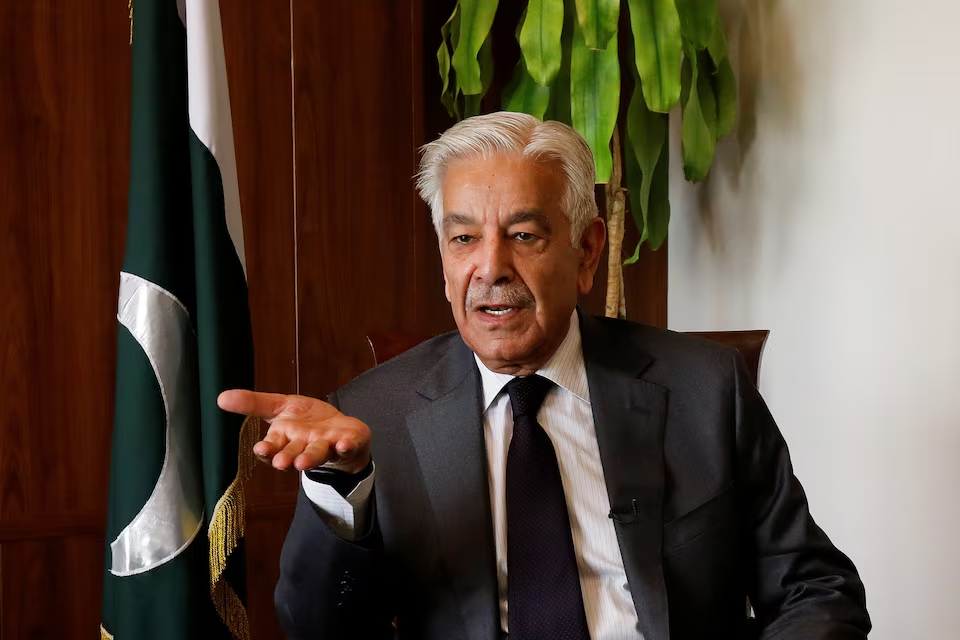
Pakistan's Defence Minister Khawaja Muhammad Asif speaks during an interview with Reuters in Islamabad, Pakistan, October 20, 2025.
Tap the image or the background to close.
In Islamabad on 25 October 2025, Pakistan’s Defence Minister Khawaja Muhammad Asif delivered a stark warning: if the ongoing peace negotiations with neighbouring Afghanistan fail to yield a long-term enforcement mechanism, Pakistan is prepared to enter “open war” with Kabul.
The talks, taking place in Istanbul, represent the latest effort to solidify a truce following a period of intense border clashes, militant attacks and air-strike exchanges — the most serious flare-up since the Taliban assumed control of Kabul in 2021.
Asif, speaking publicly from Islamabad, said: “We have the option, if no agreement takes place, we will have open war with them. But I saw that they want peace.” Though he asserted that the cease-fire, which holds to date, was still intact, the warning underscored Pakistan’s frustration with what it terms Afghanistan’s failure to curb militant sanctuaries inside its territory.
Key transit points along the 2,640-kilometre Pakistan-Afghanistan border — often referred to as the Durand Line — remain closed, and both sides have accused the other of violating the truce. Islamabad alleges that armed groups including the Tehrik‑i‑Taliban Pakistan (TTP) operate with impunity inside Afghan territory and launch strikes into Pakistan. Kabul denies sheltering militants and accuses Pakistan of violating Afghan sovereignty with cross-border drone and air operations.
The stakes are high. Pakistan’s military hard-liner posture reflects growing concerns within Islamabad about internal instability, militant infiltration and the potential for regional spill-over. Analysts warn that renewed large-scale hostilities could hasten refugee flows, disrupt trade routes and destabilise South Asia further.
Meanwhile, Afghan negotiators emphasise diplomatic resolution and call for recognition of sovereignty and border integrity. The Istanbul talks are time-sensitive and both sides have reportedly offered concessions, but the lack of transparency and absence of a concrete enforcement mechanism remain deep-seated obstacles. Pakistan is reportedly pushing for a joint monitoring mechanism, cross-border intelligence sharing, and immediate action against militant sites. Afghanistan, wary of Pakistani dominance, seeks assurances on non-interference and the future of refugee populations.
If the talks collapse, defence analysts expect Pakistan to resume cross-border operations, with options ranging from expanded air-strikes to full ground incursions. For Afghanistan, whose economy and governance structure remain fragile under the Taliban regime, the prospect of a new conflict presents serious risks: disruption of donor flows, humanitarian setbacks and challenge to internal legitimacy.
Regional powers and international players are also paying attention. For both the United States and China, Pakistan and Afghanistan represent strategic geographies — home to nuclear-armed Islamabad and a neighbouring state with ongoing Western diplomatic engagement. A breakdown in talks could re-ignite proxy dynamics and heighten competition across borders.
Local civilians along the border testified to an atmosphere of anxiety. In the Chaman crossing region, residents described brief but heavy exchanges of artillery and reported movement of military reinforcements. “We live in hope that the guns stay silent, but every morning brings fear,” said one resident. His neighbour added: “If the talks fail, we may see what we thought was settled return — war at our doorstep.”
For Islamabad, the clock is running. Defence Minister Asif emphasised that the window for agreement is short. Any further militant attack will escalate matters. The closing of this phase of talks marks a tipping point: either a durable peace mechanism emerges or the region slides back into large-scale confrontation.
Internationally, the conversation now shifts to how donor powers, UN agencies and neighbouring countries can support de-escalation. Analysts suggest offering economic incentives, border-monitoring missions, and increased engagement with the Taliban government to build trust and ensure implementation. But if Pakistan takes military action, those efforts may collapse.
In short, today’s warning from Pakistan signals a final juncture: diplomacy with Afghanistan is hanging by a thread, and the outcome could reshape South Asia’s security architecture. For now, both sides appear to be holding fire — but the message is clear: failure is not an option.

