

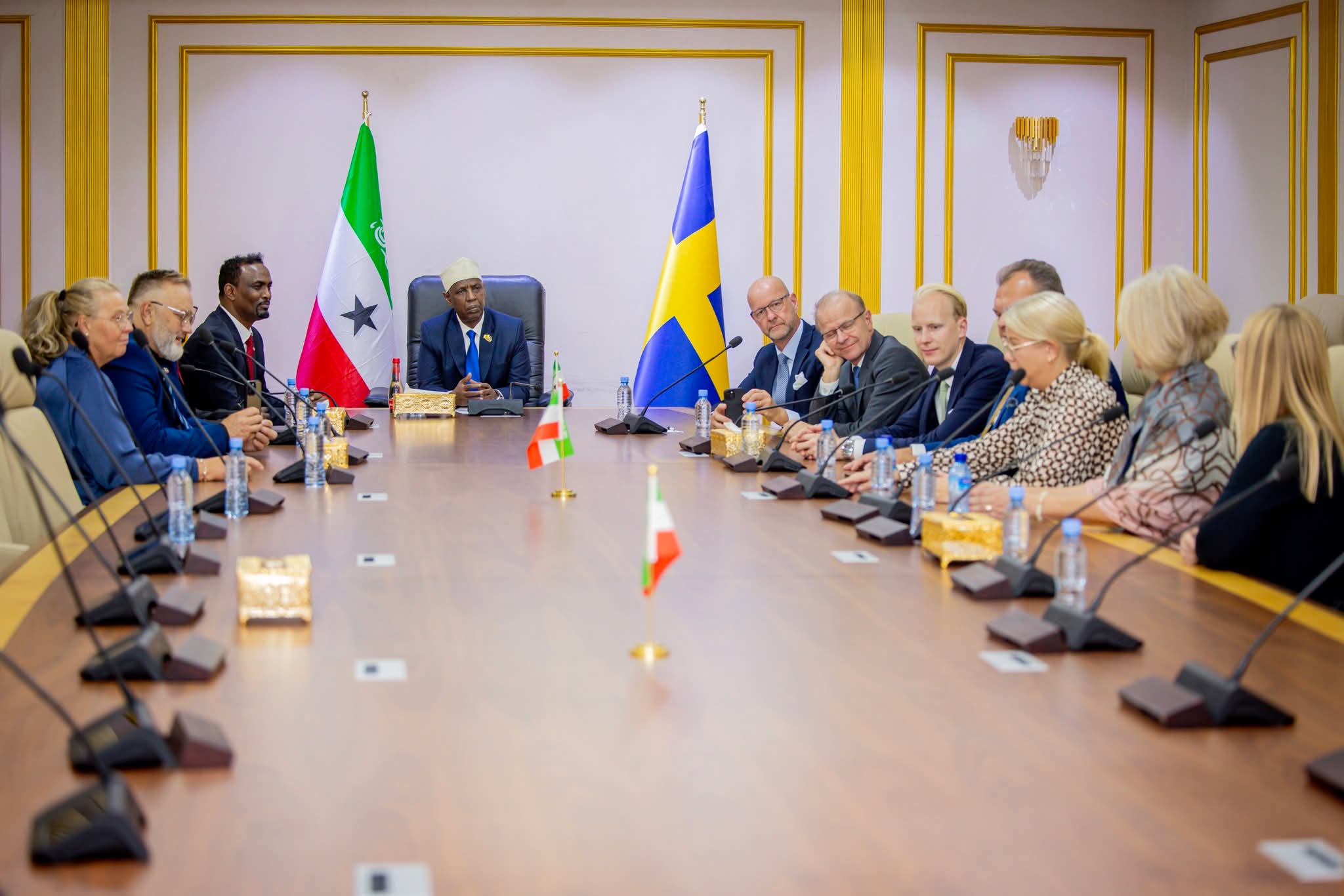
A Landmark Meeting Between Somaliland's Leadership and Swedish Lawmakers Signals Growing International Engagement. © Buraopost
×
![Enlarged view of Somaliland-Sweden diplomatic meeting]()
Subscribe to BBN Daily
Join our newsletter for the latest news and updates, delivered straight to your inbox.
Thank You!
We've received your request. Please check your email to confirm your subscription.
Hargeisa, the vibrant capital city of the Republic of Somaliland, became the center of diplomatic attention today as Vice President and Acting President Mohamed Ali Aw Abdi held a significant meeting with a high-level delegation from the Parliament of Sweden. The visit marked one of the most high-profile engagements between Somaliland and a European country in recent months, reflecting the country’s growing diplomatic visibility and the increasing interest of Western nations in Somaliland’s democratic progress and stability.
The meeting, held at the Presidential Palace in Hargeisa, brought together senior government officials, foreign diplomats, and key members of Somaliland’s Ministry of Foreign Affairs. The Swedish delegation, composed of prominent Members of Parliament and political figures, arrived on an official visit aimed at deepening understanding of Somaliland’s political, social, and economic landscape, while exploring pathways for cooperation, investment, and recognition.
Accompanying Vice President Mohamed Ali Aw Abdi were the Minister of Foreign Affairs and International Cooperation, Abdillahi Daahir Aadan, and Somaliland’s official representative to Sweden, Zakariye Hassan Wacays. The Swedish delegation included Magnus Oscarsson (MP), Mikael Oscarsson (MP), Mathias Bengtsson (MP), Dan Hovskär (MP), Annicki Oscarsson (party official), Natalie Oscarsson (party official), Katrin Hovskär (party official), and Mikael Torstensson, the Special Envoy of Somaliland to Sweden, who was joined by his wife, Elisabeth Torstensson.
The delegation’s visit carried a clear objective: to assess Somaliland’s democratic progress, examine its peace and stability framework, and identify areas where collaboration could advance mutual interests. It also aimed to strengthen Sweden’s understanding of Somaliland’s long-standing pursuit of international recognition — an issue that has shaped the country’s foreign relations for over three decades.
Vice President Mohamed Ali Aw Abdi warmly welcomed the delegation, thanking them for choosing Somaliland as their destination and for recognizing the country’s political maturity and democratic integrity. He emphasized that Somaliland’s leadership values partnerships based on mutual respect and understanding, especially with nations that share democratic principles and a commitment to peace and human rights.
During the meeting, the Vice President provided the Swedish delegation with a comprehensive overview of Somaliland’s historical journey toward sovereignty. He recounted how, following years of civil war and the collapse of the Somali Republic in 1991, the people of Somaliland overwhelmingly voted in a national referendum to restore their independence. This decision, he said, was not merely a political declaration but an expression of the collective will of a people who sought peace, justice, and self-determination after decades of suffering.
The Vice President further explained that Somaliland has, for 34 years, maintained peace, democratic governance, and a functioning state structure — all without formal international recognition. He stressed that Somaliland fulfills every criterion required for statehood under international law, including a defined territory, a permanent population, a stable government, and the capacity to enter into relations with other states. He added that the country’s record of stability and constitutional order makes it a reliable partner in the Horn of Africa, one of the world’s most geopolitically sensitive regions.
As discussions continued, both sides explored opportunities for enhanced cooperation in several key sectors. The Vice President outlined Somaliland’s ambitious vision for economic growth, highlighting the country’s strategic position along the Gulf of Aden and its potential as a hub for regional trade. He described the expansion of the Port of Berbera as a cornerstone of Somaliland’s economic transformation, supported by investments that could facilitate trade routes connecting Africa to the Middle East and Asia.
Renewable energy was another focal point of the talks. The Vice President underscored the government’s efforts to diversify its energy sources and attract foreign investment in solar and wind power projects. He noted that Somaliland’s vast natural resources and abundant sunlight present excellent opportunities for sustainable energy partnerships — an area where Swedish expertise and technology could play a vital role.
Agriculture and livestock, which form the backbone of Somaliland’s economy, were also discussed in depth. The Vice President invited Swedish investors to participate in modernizing Somaliland’s livestock sector through improved veterinary services, cold-chain systems, and meat processing facilities. He also pointed to opportunities in the fisheries sector, where sustainable practices could help create jobs, improve food security, and generate export revenue.
Infrastructure development and education featured prominently in the dialogue. The Vice President spoke about the government’s priorities in expanding road networks, improving urban infrastructure, and building stronger links between rural and urban communities. He emphasized the importance of vocational training and education partnerships to equip young Somalilanders with skills for employment and entrepreneurship.
Health and humanitarian development were also on the agenda. Vice President Mohamed Ali Aw Abdi reaffirmed Somaliland’s commitment to upholding human rights and supporting vulnerable groups. He highlighted ongoing efforts to strengthen public health systems, expand access to clean water, and promote gender equality in education and employment. He praised Sweden’s global reputation as a leader in social welfare and encouraged cooperation in healthcare capacity building and community development programs.
The Swedish delegation listened attentively, expressing admiration for Somaliland’s achievements in maintaining peace and democracy without external assistance. They praised the government’s commitment to democratic values, noting that Somaliland stands as a model of self-governance in a region often marred by conflict and instability.
Members of the delegation expressed their determination to raise awareness about Somaliland’s case within the Swedish Parliament. They emphasized the importance of encouraging dialogue in Sweden and the European Union regarding Somaliland’s legitimate right to international recognition. Several delegates voiced their belief that acknowledging Somaliland’s statehood would not only reflect fairness and historical justice but also contribute to regional peace and economic development.
In addition, the delegation promised to strengthen ties between the people of Sweden and Somaliland by promoting parliamentary exchanges, educational partnerships, and business-to-business connections. They underscored Sweden’s interest in supporting projects that promote democracy, environmental sustainability, and economic empowerment.
The atmosphere during the meeting was described as warm, open, and highly constructive. Both parties demonstrated mutual respect and a shared vision for collaboration based on transparency and long-term development. Observers noted that the meeting represented one of the most comprehensive discussions ever held between Somaliland’s leadership and Swedish representatives, symbolizing a growing recognition of Somaliland’s stability and achievements.
In his closing remarks, Vice President Mohamed Ali Aw Abdi expressed deep gratitude to the delegation for their visit and thoughtful engagement. He noted that Somaliland’s pursuit of recognition is not an act of defiance but a rightful claim grounded in international law and historical legitimacy. He urged Sweden, as a respected member of the international community, to take a principled stand in supporting Somaliland’s recognition and to lead by example in acknowledging nations that have demonstrated commitment to peace, democracy, and human rights.
The Vice President also emphasized that recognizing Somaliland would strengthen peace and security across the Horn of Africa. He explained that Somaliland’s stability acts as a buffer in a volatile region, contributing to maritime security, counter-terrorism efforts, and the prevention of illegal migration. He added that with formal recognition, Somaliland could access international financial systems and development funding, which would further empower its government to provide essential services to its citizens and strengthen regional cooperation.
The meeting concluded with an exchange of gifts and official photographs at the Presidential Palace, followed by a tour of key government institutions and development sites in Hargeisa. The Swedish delegation expressed their admiration for the hospitality they received and their respect for the resilience and determination of the Somaliland people.
In a joint statement, both sides reaffirmed their commitment to continued dialogue and cooperation. The Swedish delegation promised to deliver a detailed report to their Parliament outlining their observations and recommendations for deeper engagement with Somaliland.
As the delegation departed Hargeisa, optimism filled the air. Analysts noted that the visit marked a milestone in Somaliland’s foreign relations, reinforcing its image as a stable, democratic, and forward-looking nation. The event also signaled a growing realization among international policymakers that Somaliland’s achievements cannot be ignored, and that meaningful engagement serves the interests of both regional stability and global peace.
For Somaliland, the meeting underscored its unwavering commitment to diplomacy and its readiness to engage with nations that value democracy, transparency, and partnership. For Sweden, it offered a chance to witness firsthand a success story in the Horn of Africa — a nation that has built peace and democracy from the ashes of conflict and continues to thrive despite the absence of international recognition.

