

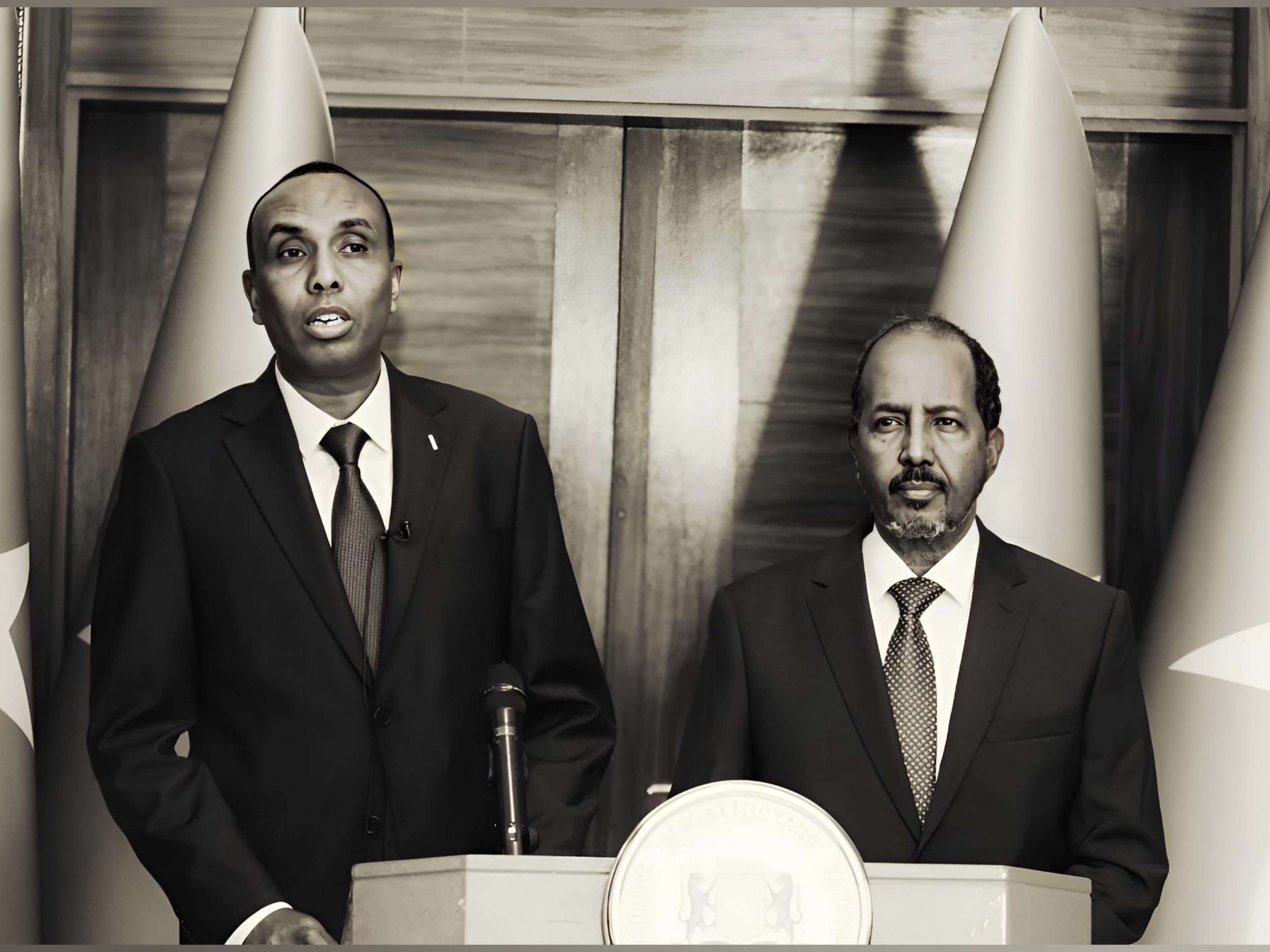
Somalia's failed leadership — President Hassan Sheikh Mohamud and Prime Minister Hamse Abdi Barre during a government session in Mogadishu.
Subscribe to BBN Daily
Join our newsletter for the latest news and updates, delivered straight to your inbox.
Thank You!
We've received your request. Please check your email to confirm your subscription.
Mogadishu’s recent decision to classify Somaliland alongside al-Shabaab as a national security threat exposes the depth of political confusion and failure within Somalia’s federal system. This shocking move demonstrates not only the absence of strategic direction in Mogadishu but also its persistent denial of Somaliland’s legitimate political and historical reality.
For years, Somalia has been struggling under Chapter VII of the United Nations Charter — a clear sign that the international community still views it as a fragile and unstable state. Yet instead of confronting its internal insecurity, corruption, and lack of governance, Somalia’s leadership has chosen to turn its political weakness into hostility against Somaliland, a peaceful and self-governing democracy that has maintained stability for over three decades.
Somaliland’s case is not a threat to peace — it is a political and legal reality born from history and the will of its people. Before the 1960 union, Somaliland was already a fully independent state, recognized by several countries and functioning under its own governance. Somalia, on the other hand, was still emerging from Italian colonial rule, a period marked by limited political experience and administrative dependence. When the two territories united in 1960, Somaliland entered the union voluntarily, hoping for a partnership of equals. But the dream quickly collapsed as dictatorship, injustice, and centralization dominated Mogadishu’s rule.
The union failed — not because of the people, but because of Somalia’s inability to respect equality and governance. Somaliland’s decision to restore its independence in 1991 was not an act of rebellion but an act of self-determination grounded in legality, peace, and history. Since then, Somaliland has built a functioning democracy, held multiple peaceful elections, and maintained internal stability — achievements that stand in stark contrast to the chaos and violence that continue to define Somalia’s political landscape.
By labeling Somaliland a “threat,” Somalia is not protecting its national interests — it is projecting its failures. No threat comes from Hargeisa; the real threat lies in Mogadishu’s insecurity, corruption, clan divisions, and dependence on international forces for survival. A government that cannot control its own capital, relies on external troops for protection, and operates under foreign supervision has little moral or political ground to declare others as security threats.
The narrative pushed by Mogadishu about “recognition” is another layer of denial. Somaliland does not seek to divide a nation that never truly functioned as one. It seeks to reclaim its sovereignty — a sovereignty that existed before Somalia’s independence and was temporarily shared under a failed union. The people of Somaliland have chosen peace, progress, and democracy, while Somalia remains trapped in cycles of instability and foreign intervention.
In reality, Somaliland and Somalia are two different societies with distinct colonial histories, political cultures, and governance traditions. While they share language and religion, they are not the same people. Somaliland’s British colonial legacy left behind a tradition of law, order, and institutional governance — something Somalia, under Italian rule, never developed to the same extent. The difference in political maturity between the two regions is visible even today.
Somalia’s obsession with claiming Somaliland only underscores its insecurity and desperation. Instead of confronting terrorism, corruption, and clan wars, Mogadishu’s leaders are trying to manufacture unity through hostility. But unity cannot be built on denial, and peace cannot grow from lies.
Somalia has failed to build a functioning army, failed to hold credible elections, and failed to control its borders. The government relies heavily on foreign donors, while public institutions remain weak, politicized, and corrupt. This internal collapse has pushed Mogadishu to seek external enemies as a distraction — and Somaliland has become the easiest target for its propaganda.
However, the reality remains unchanged. Somaliland continues to move forward — peacefully, democratically, and independently. Its economy grows through trade, investment, and diaspora remittances. Its people enjoy stability and freedom of expression, while its democratic institutions serve as a model for the Horn of Africa.
By contrast, Somalia’s repeated accusations, security decrees, and false narratives reveal only the depth of a government that has lost legitimacy at home and credibility abroad. The world sees through the façade: a fragile state that blames others for its failures, even as it survives under UN guardianship.
Somaliland’s independence is not a threat — it is a success story born from the ashes of a failed union. The world must recognize this truth: peace, democracy, and stability exist in Hargeisa, not in the halls of Mogadishu’s broken government. Somalia may try to rewrite history, but Somaliland’s story is already written — in resilience, in freedom, and in the unbreakable will of its people.

