

Image by Efrem Lukatsky/AP
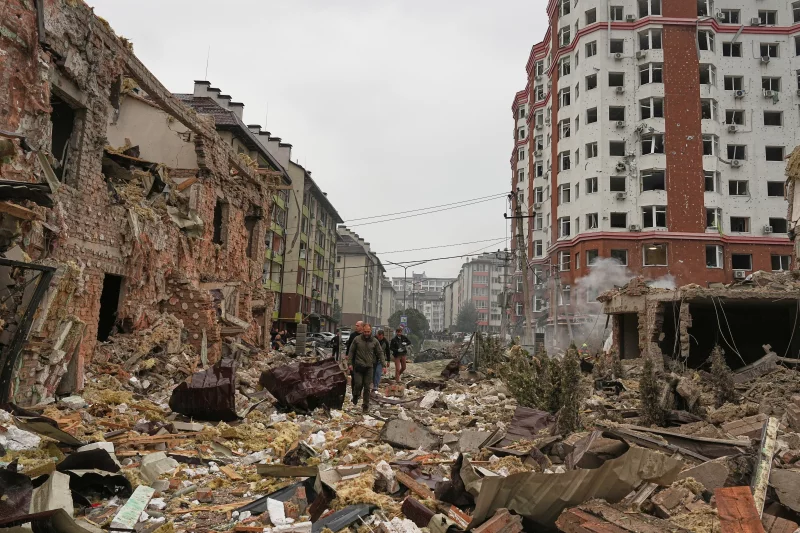
People walk near apartment buildings damaged after a Russian attack in Kyiv on Sunday.
Tap the image or the background to close.
In the early hours of 25 October 2025, the Ukrainian capital, Kyiv, along with other strategic regions, came under a wave of missile and drone strikes launched by Russian forces, according to local officials. At least four civilians were killed and more than a dozen wounded in the assault, which targeted infrastructure and residential zones.
Explosions rocked the city around 04:00 local time, with fires erupting at a warehouse and adjacent units in the Dniprovskiy, Desnianskiy and Darnytskiy districts. Residents described the sound of successive blasts and rising plumes of black smoke. Ukraine’s air-defence authorities said they intercepted a portion of the incoming strike load, but stressed that many threats still got through.
A senior Ukrainian official labelled the strikes “terror attacks” designed to undermine civilian morale rather than target strictly military objectives. Notably, no major military production facility was reported hit in the Kyiv region, prompting sharp criticism of Moscow’s motives.
The attacks arrive at a key juncture in the conflict: nearing its fourth year, Ukraine is now entering the colder months and facing complex challenges in protecting energy, power and heating infrastructure. Kyiv has repeatedly warned that Russia will intensify attacks ahead of winter to create hardship ahead of the frontline fighting.
In response to today’s strikes, Ukrainian authorities issued an urgent appeal to Western allies for rapid deployment of additional air-defence systems, long-range missiles and humanitarian support. President Volodymyr Zelenskyy said in a statement: “These attacks are designed to strike at the heart of our society, not just our military. We must be supported with the tools to defend our people.”
Internationally, the strikes have spurred renewed momentum among Kyiv’s partners to pursue tougher sanctions on Russian oil and gas exports, a move seen as vital to reducing Moscow’s war-financing capacity. Many European capitals are now debating coordinated action.
Military analysts note that Russia is increasingly using integrated drone and missile tactics to stretch Ukraine’s air-defence systems, forcing Kyiv to adapt its strategy amid diminishing resources. Ukraine itself has stepped up drone strikes inside Russian territory, including those targeting energy and ammunition infrastructure.
On the ground, the human toll and disruption continue to mount. In the Dniprovskiy district, one local resident told reporters: “We felt like we were under bombardment overnight. There is fear, anger, uncertainty about what comes next.” Fire crews were still working through the morning, and power disruptions were reported in several areas.
The timing of the strike is significant. Analysts believe Moscow may be attempting to pressure Ukraine and its allies ahead of key diplomatic summits, complicating Kyiv’s ambitions to secure long-range weapons from the U.S. and other partners. With winter looming, the urgency of bolstering air-defences and maintaining civilian resilience has never been greater.
Ukraine’s government has emphasised that while frontline casualties remain critical, the battle for infrastructure and civilian protection is now a strategic dimension of the war. As one Ukrainian official put it: “If our people freeze in the dark, the war is already won for the aggressor.”
In Moscow, official statements continue to frame the strikes as legitimate attacks against Ukraine’s military-industrial complex, though independent observers remain sceptical given the civilian impact. The United Nations and other international bodies may view today’s events as further evidence of war crimes-type targeting.
This assault may mark a new phase — one where escalation includes targeting civilian resilience more explicitly. For Kyiv, the response will involve not only battlefield tactics but domestic hardening: deploying mobile generators, reinforcing shelters, and assisting displaced families. Allies are now discussing whether to upgrade Ukraine’s air-defences from short-range systems to medium- and long-range platforms capable of intercepting missiles beyond the immediate front lines.
As the daylight hours advance, Kyiv remains under high alert. Schools are closed for the day in some districts, emergency generators are active and repair crews are mobilised. The question now is whether today’s strike will be a one-off or signal a steady intensification of assaults ahead of the winter season. For Ukraine, the message is clear: the war is shifting shape, and the civilian home-front is increasingly a battlefield.

