

Photo by Brian Lawless / Press Assn. / AP
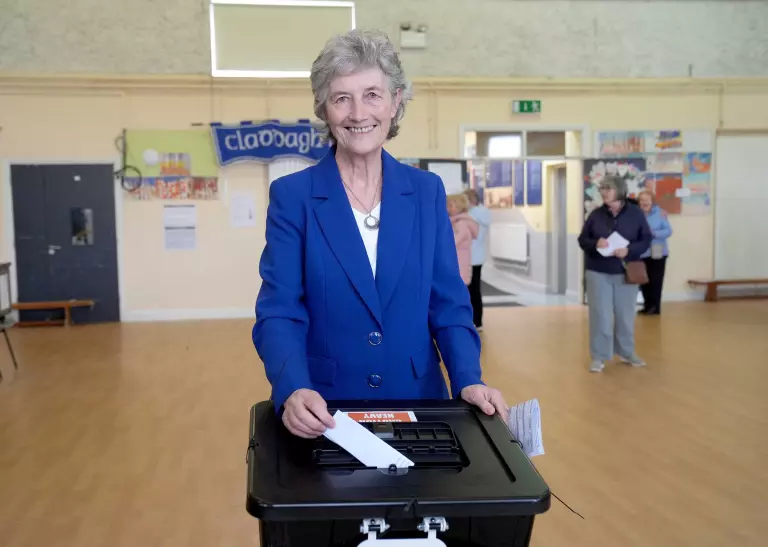
Independent candidate Catherine Connolly casts her ballot in the Irish presidential election at Claddagh National School in Galway city, Ireland, on Friday.
Tap the image or the background to close.
In Dublin on 25 October 2025, independent politician Catherine Connolly is poised to become the 10th President of Ireland, after her main rival conceded the race. Her lead in the vote count has become insurmountable, and the concession signals what many analysts describe as a landmark shift in Irish politics.
Connolly, aged 68, has served as Teachta Dála (TD) for Galway West since 2016 and previously held roles including Deputy Speaker of Dáil Éireann. Her campaign emphasised social justice, equality, a stronger voice for Ireland internationally, and a more assertive role on issues such as housing, language rights and neutrality.
While the Irish presidency remains largely ceremonial, it holds significant moral and symbolic sway. Analysts note that Connolly’s election could influence the tone of national debate — especially on issues such as Ireland’s neutrality, its place in the European Union, and its stance on global human rights.
Her path to the presidency has been marked by the backing of an unusual coalition: although running as an independent, Connolly secured key support from left-wing parties including Sinn Féin, the Labour Party and the Social Democrats. The decision by Sinn Féin to support her was described as a “game-changer” for the race.
Connolly has pledged she will serve one term if elected, and said she would be a president “for all of Ireland — north and south, urban and rural, young and old.” Her personal background reinforces her campaign themes: a former barrister and clinical psychologist, fluent in Irish (Gaeilge), with a career rooted in community and public service.
Observers say her victory reflects broader dissatisfaction with the centrist political establishment, particularly the coalition government of Fine Gael and Fianna Fáil, whose handling of housing, health and cost-of-living issues has drawn growing criticism. The considerable support for Connolly among younger voters and those disenchanted with traditional parties suggests a new dynamic in Irish electoral politics.
As night descended on the capital, crowds gathered in Dublin to observe the results. Connolly appeared on stage, addressing supporters with a message of unity: “We must rise to the challenges of our time, and I will serve you all, without fear or favour.” With the outcome all but confirmed, the formal announcement of her election is expected later today by the returning officer.
Internationally, her presidency arrives at a moment when Ireland’s role on the world stage is under the spotlight — from its hosting of EU-related meetings to its stance on conflicts abroad. Connolly’s track record suggests she may emphasise human rights and neutrality, potentially recalibrating Ireland’s diplomatic posture.
Her agenda, critics caution, will face limits: the Irish presidency lacks executive powers, meaning real shifts depend on her ability to persuade rather than command. Nonetheless, aides say she intends to use the office to amplify civic voices, champion disadvantaged communities and reinvigorate the Irish language.
In the coming weeks, attention now turns to Connolly’s inauguration, scheduled for 11 November 2025, and to how she will position herself at the heart of Irish public life. For voters who backed her, the result offers hope for an era of fresh voices and renewed engagement; for opponents, it signals a challenge to business-as-usual politics. Whichever way it is viewed, the Irish presidency is about to enter a new chapter — under a candidate who promises to shake up the status quo, while affirming her commitment to serve the entire nation.

