

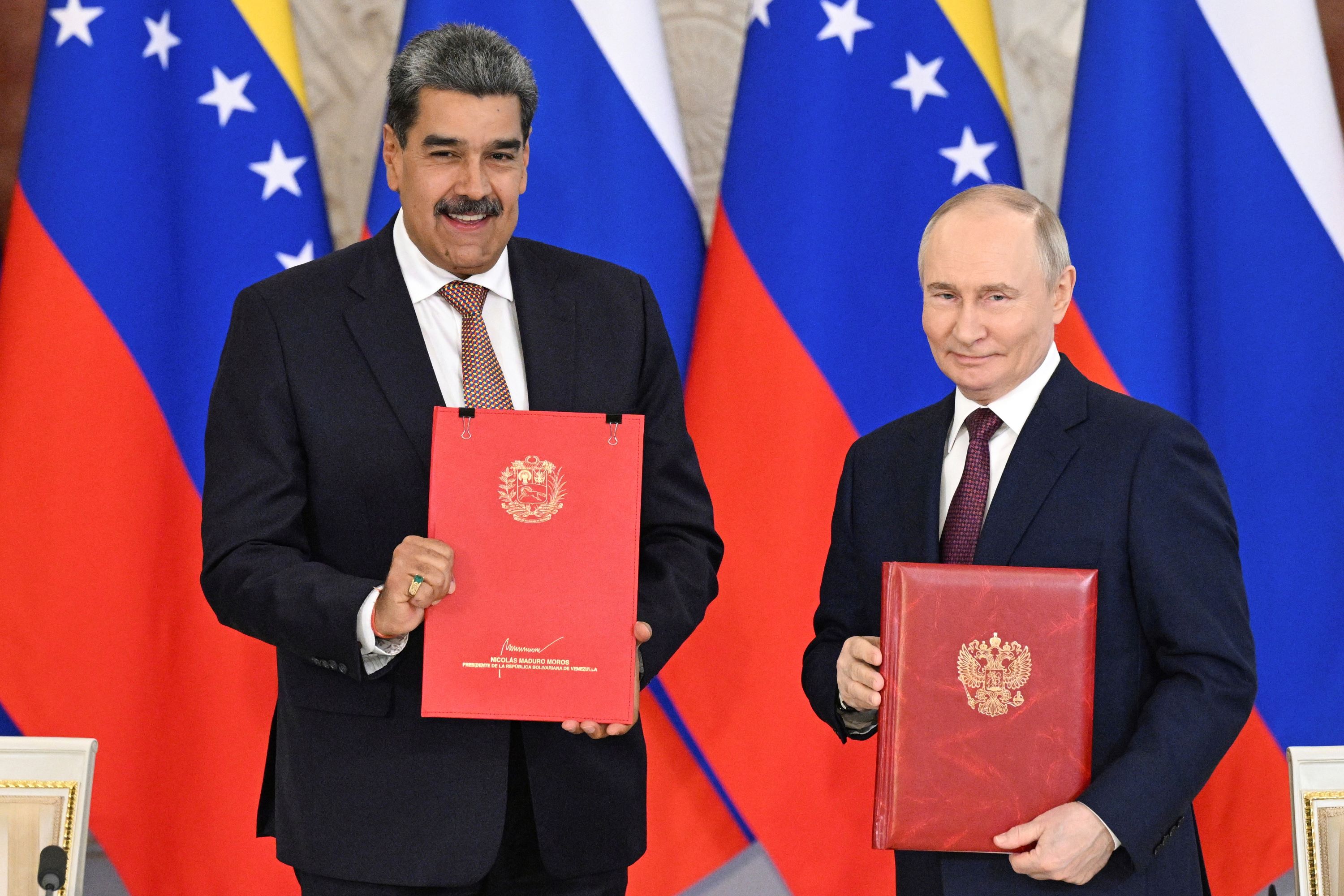
© RIA Novosti via AP
Venezuelan President Nicolas Maduro (left) and Russian President Vladimir Putin attend a signing ceremony after their meeting at the Kremlin in Moscow, Russia, May 7, 2025.
Tap the image or the background to close.
Moscow, October 27, 2025 – Russian President Vladimir Putin put his signature on a law today that ratifies a major strategic partnership agreement with Venezuela, bringing the pact into full effect and signaling a renewed commitment to closer ties between the two countries. The ceremony, though low-key, carries weight in the world of geopolitics, where alliances are shifting and old rivalries are bubbling up again. This isn't just paperwork; it's a statement of solidarity at a time when both Russia and Venezuela are pushing back against what they see as Western dominance.
The agreement itself stems from talks held earlier this year. Back in May, Venezuelan President Nicolas Maduro traveled to Moscow for high-level negotiations with Putin. The two leaders, who have met more than a dozen times over the years, inked the deal on May 7, laying out a 10-year framework for cooperation that can automatically renew every five years after that. It's designed to cover a wide range of areas, from energy and mining to transport and technology. But it goes deeper, touching on sensitive topics like arms control, disarmament, and non-proliferation, all with an eye toward promoting what the document calls "equal and indivisible security" for nations around the globe.
For Russia, this partnership fits into a broader strategy of expanding influence in Latin America, a region traditionally seen as the United States' backyard. Venezuela, rich in oil but battered by economic woes and political turmoil, has long turned to Moscow for support. The relationship dates back centuries, with official diplomatic ties established in 1857 during the era of the Russian Empire. But it really heated up in the early 2000s under Venezuela's late leader Hugo Chávez. Chávez, a fiery socialist who railed against U.S. imperialism, found a willing partner in Putin, who was rebuilding Russia's global standing after the Soviet collapse.
From 2005 onward, Russia became a key supplier of military hardware to Venezuela. Billions of dollars in arms deals flowed in, including fighter jets, helicopters, and missile systems. This wasn't just business; it was a way for Russia to poke at the U.S. without direct confrontation. In return, Venezuela offered Russia a foothold in the Americas, complete with oil partnerships and joint ventures. Companies like Rosneft, Russia's state oil giant, invested heavily in Venezuelan fields, helping to extract the country's vast reserves despite technical challenges and international sanctions.
When Maduro took over after Chávez's death in 2013, the bond only grew stronger. Maduro, facing his own crises – hyperinflation, mass protests, and a disputed 2018 election – leaned on Russia for loans, food aid, and political backing. Moscow recognized Maduro as the legitimate president even as the U.S. and many Western countries threw their support behind opposition figures like Juan Guaidó. In 2019, when tensions peaked and there were fears of a U.S. intervention, Russian military advisors showed up in Caracas, a move that raised eyebrows in Washington.
Fast forward to today, and the context feels even more charged. Russia is bogged down in its conflict with Ukraine, facing sanctions that have isolated it from much of the West. Venezuela, meanwhile, is still grappling with its economic meltdown, though recent oil price rebounds have offered some breathing room. Both countries are part of the BRICS group – Brazil, Russia, India, China, South Africa – which is positioning itself as an alternative to U.S.-led institutions. This new agreement could amplify that, perhaps opening doors for more joint projects in areas like renewable energy or digital infrastructure.
Details from the pact highlight practical steps. In energy, the two sides plan to boost collaboration on oil extraction and refining, areas where Venezuela's state-owned PDVSA has struggled due to underinvestment and corruption scandals. Mining is another focus, with Venezuela's gold and diamond resources potentially drawing Russian expertise. Transport links might see improvements, like better air and sea connections to facilitate trade. On the security front, the emphasis on disarmament and non-proliferation seems ironic given both nations' histories, but it's framed as a push for global stability on their terms.
Maduro has already given the deal his stamp of approval. Earlier this month, on October 7, he signed it into law in Venezuela, calling it a milestone for bilateral relations. In a televised address, he praised Russia as a true friend, one that stands by Venezuela in tough times. "This treaty is not just about economics; it's about sovereignty and mutual respect," Maduro said, echoing themes that have defined his presidency.
In Russia, the ratification process moved swiftly. The State Duma, the lower house of parliament, approved it unanimously on October 17, followed by the Federation Council. Putin's signature today was the final hurdle. Kremlin spokespeople described the agreement as a natural evolution of the partnership, one that benefits both sides equally. "We are committed to strengthening ties with our Venezuelan partners in a spirit of trust and cooperation," a statement from the Kremlin read.
But what does this mean for the bigger picture? Analysts see it as a thumb in the eye to the United States, especially with elections looming and foreign policy debates heating up. The U.S. has imposed heavy sanctions on both Russia and Venezuela, aiming to curb their influence. By deepening their alliance, Moscow and Caracas could find ways to circumvent those restrictions – think bartering oil for weapons or sharing technology to evade financial blocks.
There's also the military angle. While the agreement doesn't explicitly call for joint defense pacts, it opens the door for more cooperation in that realm. Russia has already helped Venezuela modernize its armed forces, and there are whispers of potential ammunition production deals. In a region where U.S. military presence is strong, this could alter the balance, making neighboring countries like Colombia nervous. Some experts worry it might encourage Russia to meddle more in Latin American affairs, using Venezuela as a proxy much like the Soviet Union did with Cuba during the Cold War.
Economically, the partnership could help Venezuela stabilize. With the world's largest proven oil reserves, the country has immense potential, but sanctions have choked off investment. Russian companies, hardened by their own sanction experiences, might step in where others fear to tread. Joint ventures could revive fields that have lain dormant, boosting output and revenues for both sides. Trade between the two has already grown; in recent years, Russia has exported wheat and medicine to Venezuela, while importing tropical fruits and other goods in return.
Yet challenges remain. Venezuela's internal politics are volatile, with ongoing disputes over elections and human rights drawing international criticism. Russia, too, is stretched thin with its Ukraine engagement, limiting how much it can commit elsewhere. Critics argue that this alliance props up Maduro's regime, delaying needed reforms and prolonging suffering for ordinary Venezuelans. Millions have fled the country in recent years, creating a refugee crisis in the region.
On the global stage, this deal aligns with Russia's push for a multipolar world. Putin has long advocated for alternatives to U.S. hegemony, and partnerships like this one with Venezuela – along with ties to Iran, North Korea, and China – form part of that vision. For Maduro, it's a lifeline, reinforcing his position amid threats from abroad. The U.S. response has been muted so far, but officials in Washington are watching closely. A State Department spokesperson noted that such agreements "do little to address the real needs of the Venezuelan people" and urged focus on democratic processes.
As the ink dries on this latest chapter, the Russia-Venezuela relationship continues to evolve. What started as opportunistic arms deals has blossomed into a full-fledged strategic alliance, one that could reshape dynamics in the Western Hemisphere. Whether it leads to prosperity or more tension remains to be seen, but for now, it's a reminder that in today's world, old friends can become even closer when the pressure is on.
The agreement also touches on cultural and educational exchanges, though these are less highlighted. Student programs and joint research initiatives could foster people-to-people ties, building goodwill beyond government halls. In energy specifics, there's talk of green technologies, with Russia sharing expertise in nuclear power – though Venezuela's focus remains on hydrocarbons.
Looking ahead, implementation will be key. Past deals have sometimes faltered due to bureaucratic hurdles or economic shifts. But with both leaders invested, this one might stick. For businesses, it opens opportunities; for diplomats, it poses questions. In Caracas and Moscow, celebrations are underway, but elsewhere, the mood is watchful.
This partnership isn't isolated. It's part of a pattern where sanctioned nations band together, creating parallel systems for trade and finance. Think cryptocurrency deals or barter arrangements that sidestep the dollar. Venezuela has experimented with its own digital currency, the Petro, backed by oil, and Russia has shown interest in similar tools.
Humanitarian aspects can't be ignored. Russia's aid shipments have helped alleviate shortages in Venezuela, from vaccines during the pandemic to food staples. While critics call it propaganda, for many on the ground, it's tangible support.
In the end, Putin's signature today cements a bond forged in adversity. As global powers jockey for position, alliances like this one highlight the fluid nature of international relations. Venezuela and Russia, separated by oceans but united by interests, are betting on each other for the long haul. The world will be watching to see how it plays out.

