

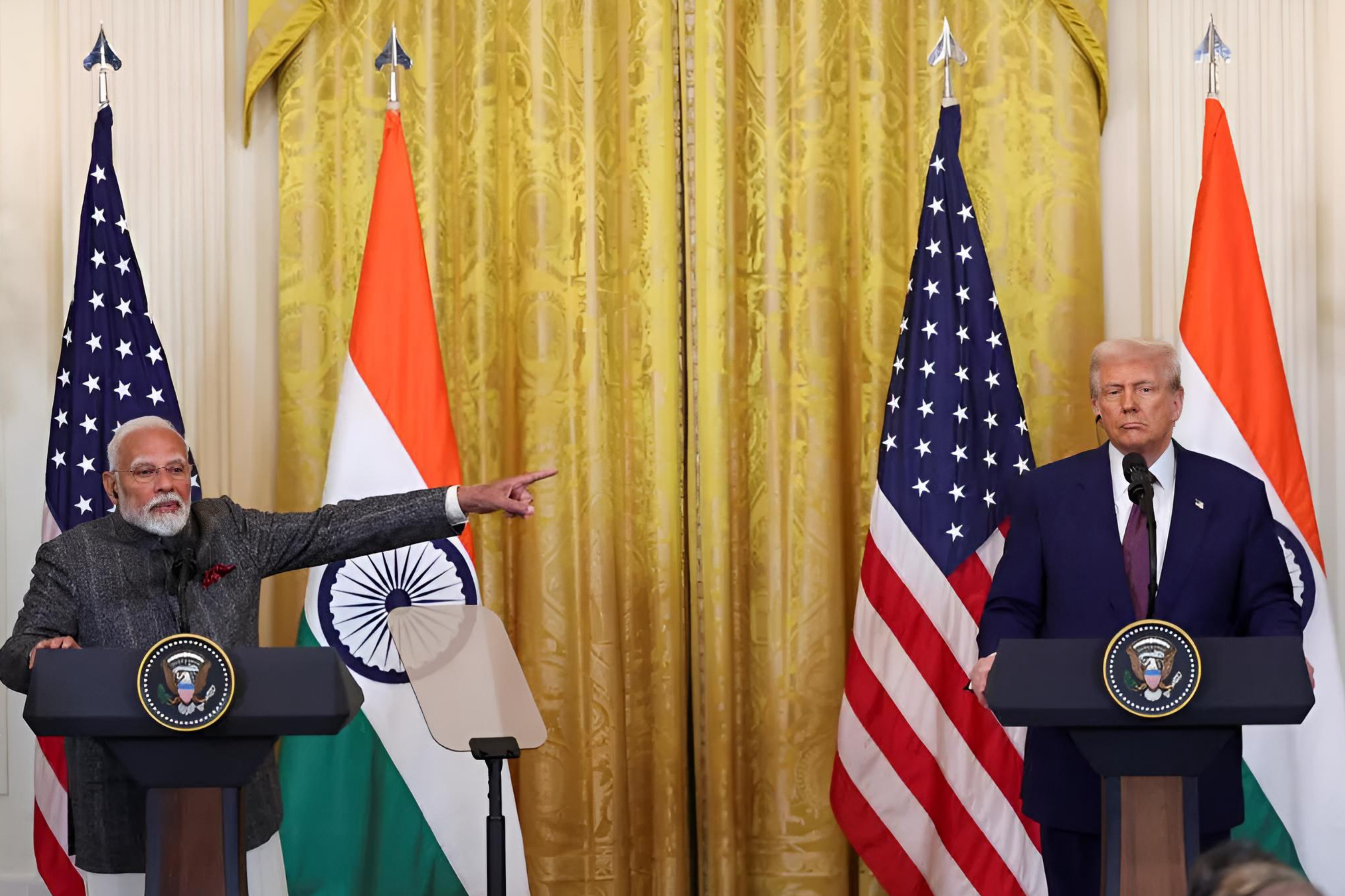
Prime Minister Narendra Modi and President Donald Trump hold a joint press conference in Washington as outsourcing and U.S.-India trade tensions take center stage. © EAF
×
![Enlarged view of Modi-Trump press conference]()
Subscribe to BBN Daily
Join our newsletter for the latest news and updates, delivered straight to your inbox.
Thank You!
We've received your request. Please check your email to confirm your subscription.
Washington, D.C. — September 5, 2025 — President Donald Trump is reportedly mulling over measures to block U.S. tech companies from outsourcing jobs to India, a move that could reshape global IT landscapes and hit India's economy hard. This development stems from recent discussions within the White House, highlighted by conservative commentator Jack Posobiec's social media post calling for tariffs on all outsourcing, which was reposted by Peter Navarro, Trump's Senior Counsellor for Trade and Manufacturing. The proposal aims to prioritize American workers in the tech sector, echoing Trump's "America First" agenda that has already imposed steep tariffs on Indian goods.
Outsourcing, in simple terms, is when companies like Google, Microsoft, or Amazon hire workers or services from abroad—often at lower costs—to handle tasks such as software development, customer support, or data processing. India has been a powerhouse in this area for decades, thanks to its large pool of skilled, English-speaking professionals and competitive pricing. Major Indian firms like Tata Consultancy Services (TCS), Infosys, and Wipro rely heavily on contracts from U.S. giants, generating billions in revenue and employing hundreds of thousands. In 2023, for instance, estimates showed Accenture outsourcing around 120,000 jobs to India, followed by IBM with 95,000 and Microsoft with 60,000.
The potential block could involve tariffs on IT services provided remotely from India, taxes on remittances sent back by foreign workers, and overhauls to the H-1B visa program. The H-1B visa allows skilled professionals, many from India, to work temporarily in the U.S., but critics argue it undercuts American job opportunities. Trump has previously criticized tech outsourcing during an AI summit in July, urging companies to stop hiring in India and China to bolster U.S. dominance in emerging technologies like artificial intelligence. "Those days are over," Trump reportedly said, emphasizing that American firms should focus on domestic talent to maintain a competitive edge.
For the U.S., this policy could mean more jobs at home, potentially reducing unemployment in tech hubs like Silicon Valley and addressing concerns over wage suppression. Supporters, including some American workers and policymakers, view it as a way to "level the playing field" and protect national interests amid rising global competition. However, U.S. tech companies warn that such restrictions might increase operational costs, slow innovation, and disrupt supply chains, as India's workforce fills critical skill gaps in areas like coding and cloud computing.
On India's side, the implications are stark. The country is the world's top recipient of remittances, with the U.S. contributing 27.7% of inflows in 2023-24, according to Reserve Bank of India data. Taxes on these could result in billions lost annually, as noted by the Global Trade Research Initiative (GTRI). Indian IT exports, valued at over $250 billion yearly, could face higher costs, contract losses, and the need to pivot to other markets like Europe or Asia. Critics in India argue this could lead to an economic "downfall" for the U.S. too, given its heavy reliance on Indian talent for profit generation.
Reactions have been mixed. Some U.S. voices celebrate it as a win for domestic employment, while Indian analysts liken it to "burning your furniture to stay warm"—a short-term fix with long-term consequences. As of now, no formal policy has been enacted, but the White House's signals suggest this could escalate tensions in U.S.-India trade relations. Experts recommend Indian firms prepare by diversifying and investing in local U.S. hiring to mitigate risks.

