


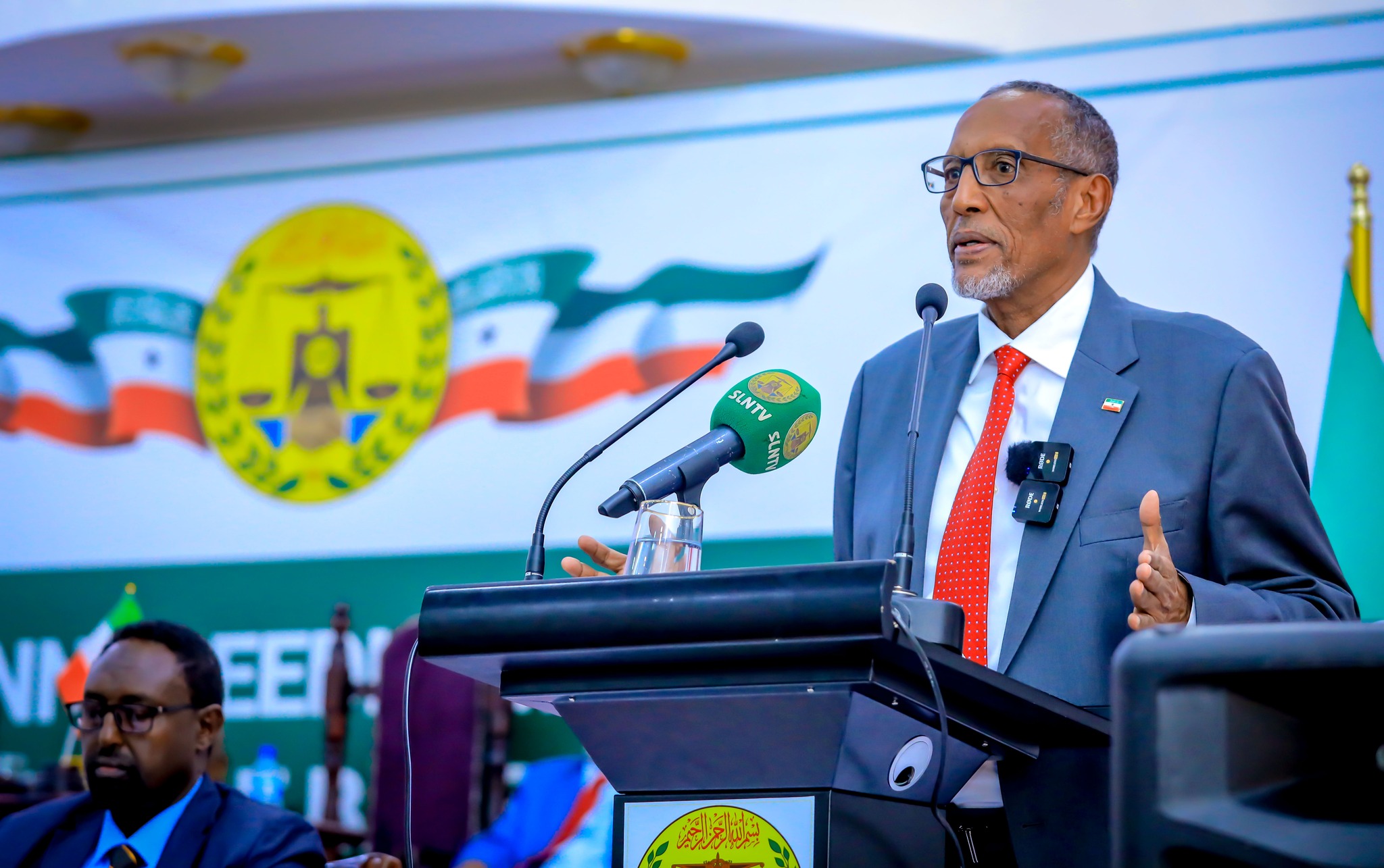
Former President Muse Bihi has broken his silence in an exclusive interview with Somaliland Chronicles, reflecting on his presidency, the controversial Taiwan partnership, strained relations with Djibouti, and the clan politics that shaped Somaliland's path. © Buraopost
×
![Enlarged view of former President Muse Bihi]()
Subscribe to BBN Daily
Join our newsletter for the latest news and updates, delivered straight to your inbox.
Thank You!
We've received your request. Please check your email to confirm your subscription.
Hargeisa, September 7, 2025 - Former President Muse Bihi Abdi has spoken with striking candor about some of the most defining and controversial choices of his presidency, offering Somalilanders a rare opportunity to hear not just what decisions were made in the corridors of power, but why they were made and how those choices continue to shape the nation’s fragile path toward recognition and stability. In a wide-ranging interview with Somaliland Chronicles, Bihi pulled back the curtain on his years in office, describing the political storms he endured, the reasoning behind his bold diplomatic gamble with Taiwan, and his struggles with domestic clan dynamics that, in his words, remained the hardest part of leading Somaliland. What emerged was not merely a recollection of past battles but a meditation on the nature of leadership in a nation still caught between hope and vulnerability, between aspirations of sovereignty and the realities of fragile internal unity.
The interview drew immediate attention across Somaliland, not only because of the weight of the speaker’s legacy, but also because of the openness with which he approached questions that many former leaders would have chosen to avoid. Bihi’s willingness to revisit his most divisive policies reflects a political culture that is still maturing, where accountability is rare and retrospection often discouraged. His decision to speak candidly now, after leaving office, may signal a growing understanding among Somaliland’s leaders that the public deserves to know not only what happened during their tenure but also what it felt like to govern under immense pressure, balancing external threats with internal fractures.
Central to the conversation was the landmark decision to deepen ties with Taiwan, a move that electrified Somaliland’s foreign policy and simultaneously infuriated rivals at home. At the time, many accused Bihi of jeopardizing relations with China and complicating Somaliland’s already delicate regional position. Yet Bihi defended the decision in the interview, framing it as a strategic leap of faith in pursuit of long-term diplomatic visibility. For him, the Taiwan partnership was not about short-term benefits but about carving out space for Somaliland in a world that still refuses to recognize it formally. The choice drew parallels with the pragmatism of other small nations that leveraged partnerships with controversial allies to gain leverage in international forums. In explaining his rationale, Bihi offered a lesson in statecraft: leadership sometimes requires enduring the fury of rivals and critics if the prize is a stronger, more resilient national identity on the world stage.
But what may have surprised many listeners was not his defense of Taiwan, but his admission that the fiercest battles were not fought abroad but at home. “Out of everything, managing the political dynamics at home was the hardest,” he confessed, a statement that captured both the exhaustion and the reality of governance in Somaliland. For decades, Somaliland has prided itself on stability in a volatile region, but that stability often masks the fragile balancing act required to keep clan politics from tearing the fabric of the state. Bihi’s words hinted at a truth many Somalilanders know but few leaders admit publicly: that the very clans which form the foundation of Somaliland’s identity also pose a constant risk to its cohesion. He described how internal rivalries drained energy and focus that could have been directed toward nation-building, a struggle that remains as urgent today as it was during his presidency.
Perhaps the most intriguing moment of the interview came when Bihi addressed the often-tense relationship with neighboring Djibouti. Many expected him to justify the friction or to lay blame on external actors, but instead he expressed confusion at the hostility. “I don’t understand the reason behind the hostility,” he said, an almost disarming admission that left listeners unsettled. For Somalilanders, accustomed to seeing their leaders speak with certainty, the honesty of that remark raised more questions than answers. Was Djibouti’s posture the product of rivalry over international recognition, economic competition, or regional geopolitics shaped by larger powers? Whatever the case, Bihi’s unexpected answer revealed that even leaders themselves are sometimes left guessing at the motives of their neighbors. His candor may unsettle some, but it also underscored the complexity of navigating a Horn of Africa landscape where alliances shift quickly and transparency is a rare commodity.
Beyond the immediate controversies, the interview carried a larger theme: Somaliland’s struggle for survival in a hostile environment. Bihi painted a picture of a nation besieged not only by external forces that would prefer to see its experiment in self-rule collapse, but also by internal actors who underestimate the severity of these threats. His reflections suggested that part of the burden of leadership is not merely defending against visible enemies but convincing one’s own people of the dangers they cannot or will not see. This is perhaps the most sobering lesson of his presidency: that Somaliland’s greatest vulnerability lies not in the maneuvers of foreign adversaries but in the complacency of its own political class.
Analytically, the interview serves as more than a retrospective; it is a window into the mechanics of governance in a state that exists in limbo. Bihi’s words remind us that leadership in Somaliland is less about wielding power in the conventional sense and more about managing the contradictions of a political system built on both modern institutions and traditional clan loyalties. The endurance of this system has been both a source of resilience and a barrier to deeper statehood. By admitting how draining and precarious this balancing act was, Bihi humanized the presidency in a way few of his predecessors or contemporaries have dared to do.
The Taiwan decision, in particular, becomes more meaningful when framed against this background. It was not only about diplomacy but also about crafting an external narrative strong enough to offset internal weakness. By aligning with Taiwan, Bihi sought to project Somaliland as bold, independent, and unafraid of controversy—a message designed as much for his domestic rivals as for the international community. In hindsight, the gamble seems emblematic of his leadership: risky, polarizing, but underpinned by a strategic vision that saw recognition not as a gift to be awaited but as a status to be pursued relentlessly.
The Djibouti remarks, meanwhile, highlight the dangers of opacity in regional politics. If a sitting president could not fully explain his neighbor’s hostility, what chance does the ordinary citizen have of understanding the forces shaping Somaliland’s foreign relations? The confusion expressed by Bihi may also reflect the limits of Somaliland’s leverage in a region dominated by more powerful players. Yet his willingness to acknowledge this limitation rather than cloak it in false certainty may, paradoxically, strengthen his credibility. It reminds Somalilanders that humility and honesty, even when unsettling, can be a form of strength in leadership.
The domestic reflections are perhaps the most painful. The clan system, long celebrated as a source of Somaliland’s stability compared to Somalia’s chaos, also emerges here as the central obstacle to state-building. Bihi’s admission that it consumed his energy more than foreign affairs reveals just how entrenched and disruptive it remains. For analysts, this underscores a key point: the survival of Somaliland as a functioning state will depend less on recognition by foreign powers than on its ability to reform or at least restrain its own clan-based politics. Without this, external recognition may remain a distant dream, because the internal contradictions will continue to weaken the state’s foundations.
The interview has already sparked conversations across Somaliland’s political spectrum. Some see it as a vindication of Bihi’s presidency, proof that his decisions were motivated by vision rather than vanity. Others argue that his words expose the limits of his leadership, that he struggled to master the very dynamics he admits were so challenging. But perhaps the real significance lies not in whether Bihi emerges as vindicated or criticized, but in the precedent he sets. By speaking openly, he has shown that leaders can and should explain themselves to the people, even after leaving office. This is a form of accountability that Somaliland, still consolidating its democracy, badly needs.
The timing of the interview also matters. Somaliland today faces rising pressure from external actors, ongoing disputes about elections, and persistent questions about its international strategy. Against this backdrop, Bihi’s reflections act as both a warning and a guide. They warn of the dangers of underestimating internal divisions and external threats. They guide by showing that difficult decisions, even when unpopular, can be justified if anchored in long-term vision. His candid remarks about Djibouti, Taiwan, and clan politics do not provide easy answers, but they enrich the public understanding of what it means to govern under such conditions.
In the end, what stands out most is not any single policy or statement, but the overall tone of humility and honesty. This is unusual in politics, where leaders often cling to defensive postures long after leaving office. By breaking that mold, Bihi has offered Somalilanders something rare: a glimpse of leadership stripped of bravado, a portrait of a man who bore the weight of a nation and now, in retrospect, admits just how heavy that weight was. For a people accustomed to being ignored or misunderstood by the world, this kind of openness may itself be a step toward the recognition they seek—not from foreign governments, but from within their own society.
As Somaliland continues its uncertain journey, interviews like this one remind its citizens that the future will not be shaped only by victories abroad or recognition from distant capitals. It will be shaped most of all by the willingness of its leaders, past and present, to confront the truth about the challenges at home, to take risks in pursuit of a vision, and to share those truths openly with the people they serve. Muse Bihi’s words, whatever their political consequences, stand as a testament to that kind of leadership—flawed, embattled, but undeniably human.

