

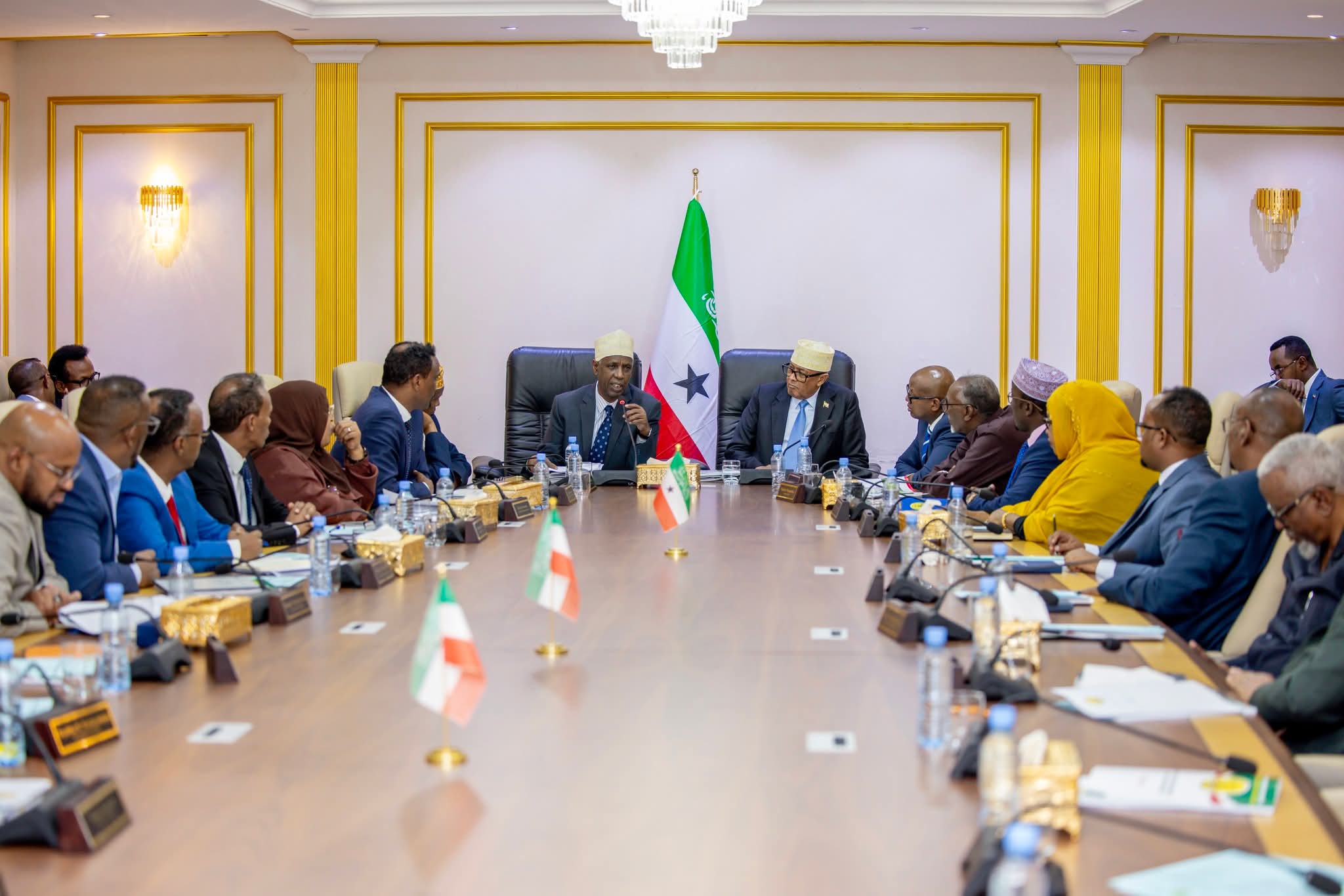
President Abdirahman Mohamed Abdillahi "Cirro" chairs the 31st session of Somaliland's Cabinet, joined by Vice President Mohamed Ali Aw Abdi at the Presidential Palace in Hargeisa.
Hargeisa – The 31st session of the Council of Ministers of the Republic of Somaliland, chaired by President Abdirahman Mohamed Abdillahi “Cirro” alongside Vice President Mohamed Ali Aw Abdi, was convened today at the Presidential Palace. The meeting brought together senior government officials and ministers to deliberate on a range of pressing national issues, including drought relief, security, economic development, the regulation of government and non-governmental organizations, public-private partnerships, and legislative reforms in the fisheries sector.
The discussions reflected the government’s ongoing efforts to address both immediate humanitarian challenges and long-term development goals, with contributions from key ministers and officials providing detailed reports on their respective sectors.
Vice President Mohamed Ali Aw Abdi, who also serves as Chairman of the National Drought Relief Committee, opened the briefing by outlining the current state of the country’s d rought crisis. He reported that government-led relief efforts were progressing steadily in many areas, with the recent rains in parts of western Somaliland offering some respite from severe water shortages. These rains, he noted, had eased water scarcity in affected districts, though food insecurity in those regions remained largely unchanged.
The Vice President cautioned that the situation in the eastern regions of the country was worsening, with a shortage of water spreading from eastern Sanaag through Saaxil, Saraar, and into the Hawd area of Togdheer. In response, the drought relief committee had mobilized resources to deliver water to these areas and was actively coordinating the collection and distribution of all forms of aid — including financial support, supplies, and water — to assist those most affected by the drought.
On matters of national security, Minister of Interior and Internal Security Abdalle Mohamed Carab informed the Cabinet that Somaliland’s overall security situation remained stable across all six regions of the country. He emphasized that political stability and public order were intact, with the exception of isolated incidents of everyday criminal activity and frequent road accidents, the latter being a leading cause of fatalities in the country.
The economic and fiscal situation was presented by Ismail Mowlid Abdillahi, Minister of State at the Ministry of Finance and Economic Development. He reported that revenue collection for August 2025 was on track with government projections, crediting the results to the ministry’s intensive efforts. He also updated the Cabinet on the preparation of the 2026 national budget, explaining that all necessary economic reports, policy priorities, and foundational documents had been completed in accordance with the budget preparation schedule. Circulars for the budget had already been distributed to central government agencies, revenue-generating bodies, and local governments.
The minister added that work was progressing on economic growth plans and studies led by the Cabinet’s High Economic Council. These initiatives are intended to strengthen Somaliland’s economy by enhancing production capacity, encouraging investment, and improving resource management.
Minister of Planning and National Development Kaltuun Sheikh Hassan Abdi addressed the Cabinet on the registration of both governmental and non-governmental organizations operating in Somaliland. She explained in detail the legal frameworks, procedures, and requirements for registering such entities. All organizations seeking registration are required to submit a project proposal, donor agreements, a detailed budget breakdown, and a project log form to the ministry. She underscored the importance of maintaining an accurate and modern database of all registered entities, enabling the government to monitor their activities and prevent duplication of efforts or misuse of resources.
On the matter of public-private partnerships, Minister of Investment and Industrial Development Saciid Mohamed Buraale, together with Attorney General Ali Baashe Mohamed, presented a draft law that they described as a crucial tool for unlocking new economic opportunities. The proposed legislation, they said, would enable the government to form strategic partnerships with private sector enterprises, thereby attracting additional investment, accessing technical expertise, and leveraging modern technology. The law would empower both the government and private companies to jointly execute major national projects, sharing both profits and risks.
The fisheries sector was also on the agenda, with Deputy Minister of Fisheries and Marine Resources Sharmaarke Abdi Muse and Attorney General Ali Baashe Mohamed presenting amendments to Fisheries Law No. 84/2025. The Deputy Minister outlined the main objectives behind the revisions, which include aligning the law with recent administrative changes in the ministry, ensuring that fisheries — as a key sector of the economy — contribute more effectively to national economic growth, harmonizing the law with international regulations governing the blue economy, and establishing a robust management system to support investment, administration, and conservation of Somaliland’s marine resources.
As the session concluded, President Cirro commended 10 ministries for their six-month performance reports, praising their achievements and dedication. The ministries recognized were: Justice and Judicial Affairs; Interior and National Security; Environment and Climate Change; Foreign Affairs and International Cooperation; Planning and National Development; Communications and Technology; Fisheries and Marine Resources; Health Development; Religion and Endowments; and Public Works, Land, and Housing.
The President encouraged all ministries to continue their efforts with the same level of commitment, emphasizing that the progress of the nation depends on coordinated action, transparent governance, and responsiveness to the needs of the people.
Today’s meeting highlighted the Somaliland government’s determination to address immediate humanitarian crises such as drought, while simultaneously laying the groundwork for sustainable economic development, improved governance, and strengthened public-private collaboration. By tackling security, economic planning, resource management, and legislative reform in a single session, the Council of Ministers demonstrated an integrated approach to national policy-making, with the overarching goal of ensuring stability, growth, and prosperity for the nation.

