


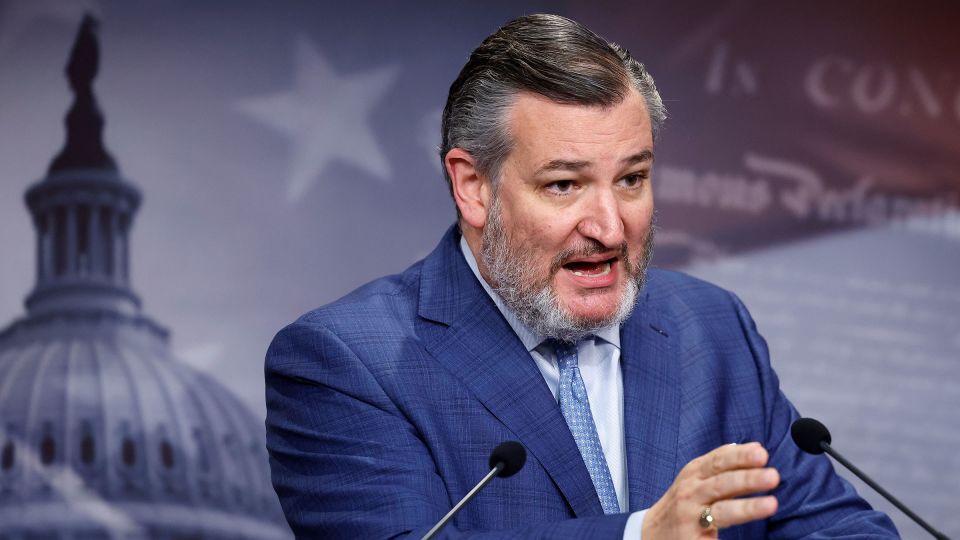
© Chip Somodevilla/Getty Images
A leading Republican senator calls for the U.S. to formally recognize Somaliland, framing it as a vital ally in counterterrorism, maritime security, and great-power competition in the Horn of Africa.
×
![Enlarged view]()
In his letter, Cruz frames Somaliland not merely as a regional actor but as a strategically indispensable partner for the United States in the Horn of Africa. He underscores its importance in both security and diplomacy, portraying the territory as a stable and capable ally in a volatile region where governance failures and extremist threats persist. “Somaliland has emerged as a critical security and diplomatic partner for the United States, helping America advance our national security interests in the Horn of Africa and beyond,” Cruz writes, drawing attention to its geographic and military significance.
Somaliland, located along the Gulf of Aden, sits adjacent to one of the world’s busiest and most strategically sensitive maritime corridors — a choke point for global trade and energy supplies. Cruz points out that the territory has well-trained security forces and has been an active participant in counterterrorism and anti-piracy operations that bolster regional stability and safeguard international shipping lanes. He also highlights Somaliland’s diplomatic openness, citing the establishment of a Taiwanese Representative Office in Hargeisa, its outreach to Israel, and its public endorsement of the Abraham Accords as evidence of its alignment with U.S. and allied interests.
In his appeal to President Trump, Cruz stresses that the recognition of Somaliland’s independence is not just symbolic but operationally critical. “Somaliland remains committed to forging closer ties with the U.S., and is actively engaged in enhancing military cooperation, counterterrorism efforts, and economic and trade partnerships,” he notes. “To do so to the greatest effect, and the greatest benefit to American national security interests, it requires the status of a state. I urge you to grant it that recognition.”
The letter carries particular weight because Cruz is not only a senior figure in Republican politics but also represents Texas, a Republican stronghold that plays an outsized role in shaping the party’s agenda. His intervention signals that the recognition of Somaliland is no longer a fringe issue but one gaining traction among influential lawmakers who have the President’s ear.
This development follows closely on the heels of a related legislative move in the House of Representatives. Just two months earlier, Congressman Scott Perry of Pennsylvania introduced the Republic of Somaliland Independence Act, a bill that would formally recognize Somaliland as an independent country and authorize the President to take the necessary diplomatic steps. Perry’s argument mirrors Cruz’s, asserting that Somaliland already operates as a fully functional state, distinct from Somalia’s central government in Mogadishu, which remains mired in political instability, conflict, and governance crises.
View the Full Letter from Senator Ted Cruz
Click to open the official PDF document from the U.S. Senate.
Ted Cruz
Perry’s proposal emphasized that Somaliland has maintained its own democratic institutions, independent political system, and functioning security apparatus for decades, making it a de facto sovereign nation in all but international recognition. In contrast, Mogadishu continues to grapple with violent insurgencies, rampant corruption, and fragmented authority, often relying on foreign military support to maintain even partial control of its territory.
Cruz’s letter to Trump represents a significant escalation in political pressure on the White House to act. While Somaliland has quietly enjoyed increasing engagement with U.S. officials over the years — particularly in areas of counterterrorism cooperation and maritime security — Washington has stopped short of granting formal recognition, largely due to concerns over African Union consensus and the potential diplomatic fallout with Somalia’s internationally recognized government.
However, Cruz’s intervention reframes the discussion within a broader geopolitical context. By portraying Somaliland as a reliable and willing ally amid intensifying great-power competition in the Red Sea and Gulf of Aden, he implicitly challenges the traditional caution that has defined U.S. policy. With China deepening its presence in Djibouti — home to both a Chinese military base and America’s only permanent military installation in Africa — and Russia seeking to expand its own strategic foothold in the region, proponents of recognition argue that the U.S. cannot afford to overlook Somaliland’s potential as a partner.
From a security standpoint, the senator’s emphasis on Somaliland’s operational capabilities — particularly its role in maritime safety and counter-extremism — taps into longstanding U.S. concerns about instability spilling over into vital trade routes. Somali piracy in the late 2000s disrupted global shipping and forced the deployment of multinational naval patrols. Although piracy has waned, the underlying instability in southern Somalia, combined with the persistent threat of al-Shabaab, ensures that the risk remains. Recognizing Somaliland, Cruz suggests, would anchor U.S. influence in a part of the Horn of Africa that has proven both capable and cooperative.
From a diplomatic perspective, Cruz’s praise for Somaliland’s international outreach underscores its willingness to align with U.S. foreign policy priorities. The decision to host a Taiwanese representative office, despite pressure from China, reflects an independent foreign policy that resonates with U.S. efforts to counter Beijing’s influence globally. Similarly, its overtures toward Israel and endorsement of the Abraham Accords align with a broader U.S. strategy of building regional coalitions that include African and Middle Eastern partners.
Economically, recognition could open the door to expanded bilateral trade and investment, especially in infrastructure, energy, and logistics. Somaliland’s deepwater port of Berbera — already undergoing significant development with Emirati investment — could become a strategic hub for U.S. and allied commercial and military activity, providing an alternative to congested or politically sensitive ports in the region.
Cruz’s call also reflects an emerging bipartisan undercurrent in U.S. policy circles, where Somaliland is increasingly viewed not as a secessionist problem to be managed but as a model of stability and democratic governance in a troubled region. While the African Union has historically resisted recognition, fearing it could encourage other separatist movements, Somaliland’s proponents argue that its case is unique: it voluntarily merged with Somalia in 1960 and withdrew from that union in 1991 after years of conflict, restoring the sovereignty it had briefly held at independence.
Whether Cruz’s appeal will translate into immediate policy change remains uncertain. Recognition decisions carry complex diplomatic consequences, and the Trump administration — though often willing to challenge international norms — would need to weigh regional stability, African Union positions, and the reaction of Somalia’s government. Yet the combined push from both the Senate and the House, with influential Republican voices at the forefront, marks a new chapter in Somaliland’s decades-long quest for recognition.
For Hargeisa, the momentum in Washington represents more than symbolic support. If the U.S., as the world’s most influential diplomatic actor, were to break ranks and extend recognition, it could trigger a cascade of endorsements from other nations, opening the door to full membership in international organizations and access to development financing. For now, Somaliland’s leaders will likely watch closely as Cruz’s letter circulates in the West Wing, aware that in U.S. politics, high-level advocacy can sometimes turn distant aspirations into actionable policy.
In the unfolding dynamics of the Horn of Africa, where global powers are competing for influence and security risks remain acute, Cruz’s intervention reframes Somaliland not as a peripheral issue but as a potential cornerstone of U.S. strategy. Whether the Trump administration will seize that opportunity remains to be seen, but the call from one of its most prominent senators ensures that the question of Somaliland’s recognition can no longer be quietly set aside.

