

© Julia Demaree Nikhinson/AP
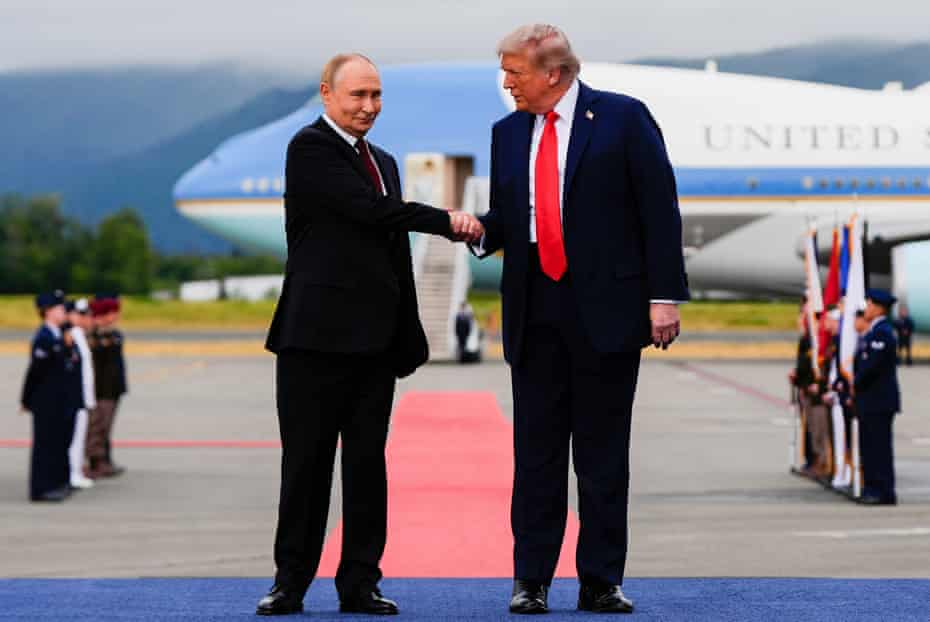
U.S. President Donald Trump and Russian President Vladimir Putin at Joint Base Elmendorf-Richardson in Anchorage, Alaska, August 15, 2025. This Trump-Putin Alaska summit highlights discussions on Ukraine, NATO relations, and global security amid heightened geopolitical tensions.
×
![Enlarged view of Trump-Putin Alaska summit meeting]()
ALASKA - a land of icy wilderness, historic symbolism, and geopolitical weight, became the unexpected setting of one of the most anticipated political meetings in years when U.S. President Donald Trump and Russian President Vladimir Putin met face to face on August 15, 2025. The summit, held at Joint Base Elmendorf-Richardson in Anchorage, was billed as a potential turning point in the war in Ukraine and an opportunity for the United States and Russia to reset a fractured global order. Instead, after hours of high-profile engagement, ceremonial gestures, and soaring expectations, the summit concluded without a ceasefire, without a peace deal, and without any clear path forward, leaving analysts, allies, and critics divided over its meaning.
From the start, the summit was steeped in symbolism. Trump and Putin greeted each other warmly on the red carpet, with Trump uncharacteristically applauding Putin’s arrival. The two then shared an unprecedented ride together in the U.S. presidential limousine, “The Beast,” before the start of talks. The dramatic entry was capped by a B-2 stealth bomber flyover, a military display designed as both a show of American strength and a reminder of the stakes. For many, this juxtaposition of cordiality and power theater illustrated the contradictions of the moment: an American president trying to strike personal chemistry with a Russian leader seen in the West as an aggressor, all while attempting to signal toughness through military imagery.
Behind closed doors, the two leaders spent nearly three hours in what sources described as intense yet inconclusive talks. Trump, who had publicly predicted that a ceasefire in Ukraine could be achieved “today,” failed to secure any tangible agreement. Putin, for his part, emerged with what analysts described as a public relations victory: the optics of being treated as an equal partner on the world stage, without having to concede any significant ground on Ukraine. Trump later told reporters that progress had been made, using his signature phrase, “There’s no deal until there’s a deal,” but critics noted that his words fell far short of the dramatic promises he had made going into the summit.
Putin was more measured, speaking of “understandings” reached with Trump but offering no specifics. He also issued a warning to European leaders not to interfere in what he portrayed as constructive dialogue. For Ukrainians, however, the meeting was deeply unsettling. President Volodymyr Zelenskyy was excluded from the talks, a decision that sparked anger in Kyiv and frustration among European allies. Many saw this as a dangerous precedent: Ukraine’s future being discussed without its elected leader in the room.
Observers noted that Trump’s strategy seemed focused on creating the image of progress rather than achieving substantive breakthroughs. His decision to ride with Putin, smile broadly, and later praise the Russian leader was seen by critics as overly deferential. A leaked Kremlin video later reinforced these concerns, showing Trump in behind-the-scenes moments beaming at Putin, shaking his hand with enthusiasm, and even exchanging light banter with Putin’s translator. While Trump’s supporters defended the gestures as “relationship-building,” detractors argued that they handed Putin legitimacy at a time when Russia continues to wage war in Ukraine.
The summit also highlighted Trump’s transactional approach to diplomacy. In remarks afterward, he insisted that he was willing to walk away from future meetings if no deal was reached but also portrayed the summit as a success because of the personal rapport he shared with Putin. For many in Washington and across Europe, this raised questions about whether Trump’s style prioritizes image over substance. Allies in NATO expressed concern that the exclusion of Zelenskyy and the lack of clear commitments undermined Western unity at a critical moment.
Alaska itself added layers of symbolism to the summit. Once a Russian territory sold to the United States in 1867, it has long stood as a reminder of shifting power dynamics between the two nations. Hosting the meeting there, rather than in Washington or Moscow, underscored both its strategic location—closer to Russia than any other U.S. state—and its Cold War heritage. For historians, the choice of venue was as much a message as the summit itself: a stage where past, present, and future converged in a drama of superpower politics.
Yet the absence of results left a vacuum quickly filled with speculation. Some analysts suggested that Putin had succeeded in using the summit to buy more time on the battlefield while enhancing his stature abroad. Others argued that Trump, ever the showman, prioritized optics because he believes image can eventually lead to leverage. Still, the reality remained stark: the war in Ukraine continued unabated, Russia’s territorial ambitions were unchanged, and the United States offered no new commitments to support Kyiv beyond vague assurances.
Domestically, Trump’s handling of the summit drew mixed reactions. His supporters praised him for engaging Putin directly, arguing that only Trump had the confidence and charisma to make progress where others had failed. They highlighted his willingness to meet without bureaucratic layers as proof of a leader unafraid of bold moves. Critics, however, accused him of weakness, claiming that the summit granted Putin legitimacy without extracting concessions. Editorial boards across major U.S. newspapers were quick to argue that Trump’s performance risked undermining American credibility, especially with NATO allies already wary of his second term.
In Europe, the reaction was one of unease. Leaders in Paris, Berlin, and Brussels privately expressed frustration that Trump appeared to sideline NATO and the EU in favor of bilateral talks with Moscow. For them, the Alaska summit revived fears of a U.S. foreign policy drifting away from multilateralism. Ukrainian officials were even more blunt, with one senior adviser describing the summit as “a stage for Putin’s theater.” Zelenskyy himself, while careful not to criticize Trump directly, emphasized that “Ukraine must always be part of discussions about Ukraine.”
The failure to secure a ceasefire also underscored the enduring challenge of negotiating with Putin. Over two years into the invasion, Russia has entrenched its positions in occupied territories and shows little sign of retreat. Western intelligence officials believe that Putin sees time as being on his side, betting that global fatigue with the war will eventually pressure Ukraine into concessions. By leaving Alaska without an agreement, Trump arguably played into that calculation, whether intentionally or not.
Still, some analysts suggested that the summit could set the stage for future negotiations. Even if no deal was reached, the fact that Trump and Putin spoke for hours in person might create openings later. Supporters of this view argued that diplomacy often advances incrementally, and personal rapport can matter. Yet critics countered that without Ukraine’s participation, any framework was inherently flawed.
In the broader context, the Alaska summit revealed as much about Trump’s worldview as it did about U.S.–Russia relations. For Trump, politics is theater, and diplomacy is about creating moments that capture attention. The images of him clapping for Putin, riding together in “The Beast,” and hosting a summit under the shadow of stealth bombers fit perfectly into his style of spectacle-driven leadership. But for many in the international community, these moments felt hollow against the backdrop of a grinding war that has cost tens of thousands of lives.
As the world digested the outcome, attention turned to what comes next. Trump promised to call Zelenskyy and European leaders, but it remained unclear what message he would deliver. Putin returned to Moscow with a strengthened image at home, portraying himself as a statesman in control of events. For Ukraine, the war continued with no sign of relief. For NATO, the summit was another reminder of the fragility of Western unity.
In the end, Alaska’s frozen stage delivered a summit that was heavy on drama and light on substance. It underscored the difficulty of reconciling Trump’s showmanship with the harsh realities of international conflict. It showed Putin’s ability to extract symbolic victories without making concessions. And it left the war in Ukraine exactly where it was before: unresolved, bloody, and deeply uncertain.
The legacy of the Alaska summit will likely depend on what follows. If future negotiations emerge from this encounter, it may be remembered as a first step toward peace. If not, it will be remembered as a missed opportunity—a performance that granted Putin legitimacy but offered no relief to Ukraine. For now, Alaska stands as the backdrop of a high-stakes meeting that ended with no deal, no ceasefire, and no clarity, only the haunting reality of a war still raging across Eastern Europe.

