

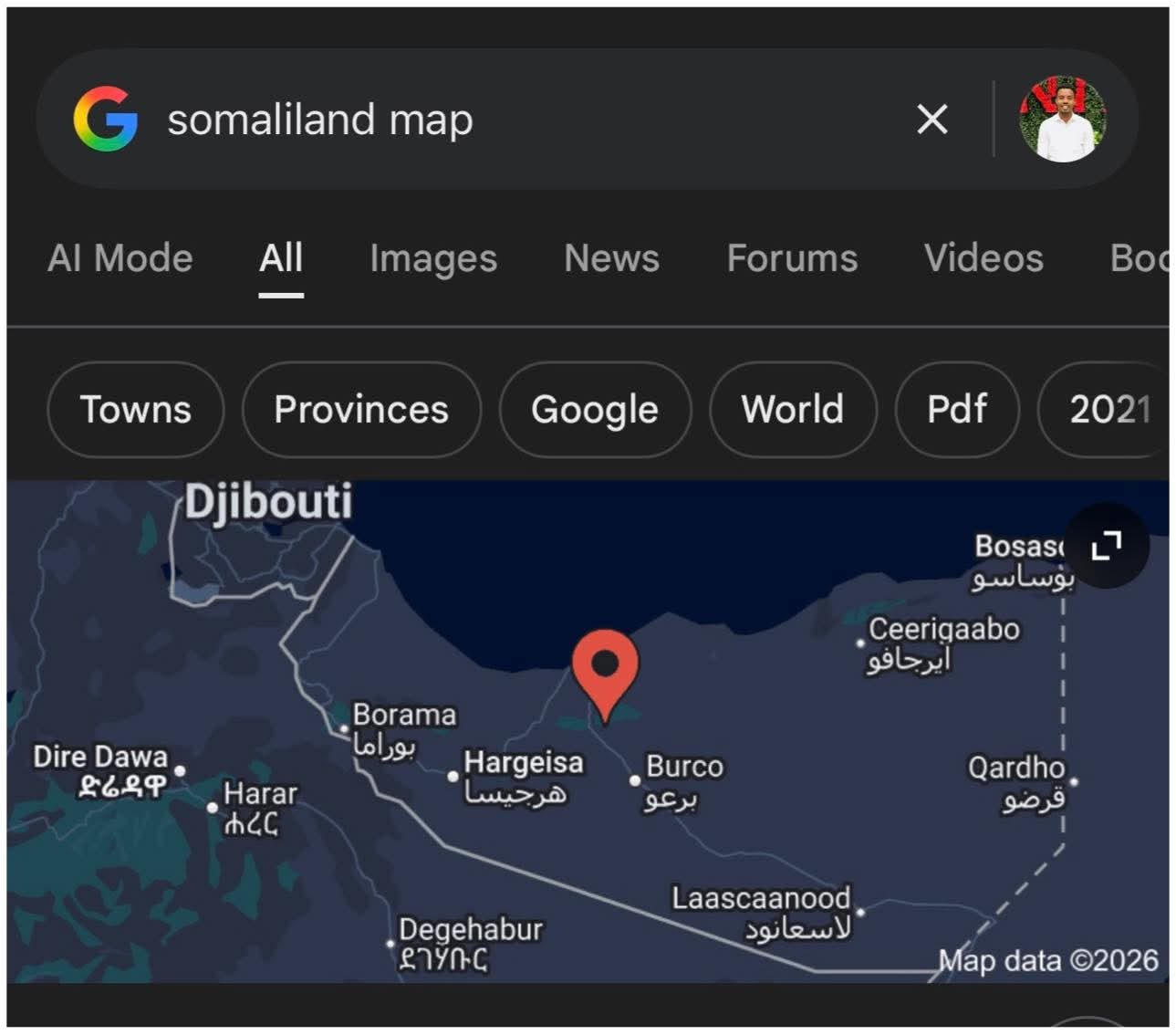
Google Maps display showing Hargeisa within Somaliland, following a user-led correction that restored previously altered border areas between Laawaycado and Yoocada. © BBN
In a notable digital and civic development, Somaliland has successfully influenced Google to correct a mapping issue that had previously removed or altered sections of its territorial boundaries, particularly in the areas between Laawaycado and Yoocada. The update follows a coordinated effort by young Somaliland citizens who raised concerns over inaccuracies in the platform’s geographic representation.
According to local accounts, parts of Somaliland’s map had been either omitted or incorrectly displayed, sparking frustration among residents who viewed the changes as both misleading and politically sensitive. In response, a group of proactive youth initiated a formal complaint process directed at Google, presenting their case with supporting documentation and historical references.
The company reviewed the submission and ultimately accepted the complaint, leading to a revision of the map. The restored version now reflects what supporters describe as the original colonial-era boundaries, aligning with Somaliland’s long-standing claim to its territorial integrity.
This development highlights the growing role of digital platforms in shaping geopolitical narratives, as well as the increasing ability of organized citizens to influence global tech companies. For Somaliland, the correction is being viewed not only as a technical fix but also as a symbolic acknowledgment of its geographical identity in widely used digital systems.
The case also underscores how mapping services, often perceived as neutral tools, can carry significant political weight. With millions relying on Google Maps for navigation and geographic reference, even minor changes can trigger broader debates over borders, recognition, and representation.
For many in Somaliland, the outcome represents a small but meaningful step in asserting their presence on the global stage—achieved not through formal diplomacy, but through civic engagement and persistence in the digital era.

