

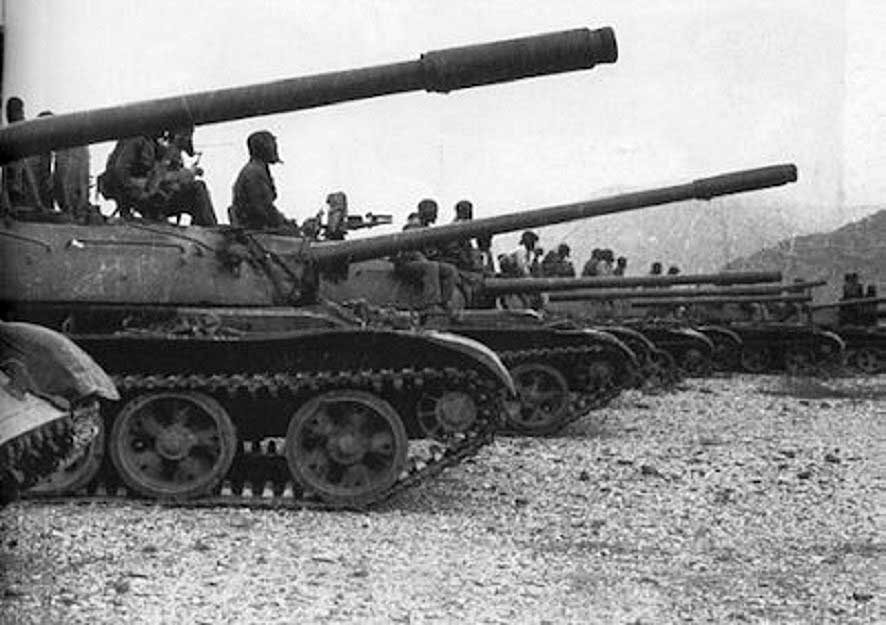
OGADEN: A column of Somali army tanks moves into the Ogaden region in 1977, marking one of the most intense phases of the war with Ethiopia. © BBN
In the history of Somaliland, few moments are as emotionally complex and politically significant as the 1977 war between Somalia and Ethiopia. For many Somalilanders, that war is remembered not just as a conflict across borders, but as a turning point that reshaped trust, alliances, and survival itself.
At the time, people from the northern regions — today’s Somaliland — were among the most heavily involved in the fighting. They were on the front lines, sacrificing lives in a war driven by Somali nationalism and the dream of uniting Somali-inhabited territories. It was a moment filled with hope, but also one that would later bring devastating consequences.
Because not long after that war, the same regions that fought the hardest faced one of the darkest chapters in their history. Cities like Hargeisa and Burao were bombed, civilians were targeted, and thousands were forced to flee. What makes this chapter even more painful is the contrast that followed: while destruction came from within the Somali state, refuge came from across the border.
Ethiopia — once seen only as an enemy — opened its borders to fleeing Somaliland civilians. Families crossed into safety, received shelter, and were given a chance to survive. For many, this created a lasting memory that reshaped how Somalilanders view Ethiopia today.
This is why, when people ask why Somaliland seeks closer relations with Ethiopia — including discussions about maritime access — the answer is not just economic or political. It is historical. It is emotional. It is based on lived experience.
From a strategic perspective, Somaliland’s cooperation with Ethiopia is often framed as mutual benefit. Ethiopia, a landlocked nation, seeks reliable access to the sea. Somaliland, positioned along a critical coastline near the Bab el-Mandeb, seeks investment, recognition, and long-term stability. In this sense, the idea is simple: Ethiopia’s growth can support Somaliland’s development, and Somaliland’s stability can strengthen Ethiopia’s regional security.
Many Somalilanders see this relationship differently from how they view other external powers. It is not just diplomacy — it is proximity, shared interests, and a history that, despite conflict, evolved into cooperation.
There is also a broader regional context. Some voices today criticize Somaliland’s outreach to Ethiopia, especially as talks of recognition grow louder. Yet those criticisms often ignore the historical realities that shaped Somaliland’s decisions. They overlook the years when Somaliland stood alone, and the moments when unexpected allies provided support.
At the same time, the past remains complicated. The 1977 war can be seen, in hindsight, as a strategic miscalculation for the people of Somaliland — a war fought for a larger national vision that did not protect them when it mattered most. But it was also a lesson. A lesson about self-reliance, about understanding geopolitical realities, and about choosing partnerships based on long-term survival rather than ideology.
Today, Somaliland is making decisions rooted in that experience. Its outreach to Ethiopia is not about forgetting the past, but about learning from it.
History does not always offer clear right or wrong answers. But it does leave behind consequences — and those consequences are what shape the choices of nations today.
For Somaliland, 1977 was not just a mistake or a moment of pride. It was the beginning of a new way of thinking — one that continues to define its path forward.

