

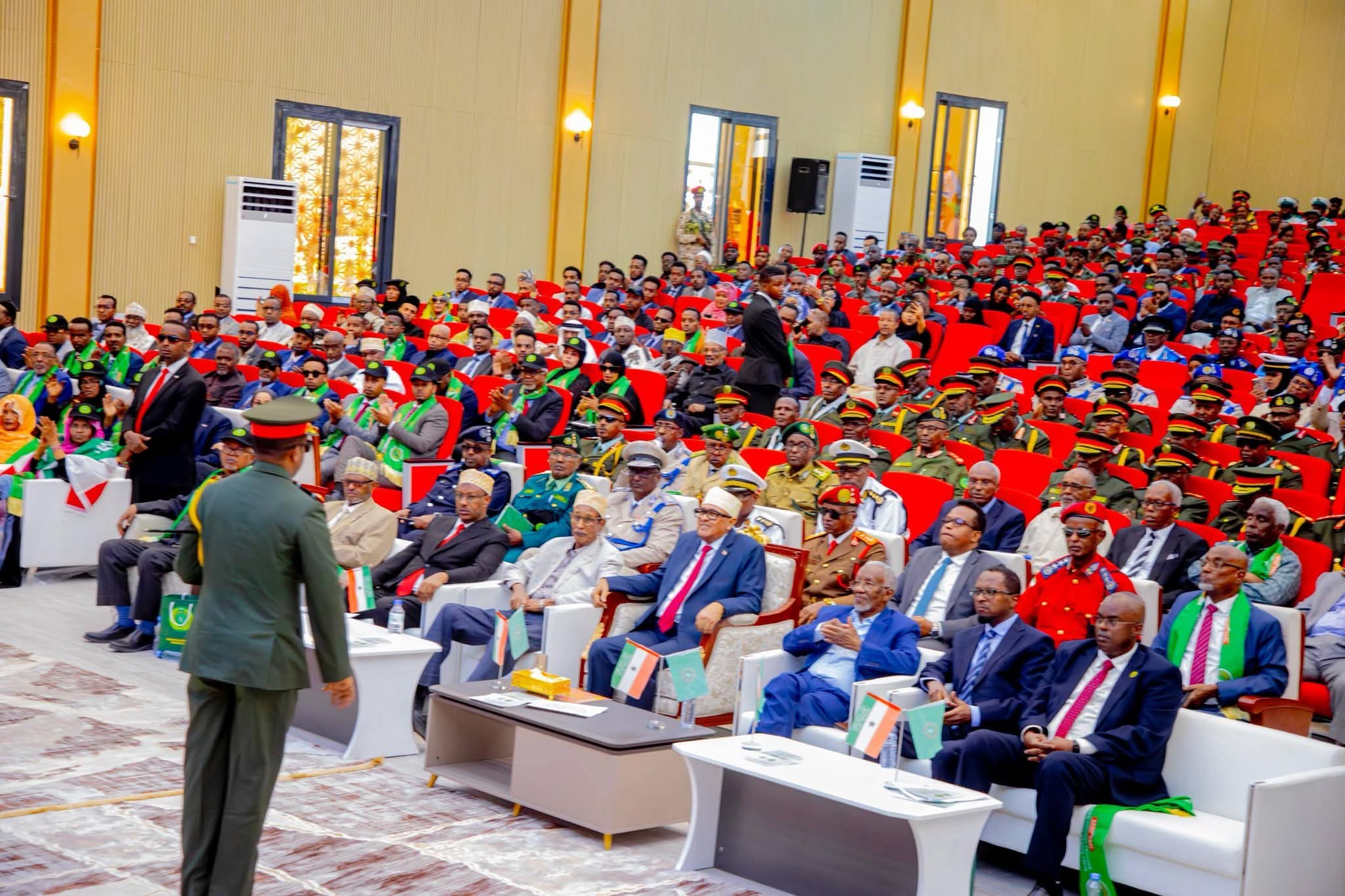
HARGEISA: Senior political leaders, opposition figures, and high-ranking military commanders gather in one hall during the 32nd anniversary of the Somaliland National Armed Forces in Hargeisa, highlighting institutional unity and a single national command structure. © BBN
Hargeisa — Somaliland on Tuesday commemorated the 32nd anniversary of the establishment of its National Armed Forces, an event that highlighted the territory’s long-standing unity, institutional stability, and capacity for self-governance. The ceremony was held at the General Command Headquarters of the Somaliland National Army and was attended by President Abdirahman Mohamed Abdullahi (Cirro), senior military commanders, government officials, and political leaders from across the spectrum.
In his address, President Cirro paid tribute to the commanders and soldiers who lost their lives defending Somaliland’s security, describing the National Army as the foundation of the territory’s peace and political continuity. He emphasized that the armed forces were created through internal reconciliation and collective national effort, uniting former rival groups under one command, one flag, and one national purpose.
The president stated that Somaliland’s army remains the most trusted public institution in the territory, playing a decisive role in maintaining stability for more than three decades without reliance on foreign military forces. He reaffirmed his administration’s commitment to protecting the dignity of the armed forces and strengthening national defense based on Somaliland’s own resources and priorities.
The anniversary came at a time of renewed regional attention on governance in the Horn of Africa. Only days earlier, Somalia faced public controversy after reports that the federal government declined to provide official state security for certain regional leaders, underscoring ongoing challenges related to authority, fragmentation, and institutional cohesion.
While Somaliland’s political leadership, opposition figures, and military command gathered in a single hall to commemorate a unified national army, Somalia continues to struggle with divided power structures and contested state authority. The contrast has revived debate over what defines a functioning government: formal international recognition, or the practical ability to ensure security, unity, and public trust.
For Somaliland, the 32nd anniversary of its National Army served not only as a commemoration but as a statement that effective statehood is demonstrated through durable institutions, national consensus, and the capacity to defend one’s territory.

