

© Jesus Vargas/Getty Images
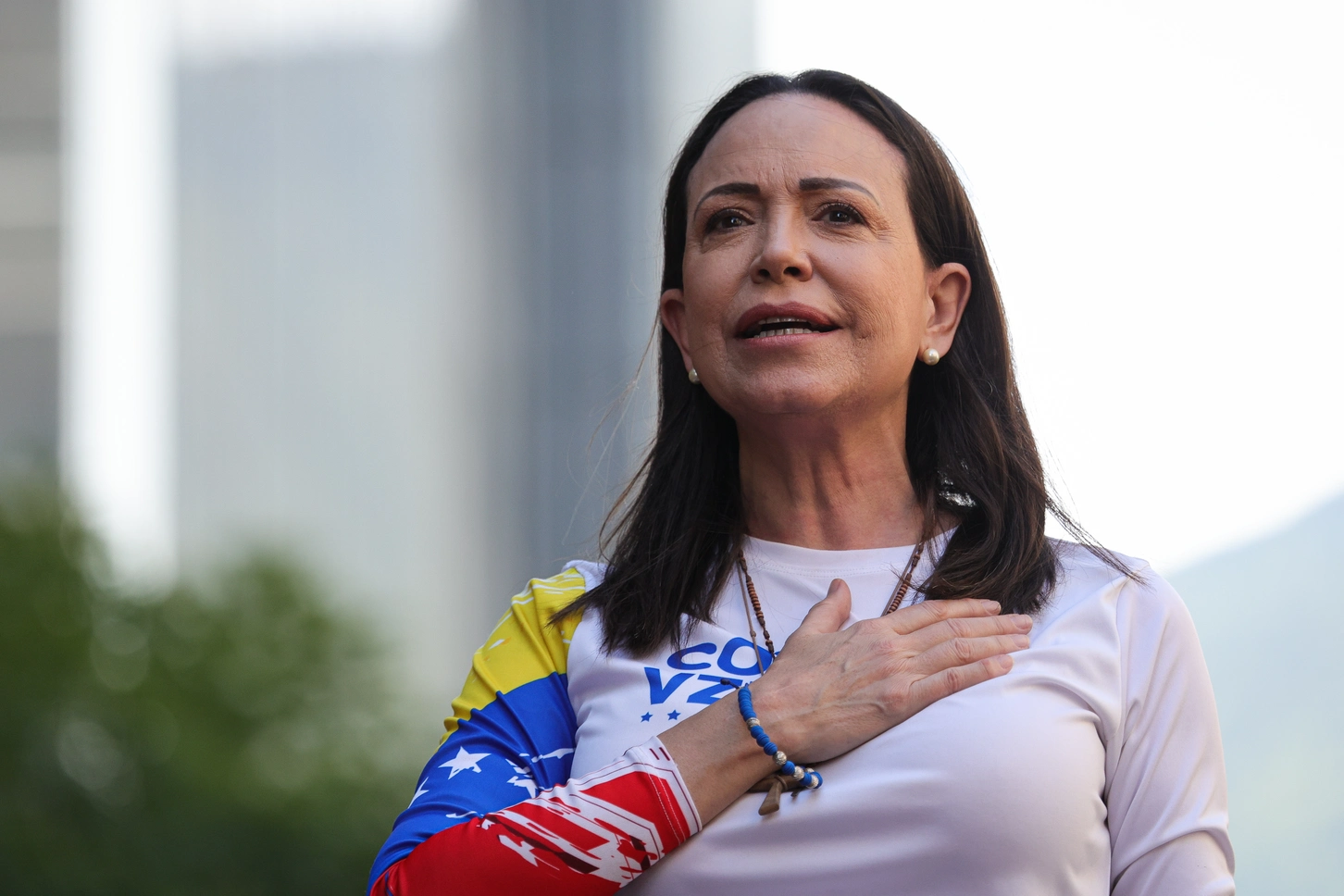
Opposition leader Maria Corina Machado during an anti-government protest on Jan. 9, 2025 in Caracas, Venezuela.
Tap the image or the background to close.
The date holds profound symbolism in Venezuela's tortured political landscape. It marks the 2014 protests, when university students took to the streets of Caracas and beyond, decrying rampant inflation, food shortages, and the erosion of democratic institutions under Maduro's increasingly authoritarian grip. Those demonstrations, which drew hundreds of thousands, were met with brutal force: tear gas, rubber bullets, and live ammunition that left dozens dead and hundreds injured. Machado, then a rising figure in the opposition, was among the voices amplifying the cries for change, her industrial engineer’s precision lending a sharp edge to the moral outrage. Today, as hyperinflation has eased somewhat through desperate economic maneuvers but repression has only deepened, her words evoke that same raw urgency, reminding Venezuelans of unfinished business.
Machado's intervention comes at a pivotal moment for the opposition. Just weeks ago, in early October, the Norwegian Nobel Committee awarded her the Peace Prize for her unwavering commitment to nonviolent resistance and the promotion of democratic values in the face of tyranny. The honor, the first for a Venezuelan, catapulted her global profile even as it intensified the dangers she faces at home. Living in semi-clandestinity since her disqualification from the 2024 presidential race—a move widely seen as electoral sabotage by Maduro’s United Socialist Party of Venezuela—Machado has crisscrossed the country in armored convoys, evading arrest warrants that accuse her of everything from conspiracy to treason. Her Nobel acceptance speech, delivered virtually from an undisclosed location, painted a vivid portrait of a nation in chaos, where over seven million people have fled since 2014, and where arbitrary detentions and extrajudicial killings remain daily perils.
In her latest address, Machado wove personal testimony with broader exhortation. She spoke of the discipline and love that she believes have already defeated Maduro's government in the court of public opinion, insisting that Venezuela’s freedom is near because the people have refused to surrender their dignity. Drawing on the anniversary’s legacy, she invoked the memory of fallen protesters, urging soldiers and police officers—many conscripted from the very impoverished communities Maduro claims to champion—to recognize their shared stake in liberation. “This is a fight for human dignity,” she declared, her voice rising with the cadence of a preacher yet grounded in the logic of cause and effect: obey the regime and you perpetuate suffering; defy it and you hasten the dawn of justice. The two-minute video ends not with a plea but a prophecy: “What is going to happen is already happening.”
The response was immediate and electric. In Caracas’s teeming Altamira district, clusters of young people gathered under sodium lamps, phones aloft, replaying the clip on loop. Social media erupted with testimonials: a nurse in Maracaibo recounting colleagues jailed for treating protesters; a former soldier in Valencia confessing his desertion after witnessing abuses; expatriates in Miami and Madrid organizing virtual vigils. By midnight, #15Noviembre trended worldwide, intertwining Machado’s message with footage from 2014—grainy cell phone videos of riot police charging barricades, juxtaposed with current clips of empty markets and graffiti scrawled on PSUV billboards reading, “Machado Nobel, Maduro Nobel Prize for Repression.”
Yet beneath the digital fervor lies a nation frayed to its seams. Venezuela’s economy, once the richest in Latin America, is a shadow of its former self. Sanctions imposed by the United States and European Union since 2017 have choked petroleum exports, but critics argue Maduro’s mismanagement—marked by corruption scandals involving billions siphoned to loyalists—bears primary blame. Hyperinflation peaked at over one million percent in 2018, forcing bartering in black markets where a kilo of rice could cost a month’s wage. Though fragile dollarization has stabilized prices, poverty afflicts 80 percent of households, and child malnutrition rivals that in conflict zones. Maduro, who assumed power after Hugo Chávez’s death in 2013, clings to control through a mix of electoral theater and tightening security apparatus. The 2024 presidential vote, marred by disqualifications and irregularities, was decried as fraudulent by international observers.
Machado’s strategy has evolved from grassroots organizing to bolder international engagement. In interviews this fall, she has not shied from advocating unconventional measures, including potential U.S. military strikes to neutralize what she calls Maduro’s narco-terrorist structure. Speaking to Bloomberg in late October, she outlined a vision of a post-Maduro Venezuela as an open market, pledging to privatize $1.7 trillion in state assets to attract foreign investment—a proposal that has drawn both applause and criticism. Her alignment with the incoming Trump administration has deepened divisions within the opposition: her faction sees it as a necessary lifeline, while moderates warn of alienating regional partners who favor diplomacy.
The regime’s riposte was swift. State television branded Machado a fascist puppet funded by imperialist overlords, airing montages of her with U.S. lawmakers to stoke nationalist sentiment. Security Minister Diosdado Cabello vowed to hunt down traitors, while pro-government colectivos patrolled opposition strongholds, firing warning shots into the night. Human Rights Watch documented at least fifteen arbitrary arrests in the twenty-four hours following her video, including a student activist detained at a campus rally. Maduro himself dismissed the anniversary as a Yankee-orchestrated farce, pivoting to boasts about agricultural yields that experts say are inflated.
International reactions underscore Venezuela’s position as a geopolitical fault line. The Nobel Committee hailed Machado’s message as a beacon of courage, urging the U.N. Security Council to revisit sanctions. In Washington, Trump’s transition team signaled openness to her proposals. Meanwhile, allies like Russia and Iran condemned her rhetoric, while China called for restraint to protect its loans. In Latin America, the divide remains stark: Colombia’s President Gustavo Petro offered mediation, which Machado rejected, arguing that dialogue with dictators is dialogue with the devil. Even social media communities abroad erupted with debate after she expressed solidarity with Israel in a call with Prime Minister Benjamin Netanyahu.
For Venezuelans, the stakes feel deeply personal. In a country where power outages can last for days and medicine shortages routinely claim lives, Machado represents not just politics but possibility. Her journey from Congress to hiding to the Nobel stage mirrors Venezuela’s own trajectory: promise, collapse, and resilience. As one supporter, a 22-year-old barista in Barquisimeto who fled a 2019 crackdown, put it, “She reminds us we’re not alone. That infamous orders can be refused, one heart at a time.”
Whether her call tips the scales remains uncertain. Venezuela’s history swings between hope and heartbreak. The 2014 protests faded under exhaustion; the 2019 blackout uprising yielded no surrender. Yet Machado’s unyielding posture, amplified by her Nobel recognition, injects fresh momentum. As dawn broke over the Andes on November 16, whispers of unsanctioned gatherings rippled through WhatsApp groups—small acts of defiance that threaten to ignite. In a land where freedom feels close yet distant, her words linger: the regime’s orders may be infamous, but the people’s will is irrevocable.

