

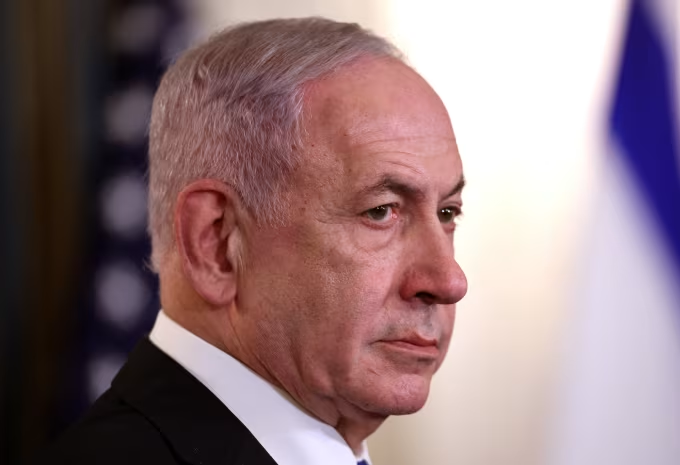
Israeli Prime Minister Benjamin Netanyahu participates in a joint news conference with U.S. President Donald Trump at the White House in Washington on February 15, 2017.
In a move that dramatically escalates the diplomatic and legal fallout from the Gaza conflict, the Istanbul Chief Public Prosecutor's Office has issued domestic arrest warrants for Israeli Prime Minister Benjamin Netanyahu and 36 other senior Israeli officials. The warrants, issued Friday, November 7, 2025, accuse the officials of genocide, crimes against humanity, and war crimes. This unilateral action by Turkey was taken under the contentious legal principle of "universal jurisdiction," which allows a state's national courts to try individuals for the most serious international crimes, regardless of where the acts were committed or the nationality of the accused. The move, which plunges the already-fraught relationship between the two nations to a new low, was immediately condemned by Israel as a "politically motivated judicial farce" and rejected by the United States as an "outrageous and unhelpful overreach."
The list of 37 names attached to the warrants includes not only Prime Minister Netanyahu but also key members of his war cabinet and security establishment, such as Defense Minister Israel Katz and National Security Minister Itamar Ben-Gvir. The Turkish prosecutor's file reportedly cites a litany of alleged crimes, including the intentional targeting of civilians and civilian infrastructure, the use of starvation as a weapon of war, and specific incidents such as the disputed Al-Ahli Baptist Hospital attack from October 2023. The Istanbul prosecutor's office, which has been known to undertake high-profile and politically sensitive cases, argued in its filing that the "failure of the international community to stop the commission of genocide" compelled Turkey to act under its own legal obligations to the Genocide Convention and the principles of universal jurisdiction embedded in its penal code. The practical implication is that any of the 37 named officials would be subject to arrest and prosecution by Turkish authorities if they were to enter Turkish territory, airspace, or waters.
This dramatic national-level intervention comes almost a year after the International Criminal Court (ICC) in The Hague issued its own international arrest warrants for Mr. Netanyahu and his former Defense Minister, Yoav Gallant, on November 21, 2024. That decision by the ICC's Pre-Trial Chamber, which also issued warrants for Hamas military commander Mohammed Deif (killed in July 2024), charged the Israeli leadership with war crimes and crimes against humanity, including starvation of civilians as a method of warfare. The 2024 ICC warrants turned Mr. Netanyahu into the first leader of a Western-backed democracy to be so designated, placing all 125 member states of the Rome Statute under a legal obligation to arrest him should he enter their territory. Turkey, however, is not a signatory to the Rome Statute and thus has no legal obligation to enforce the ICC's warrants. This new action by the Istanbul prosecutor is entirely separate—a domestic legal maneuver that, while symbolically potent, carries different legal weight and implications.
The Israeli government, which has spent the past year in a protracted diplomatic battle to discredit the ICC's jurisdiction and charges, reacted with swift fury to the news from Istanbul. An official spokesperson for the Prime Minister's Office in Jerusalem called the warrants "anti-Semitic" and "an absurd decision made by a prosecutor who is a political tool of the Erdoğan government." The statement further declared that "Israel is a democracy of law, fighting a just war against a genocidal terrorist organization, and will not be deterred by this modern-day Dreyfus trial." Mr. Ben-Gvir, one of the officials named, posted on social media that the warrant was a "badge of honor" and that "the only place this Turkish prosecutor's decision belongs is the dustbin of history." The Israeli foreign ministry is reportedly preparing a formal diplomatic protest and reviewing its diplomatic presence in Ankara, which had already been reduced to a skeletal staff.
The legal foundation for the Turkish warrants, universal jurisdiction, remains a deeply divisive concept in international law. Proponents, including many human rights organizations, view it as a critical tool for ending impunity and holding perpetrators of mass atrocities accountable when their home states or international bodies fail to act. Critics, however, decry it as a violation of state sovereignty that invites politically motivated show trials and judicial chaos, where any nation's prosecutor could attempt to try any foreign official. While several European countries, notably Germany, have successfully used the principle to prosecute lower-level officials for crimes committed in Syria and elsewhere, it has almost never been successfully applied to a sitting head of government from a major, powerful state. The Turkish move is therefore seen as a significant and high-stakes test of the doctrine's limits, one that many legal scholars fear will be seen as "lawfare" rather than a good-faith application of justice.
In Washington, the response was one of sharp disapproval, complicating the already-strained alliance between the U.S. and Turkey, both NATO members. A White House National Security Council spokesperson stated, "We fundamentally reject this move by the Turkish prosecutor. The United States has been clear that the ICC does not have jurisdiction in this matter, and we are equally clear that a domestic Turkish court has absolutely no jurisdiction. This is a counterproductive step that only serves to inflame tensions in the region." The U.S. is already in a difficult position, managing the diplomatic fallout from the ICC's 2024 warrants, which some of its own European allies, like Germany and France, have stated they are legally bound to honor. This new, unilateral action by Turkey adds another layer of complexity, putting Washington in the position of defending its ally, Israel, from legal action taken by another of its strategic, if difficult, allies.
Conversely, human rights groups and many nations in the Global South lauded the Turkish prosecutor's decision. Democracy for the Arab World Now (DAWN), a U.S.-based advocacy group, released a statement praising the action. "Turkey's arrest warrants against Israeli officials demonstrate what all countries with universal jurisdiction can and should do immediately," said its executive director. "Countries have a legal obligation under the Geneva Conventions and Genocide Convention to prosecute or extradite perpetrators of these crimes. Every country should follow Turkey's lead." The organization also called on Turkish authorities to immediately submit the arrest warrants to Interpol, the international policing organization, to request the issuance of "Red Notices," which would alert police forces worldwide. If issued, this would further restrict the travel of the named officials, creating a parallel and separate threat from the outstanding ICC warrants.
The immediate practical consequences for Prime Minister Netanyahu's ability to govern are limited, but his international isolation is now profound. Already forced to meticulously plan any foreign travel to avoid the 125 ICC member states, he must now add Turkey to the list of "no-go" countries. The web of legal jeopardy, originating from both international and national courts, makes high-level diplomacy a logistical and legal minefield. The move is largely symbolic, as no one expects Mr. Netanyahu to visit Turkey, but its power lies in that symbolism. It reinforces the "internationally wanted" status first applied by The Hague and chips away at the "perception that certain individuals are beyond the reach of the law," as one rights group noted last year. This action from Istanbul signals that the legal and diplomatic battles over accountability for the Gaza war are not only continuing but are now fragmenting, moving from a single international body in The Hague to national courts willing to assert their own authority on the world stage. It ensures that even as the conflict itself may have changed in intensity, the legal and political repercussions will continue to reverberate globally, with unpredictable consequences for international law and diplomacy.

