

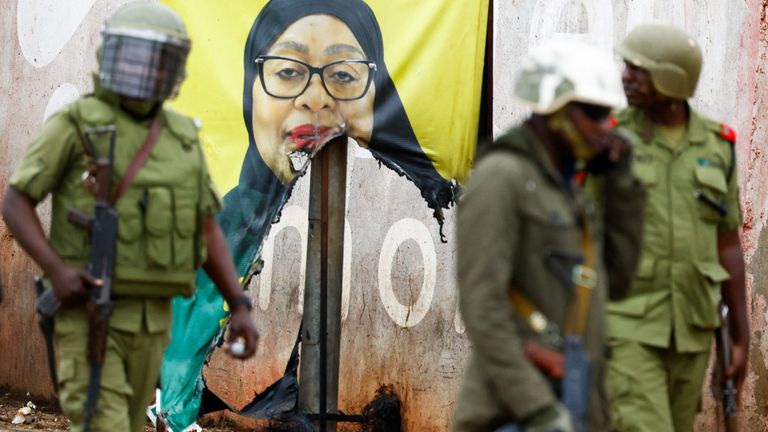
Tanzanian riot police officers walk past a vandalised campaign poster of President Samia Suluhu Hassan.
In the sweltering heat of Dar es Salaam, where the Indian Ocean's relentless waves crash against the shores like a futile protest, Tanzania's electoral commission delivered its verdict on the morning of November 1, 2025. President Julius Nyerere II, the scion of the nation's founding father, had clinched a second term with 58 percent of the vote—a margin as razor-thin as the hope flickering in the eyes of the opposition faithful. But this was no triumphant dawn; it was the spark that ignited a powder keg long primed by whispers of ballot-stuffing, voter intimidation, and the ghostly hand of state machinery pulling strings from the shadows. As jubilant crowds loyal to the ruling Chama Cha Mapinduzi party spilled into the streets waving green-and-yellow flags, the real story unfolded in the hinterlands, where gunfire echoed like thunder and the acrid smoke of burning tires choked the air.
The opposition, led by the fiery orator Aisha Mwinyi, had cried foul from the moment polls closed two weeks prior. Her campaign, a kaleidoscope of youthful energy and promises of land reform, had galvanized a generation weary of the president's iron grip on power. Mwinyi, a 42-year-old lawyer with a voice that could rally the winds, accused the regime of deploying phantom voters in the rural strongholds—ghosts conjured from inflated registries, their ballots cast in the dead of night. International observers from the African Union and the European Union corroborated fragments of the tale: polling stations overrun by party thugs, journalists roughed up and their cameras smashed, and turnout figures that defied statistical sanity. Yet, the commission, stacked with Nyerere appointees, waved away the complaints like monsoon flies, declaring the election "free and fair" in a press release that read more like a eulogy for democracy.
By midday, the unrest had metastasized. In Arusha, near the cradle of humanity's ancient footprints, protesters stormed a government office, setting alight stacks of electoral documents that curled into the sky like vengeful spirits. Security forces, clad in riot gear imported from South Africa, responded with a barrage of rubber bullets and tear gas canisters that turned the dusty streets into a hellish fog. Eyewitnesses, their voices trembling over crackling phone lines to foreign reporters, spoke of live ammunition piercing the chaos—bullets that found homes in the chests of unarmed students chanting for change. The death toll, initially pegged at a dozen, ballooned by evening: 147 confirmed, with hundreds more feared vanished into the maw of unofficial detention centers. Hospitals in Dodoma overflowed with the wounded, surgeons operating by the light of mobile phones as power grids buckled under the strain of sabotage.
This was not mere electioneering gone awry; it was the unraveling of a social contract frayed by years of economic stagnation. Tanzania, blessed with gold mines that glitter like false promises and safari circuits that draw the world's elite, had seen its GDP swell under Nyerere's watch, yet the wealth pooled at the top like rainwater in cracked earth. Youth unemployment hovered at 35 percent, a statistic that translated to idle hands in Mwanza's fishing ports and despairing graduates hawking trinkets in Zanzibar's spice-scented alleys. Mwinyi's platform had tapped into this vein of resentment, pledging to redistribute mining revenues and curb the corruption that saw ministers' families amass fortunes while villagers scavenged for clean water. Her rallies, broadcast on smuggled satellite feeds, painted a vision of a Tanzania unshackled, where the legacy of Ujamaa—Nyerere the Elder's socialist dream—could be reborn without the authoritarian husk.
But the president's camp saw heresy in her words. Nyerere II, a tall man with the bearing of a colonial-era statue, had ruled with a velvet glove over a fist of steel. His first term brought infrastructure booms—highways snaking through the Serengeti, ports humming with Chinese investments—but at the cost of civil liberties eroded like riverbanks in the rainy season. Independent media outlets faced shutterings, their editors exiled to Nairobi's expatriate cafes, while cyber laws muzzled dissent on platforms like X, where hashtags like #TanzaniaRising were algorithmically buried. The election, observers noted, was the culmination of this slow strangulation: opposition agents barred from monitoring rural polls, mobile networks jammed in key districts, and a suspiciously high number of "technical glitches" that invalidated Mwinyi's strong urban showings.
As night fell, the capital braced for siege. Barricades of burning debris lined Uhuru Street, where once Julius Nyerere himself had proclaimed independence in 1961. Families huddled in candlelit homes, radios tuned to BBC Swahili for scraps of truth amid the state broadcaster's paeans to victory. In the international arena, reactions cascaded like dominoes. The United States, fresh from its own shutdown woes, suspended non-essential aid, while the UK's foreign secretary called for "calm restraint" in a statement that rang hollow to those dodging snipers. South Africa's Ramaphosa, ever the mediator, dispatched envoys laden with pleas for dialogue, but whispers in Addis Ababa suggested the African Union might balk at sanctions, fearing a domino effect across the continent's fragile polls.
Amid the melee, stories of individual tragedy pierced the fog of statistics. Take Fatima Juma, a 28-year-old teacher from Morogoro, whose husband, a union organizer, was dragged from their home in the pre-dawn hours. She last saw him bloodied and bound, bundled into a van with tinted windows that vanished into the mist. "He only wanted schools for our children," she told a Reuters stringer, her eyes hollow as the baobab trees that dot the plains. Or Elias Kweka, a 19-year-old student at the University of Dar es Salaam, shot in the leg while livestreaming a peaceful sit-in. Now bandaged in a makeshift clinic, he dreamed aloud of fleeing to Kenya, where cousins promised asylum, but borders sealed tighter than a miser's purse dashed that hope.
The economic aftershocks rippled outward. Foreign investors, from Canadian miners to Qatari hoteliers, hit pause on deals worth billions, their stock tickers flashing red in London and Dubai trading floors. Tourism, the lifeblood of coastal enclaves like Zanzibar, teetered: bookings for next year's migrations canceled en masse, leaving guides like Omar Hassan staring at empty jeeps under acacia shade. "The lions still roar," he quipped bitterly, "but who will come to hear them now?"
Yet, glimmers of defiance persisted. Underground networks of activists, using encrypted apps smuggled via Ugandan borders, coordinated supply drops to besieged neighborhoods—rice sacks and antibiotics parachuted by drone into the night. Mwinyi herself, holed up in a safe house on the outskirts, issued a video manifesto that went viral on VPNs: "This is not the end of our story. The savanna burns, but from its ashes, we rise." Her words, laced with the poetry of Swahili proverbs, stirred embers in the diaspora—from Tanzanians in Toronto's high-rises to those in Johannesburg's townships, wiring funds and amplifying calls for justice.
As dawn broke on November 2, the standoff endured. Nyerere addressed the nation from State House, his voice steady as a drumbeat, vowing "unity against chaos" while troops massed at opposition hubs. The opposition countered with a general strike call, paralyzing ports and markets from Kilimanjaro's slopes to Lake Victoria's shores. Analysts in think tanks from Cape Town to Washington pored over maps, debating whether this was Tanzania's Tiananmen or a catalyst for reform. One thing was certain: the election had cracked open a fissure in the East African giant, one that no amount of official ink could seal. In the end, the true victors might not be counted in ballots, but in the unyielding spirit of a people who, like the Maasai warriors of old, refused to kneel before the storm.
The international press corps, swollen with freelancers from Al Jazeera to The New York Times, navigated checkpoints with baksheesh and bravado, filing dispatches that painted a portrait of a nation at the crossroads. Comparisons to Zimbabwe's Mugabe-era polls abounded, as did fears of a refugee exodus swelling camps in neighboring Rwanda. Human Rights Watch tallied atrocities: 23 women assaulted in custody, children caught in crossfire, elders beaten for harboring fugitives. The UN Security Council scheduled emergency talks, but veto shadows from permanent members loomed large.
Through it all, the ocean at Bagamoyo—where slaves once embarked on doomed voyages—lapped indifferently, a reminder that empires rise and fall, but the tides of history march on. For Tanzania, this disputed dawn was no mere footnote; it was the prologue to a reckoning, where the cost of power was measured not in votes, but in the blood-soaked soil of its sacred lands.

