


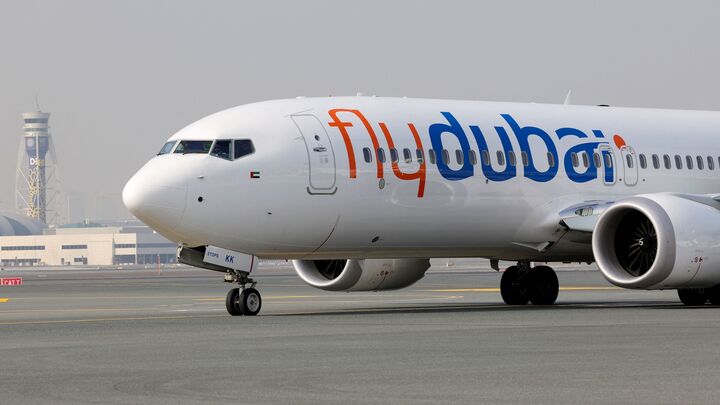
© GIUSEPPE CACACE/AFP via Getty Images
A flydubai Boeing 737 MAX taxis at Dubai International Airport in Dubai, on Nov. 22, 2023.
Subscribe to BBN Daily
Thank You!
We've received your request. Please check your email to confirm your subscription.
In a significant development for aviation and immigration in the Horn of Africa, the International Air Transport Association (IATA), along with major carriers FlyDubai and Ethiopian Airlines, have officially updated their systems to recognize Somaliland's visa-on-arrival policy for travelers heading to Hargeisa and Berbera airports. This move comes at a critical juncture, as the United States has confirmed a major security breach in Somalia's newly implemented e-Visa system, exposing sensitive personal data of thousands of applicants and raising urgent concerns over cybersecurity and traveler safety.
The updates from IATA, a global trade association representing over 300 airlines, mark a pivotal acknowledgment of Somaliland's autonomous immigration controls. Through its Timatic database—widely used by airlines worldwide for travel documentation verification—IATA now lists Hargeisa International Airport (HGA) as a destination where passengers can obtain a visa upon arrival, explicitly distinguishing it from Somalia's federal requirements. This adjustment aligns with Somaliland's longstanding policy, which allows eligible nationals from most countries, including the US, UK, EU states, and others, to secure entry permits directly at border points without prior online application. FlyDubai quickly followed suit, revising its travel advisories to confirm that no Somalia e-Visa is required for flights to HGA or Berbera International Airport (BBO), emphasizing instead the validity of Somaliland's on-site process. Ethiopian Airlines, a key operator on regional routes, issued a similar bulletin clarifying that passengers bound for Somaliland are exempt from Somalia's e-Visa mandates, reaffirming the territory's independent border management.
These changes underscore the growing international friction between Somaliland and Somalia over sovereignty, airspace, and travel protocols. Somaliland, which declared independence from Somalia in 1991 and has since operated as a de facto state with its own government, currency, and security forces, has repeatedly rejected Mogadishu's attempts to impose federal immigration rules. In early November, Somaliland's President Abdirahman Mohamed Abdillahi Irro announced that visas issued via Somalia's e-Visa platform—launched in September 2025 to streamline entries and boost revenue—hold no legal validity within Somaliland's borders. Authorities in Hargeisa instructed airlines to cease enforcing the e-Visa for Somaliland-bound flights, warning of penalties including revoked landing rights for non-compliance. This stance was bolstered by Somaliland's recent enforcement of full airspace control, requiring overflight permits from its Civil Aviation and Airports Authority and installing advanced radar systems to monitor its skies independently.
The timing of these aviation endorsements could not be more poignant, coinciding with revelations of a catastrophic data breach in Somalia's e-Visa infrastructure. On November 11, 2025, the US Embassy in Somalia issued an urgent alert detailing how unidentified hackers had infiltrated the system, potentially compromising the personal information of at least 35,000 applicants, including thousands of American citizens. Leaked records reportedly included full names, passport photos, dates and places of birth, email addresses, marital status, and home addresses—details ripe for exploitation by cybercriminals or terrorist groups like Al-Shabaab, which maintains a strong presence in parts of Somalia. Cybersecurity experts have labeled the incident a "national security disaster," highlighting chronic vulnerabilities in Mogadishu's digital systems and questioning the platform's reliability just months after its mandatory rollout. The breach has prompted travel warnings from multiple governments, with the US advising citizens to monitor for identity theft and avoid the system altogether for now.
For airlines previously caught in the crossfire, the shift represents relief amid legal and operational headaches. Somalia's Civil Aviation Authority had admonished FlyDubai and Ethiopian Airlines for allowing passengers without e-Visas to board Somaliland flights, threatening sanctions and accusing them of undermining federal sovereignty. Travelers, too, faced confusion and stranding risks, with reports of Somalilanders and foreigners double-charged or denied boarding due to conflicting rules. Now, with IATA's backing, carriers can confidently direct passengers to Somaliland's visa-on-arrival option, which costs around $60-80 and is processed efficiently at airports. United Airlines has echoed this guidance in advisories for US travelers, recommending the on-arrival process while noting Somaliland's stable security relative to Somalia.
Somaliland officials hail the developments as a "major breakthrough" in affirming their sovereignty, particularly in aviation—a sector vital to the territory's economy through remittances, trade, and emerging tourism. With flights diverted from its airspace in recent weeks due to the dispute, Hargeisa's move to ICAO-aligned standards could pave the way for broader recognition, including full Flight Information Region (FIR) certification. Critics in Mogadishu, however, decry the airlines' pivot as interference in Somalia's unity efforts, vowing to pursue legal action in international forums. As the e-Visa fallout lingers, with exposed data circulating on the dark web, the episode exposes deeper fault lines in the region's fractured governance.
Ultimately, this convergence of events not only eases travel logistics but also spotlights Somaliland's functional autonomy against Somalia's ongoing challenges. For passengers eyeing the Horn of Africa, the message is clear: separate destinations demand separate documents, and in this case, Somaliland's on-arrival welcome stands validated by some of global aviation's heaviest hitters.

