

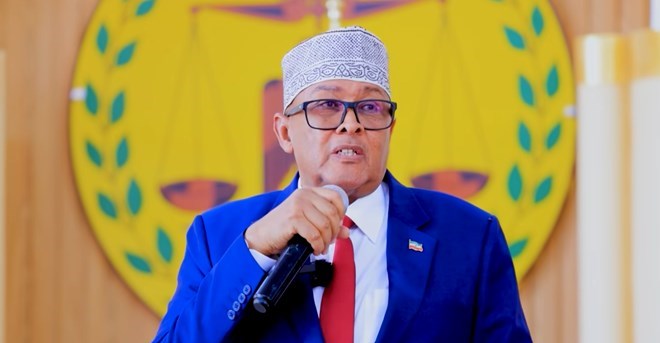
President of Somaliland addressing the nation, symbolizing leadership and progress in the country's ongoing development. © Hiran Online
×
![Enlarged view of Somaliland President addressing the nation]()
Subscribe to BBN Daily
Join our newsletter for the latest news and updates, delivered straight to your inbox.
Thank You!
We've received your request. Please check your email to confirm your subscription.
Hargeisa — Somaliland , the months since President Abdirahman Mohamed Abdillahi “Cirro” assumed office, Somaliland has entered a new chapter in its political journey, marked by policy reforms, infrastructure initiatives, and a renewed effort to engage internationally. Supporters describe this moment as a turning point for the self-declared republic, while analysts stress the need for cautious optimism amid the challenges that remain unresolved.
Cirro’s administration, emerging from a tense political climate and long-standing disputes over governance, has prioritized equal development across Somaliland’s regions. His government has promised to move away from projects concentrated solely in the capital and instead invest in infrastructure, education, and utilities in multiple cities. Observers note that this pledge reflects longstanding grievances in places outside Hargeisa, where residents have often felt neglected compared to the center.
One of the most widely discussed measures taken by the new government has been the reduction of electricity costs across Somaliland. For years, high electricity prices have been a source of frustration for households and businesses alike, with some urban centers reporting average rates of seventy-five cents per kilowatt hour. The Cirro administration has announced a step-down policy, first lowering prices to fifty cents and signaling that further reductions—to as low as twenty cents—may be achieved in the coming months. Economists warn that while the plan offers relief to consumers, it also raises questions about sustainability and how energy providers will cope with reduced revenue. Still, the announcement has been widely welcomed as a gesture toward improving living conditions and stimulating small business growth.
Beyond economic adjustments, Cirro has also turned his attention to the security sector. Somaliland’s armed forces, which have long struggled with limited funding and outdated equipment, have undergone a review and reorganization process under the new administration. Salaries for personnel have been adjusted upward, a move that addresses concerns about morale and retention. In parallel, the government has initiated a housing scheme intended to provide stable accommodation for military families. Officials describe this as an effort not only to reward loyalty but also to professionalize the security institutions that remain central to Somaliland’s stability.
Education has likewise received early attention. The president announced the introduction of a revised national curriculum, alongside plans for new schools and universities. The move underscores a recognition that Somaliland’s youthful population—often described as both its greatest resource and greatest challenge—requires expanded opportunities for learning and training. For many families, education has been a pathway to mobility, yet access and quality have remained uneven. Cirro’s emphasis on education is therefore seen as both a social investment and a political strategy to win support among younger generations.
Internationally, the administration has sought to strengthen Somaliland’s profile through active diplomacy. In recent months, President Cirro has visited regional partners such as Kenya, Djibouti, Qatar, and the United Arab Emirates. His office has also signaled plans for an upcoming trip to the United States, which observers interpret as an effort to deepen ties with diaspora communities and lobby for greater recognition abroad. While Somaliland remains unrecognized as a sovereign state by the international community, these diplomatic overtures are seen as part of a long-term strategy to position the territory as a serious actor on the Horn of Africa stage.
At the same time, Cirro has repeatedly emphasized that these foreign trips are not acts of dependency or requests for handouts. Instead, he has framed them as opportunities for partnership, trade, and shared development. This rhetoric seeks to distinguish Somaliland’s approach from that of neighboring Somalia, where President Hassan Sheikh Mohamud’s government has been criticized for seeking large aid packages from international donors. In a recent example, Mogadishu requested six billion dollars in external support, a move that triggered debates about governance and corruption. In contrast, Somaliland officials have argued that their administration is focused on managing domestic revenues—particularly tax collections—more efficiently to fund internal development.
These parallel narratives underscore the different trajectories of Hargeisa and Mogadishu, even as both grapple with complex internal and external challenges. Analysts caution that while Cirro’s early initiatives have generated optimism, translating promises into sustainable policies will require not only political will but also careful management of limited resources.
The decision to reduce electricity prices across Somaliland has generated both enthusiasm and skepticism. For ordinary households, where energy costs have often consumed a disproportionate share of monthly income, the cut from seventy-five to fifty cents per kilowatt hour has already offered a measure of relief. Small businesses in Hargeisa, Borama, Berbera, and Burao report that the adjustment has allowed them to extend operating hours and reduce overhead costs. A tailor in Burao described the reduction as “a chance to keep the lights on longer without fearing the bill,” while restaurant owners in Berbera noted that cheaper energy helps them preserve food more efficiently and compete with rivals in larger cities.
Yet the story is more complicated for energy suppliers, many of whom have invested heavily in diesel-powered generators or limited renewable infrastructure. Industry representatives caution that abrupt price cuts could destabilize companies that lack subsidies or government-backed incentives. Unless accompanied by parallel investment in renewable energy—such as solar and wind—the new pricing structure may strain providers and potentially slow expansion into underserved rural areas. Government spokespeople argue that plans are underway to support companies during the transition, with future reductions to twenty cents framed as contingent on progress in renewable adoption.
This balancing act between consumer relief and corporate sustainability highlights the broader economic dilemmas faced by the new administration. Somaliland operates in an environment without direct international loans or large-scale development aid, meaning that internal revenue generation and private sector partnerships are critical. Economists point out that while lower energy costs may stimulate growth and attract small-scale investment, the government must ensure that reforms do not create fiscal gaps that undermine broader stability.
Parallel to the energy agenda, Cirro’s reforms in the education sector have sparked debate. The unveiling of a revised national curriculum represents the first such effort in years, aimed at aligning teaching methods with both local needs and international standards. Education officials stress that the new system seeks to blend practical skills with academic training, equipping young Somalilanders for both domestic employment and opportunities abroad. Plans for new schools and universities, announced in Hargeisa earlier this year, suggest a focus on expanding access across multiple regions rather than concentrating resources solely in the capital.
Parents and students have welcomed the announcement with cautious optimism. In rural communities, where classrooms are often overcrowded and resources limited, the promise of new schools carries symbolic weight. However, teachers’ unions have raised questions about whether the government will provide sufficient training, materials, and salaries to make the reforms effective. Without investment in teacher capacity, they argue, new buildings alone will not transform outcomes. Observers also note that Somaliland’s higher education sector is already crowded with private institutions, many of which operate with minimal oversight. Striking a balance between quantity and quality remains one of the core challenges ahead.
The emphasis on education reflects both demographic pressures and political calculation. Roughly seventy percent of Somaliland’s population is under the age of thirty, creating both an opportunity and a risk. If schools and universities can produce skilled graduates, the country may benefit from an energetic workforce capable of driving innovation and growth. If not, high unemployment and frustration could fuel instability. Analysts suggest that Cirro’s government recognizes this duality, which explains the urgency behind its educational agenda.
In the realm of security, the administration’s efforts to reform the armed forces have attracted particular attention. Somaliland’s stability has often been cited as one of its most significant achievements, especially when contrasted with the volatility in southern Somalia. However, the military and police forces have long struggled with limited budgets, outdated infrastructure, and uneven pay. By raising salaries and offering housing projects for personnel, the government aims to professionalize the sector and ensure that loyalty is maintained.
Critics, however, warn that salary increases alone cannot resolve structural issues within the security apparatus. Questions remain about command hierarchy, training standards, and the capacity of the forces to adapt to emerging threats, such as cross-border militancy or organized crime. International partners, particularly in the Gulf and East Africa, have expressed quiet interest in supporting reforms, but the absence of formal recognition complicates direct security cooperation. For now, the government appears intent on projecting an image of discipline and modernization, with several public parades and ceremonies designed to showcase both new recruits and updated equipment.
The symbolic importance of these reforms should not be underestimated. In a region where armed forces are often viewed with suspicion or fear, Cirro’s administration has framed its military agenda as part of a broader social contract. By providing housing and improving welfare, the government positions itself as a caretaker of those who defend national interests. Whether this approach will translate into long-term effectiveness remains an open question, but the immediate political dividends are clear: increased morale within the ranks and positive public sentiment in urban areas.
Together, these economic, educational, and security initiatives form the backbone of Cirro’s early agenda. They also illustrate the complexity of governing an unrecognized state with limited resources but high expectations. The government’s ability to sustain momentum will depend not only on policy design but also on its capacity to manage competing demands and scarce funds.
Diplomacy has long been both an aspiration and a frustration for Somaliland. Since declaring independence from Somalia in 1991, the territory has sought international recognition with limited success. While it has maintained relative peace and stability compared to the south, no country has formally granted it sovereign status. Against this backdrop, President Abdirahman Mohamed Abdillahi Cirro has placed foreign relations at the heart of his early presidency, presenting himself as both a statesman and a salesman of Somaliland’s case to the world.
In recent months, Cirro has embarked on a series of high-profile visits to regional and global partners. His trip to Kenya was closely watched, particularly given Nairobi’s growing interest in the Horn of Africa as both a market and a security partner. Meetings with Kenyan officials centered on trade, investment, and cultural exchange, but observers noted that the symbolism of the visit was as important as the substance. By engaging directly with Kenya, Cirro signaled that Somaliland intended to strengthen its diplomatic profile beyond traditional Gulf allies.
Qatar and the United Arab Emirates have also figured prominently in his early travels. The UAE, already invested in Berbera port development through DP World, has long been seen as a critical economic partner. Cirro’s engagement with Abu Dhabi officials was described by insiders as both cordial and strategic, with discussions ranging from infrastructure investment to renewable energy. Qatar, meanwhile, has presented a different opportunity: balancing Gulf rivalries by demonstrating that Somaliland can engage across political divides. Analysts view these visits as part of a careful balancing act, ensuring that Hargeisa does not become overly dependent on one regional patron while still leveraging competition for its own benefit.
The president’s stop in Djibouti underscored the complexities of neighborhood politics. Djibouti, hosting major international military bases, remains both a competitor and a potential partner for Somaliland. While trade and transport were on the agenda, some analysts believe that Cirro’s real objective was to ease tensions and prevent Djibouti from obstructing Somaliland’s broader diplomatic ambitions. For years, Djibouti has positioned itself as the region’s primary hub for logistics and international engagement, a role potentially threatened by Berbera’s growing prominence. Maintaining a working relationship with Djibouti is therefore essential if Somaliland hopes to advance its recognition campaign without provoking regional friction.
Perhaps the most ambitious element of Cirro’s diplomatic calendar is the proposed visit to the United States. For Somaliland’s large diaspora communities, particularly in Minnesota and Washington, D.C., the trip is seen as an opportunity to build bridges between local political leadership and global advocacy networks. American lawmakers have occasionally expressed interest in Somaliland’s case, citing its democratic elections and relative stability as distinguishing features in a turbulent region. Yet Washington’s official policy remains unchanged: support for Somalia’s territorial integrity.
Cirro’s team has attempted to frame the U.S. visit not as a direct plea for recognition but as an opportunity for dialogue on security, trade, and partnership. By presenting Somaliland as a constructive actor willing to cooperate on issues such as counterterrorism, maritime security, and regional trade, the administration hopes to gradually build momentum. Officials close to the president insist that the narrative is shifting: from one of dependency to one of mutual benefit. As Cirro himself declared in a recent press conference, “We do not travel abroad to beg. We travel to partner, to invest, and to show that Somaliland can contribute to the world as much as it seeks from it.”
This rhetoric draws an implicit contrast with the approach of Mogadishu, where President Hassan Sheikh Mohamud’s government has been associated with appeals for substantial international aid packages. Earlier this year, Somalia requested six billion dollars from global donors, citing urgent fiscal and humanitarian needs. Critics argue that such requests reinforce perceptions of dependency and raise concerns about corruption and mismanagement. In Somaliland, officials have used this contrast to highlight what they portray as their own fiscal discipline, emphasizing that projects are increasingly funded through domestic tax revenues.
The comparison between Hargeisa and Mogadishu is not without risk. Some observers warn that drawing sharp distinctions may antagonize Somalia further, complicating an already tense relationship. Nonetheless, the narrative resonates with many Somalilanders, who see their government as more self-reliant and accountable. International audiences, meanwhile, remain divided: some admire Somaliland’s progress, while others fear that recognizing its independence would destabilize the fragile balance in Somalia.
Beyond recognition, Cirro’s diplomatic strategy appears designed to normalize Somaliland’s presence on the international stage. Each trip, each meeting, and each handshake contributes incrementally to the perception that Hargeisa is not an isolated outpost but an active participant in global affairs. Analysts describe this as “recognition by practice,” even if not by formal declaration. The more Somaliland engages with other governments and institutions, the harder it becomes to ignore its existence.
At home, these foreign visits have been framed as victories. State media has highlighted images of Cirro alongside foreign leaders, presenting the president as a global statesman. Opposition figures have at times questioned the tangible outcomes of the trips, but for many citizens, the symbolism is powerful. In a context where official recognition remains elusive, even small gestures of respect from other countries carry outsized meaning.
Yet the path forward is fraught with uncertainty. While regional allies may offer investment and diplomatic visibility, the absence of recognition from major powers and international organizations continues to limit Somaliland’s options. Membership in the African Union, the United Nations, or global financial institutions remains out of reach. Until that changes, Hargeisa will have to navigate the delicate balance between asserting its independence and working within a system that formally treats it as part of Somalia.
Cirro’s challenge, then, is to sustain momentum without overpromising. His early months have demonstrated ambition and energy, but diplomacy is a long game. The coming years will test whether Somaliland can translate symbolic gestures into concrete partnerships, and whether the new administration can manage expectations at home while lobbying abroad.
As President Cirro’s administration moves through its first year in office, one of its greatest tests will be balancing ambition with the realities of governance. The early initiatives in energy, education, and security have generated optimism, but beneath that optimism lies a complex set of expectations. Somalilanders, weary of stalled progress and political infighting in previous administrations, are looking for tangible change. For the president, this means not only delivering on promises but also managing the frustrations that inevitably arise when reforms take longer than anticipated.
Public expectations are particularly high in rural and regional areas. For decades, communities outside Hargeisa have complained that development projects, government services, and infrastructure investments disproportionately favored the capital. Cirro’s pledge to implement projects equally across all regions struck a chord with these communities, creating anticipation that long-neglected towns will finally see roads, schools, and health facilities improved. Residents in Borama, Las Anod, and Erigavo have expressed cautious hope that their regions will not be overlooked. Yet fulfilling these expectations requires resources that Somaliland’s limited budget may struggle to provide. Analysts note that if visible progress is not made, early goodwill could erode, leading to disappointment and potential disillusionment.
The government also faces the enduring challenge of unemployment. While economic reforms such as reducing electricity costs may stimulate small business growth, they do not automatically translate into large-scale job creation. Youth unemployment remains particularly acute, with many young Somalilanders aspiring to opportunities that the domestic economy cannot yet provide. The risk of brain drain is real: educated youth often look abroad for work, joining diaspora communities in Europe, North America, or the Gulf. Cirro’s emphasis on education reform is partly an attempt to address this challenge, but without parallel job creation strategies, the cycle may continue.
Governance itself is another arena where the administration must tread carefully. Somaliland’s reputation for relative democracy in the Horn of Africa has often been cited as one of its distinguishing strengths. Peaceful transfers of power and competitive elections have bolstered its case for recognition abroad. However, domestic critics caution that the system remains fragile. Political disputes, clan dynamics, and institutional weaknesses continue to shape the landscape. Cirro, a veteran politician with years of parliamentary experience, is seen as well-versed in negotiation and compromise. Still, his ability to maintain unity within his government and avoid factional disputes will be critical to ensuring stability.
Observers are particularly attentive to how the administration manages relations with opposition parties and civil society. In the past, political disputes over election timing and voter registration have led to unrest and accusations of authoritarianism. Cirro has pledged to respect democratic norms and strengthen institutions, but the test will come when disagreements inevitably arise. Analysts argue that Somaliland’s credibility as a democratic entity depends on its willingness to uphold transparent processes even when outcomes are inconvenient for those in power.
Contrasting these challenges with the situation in Somalia provides further perspective. While Somaliland grapples with the difficulty of governing without international recognition, Mogadishu faces the reality of governing with recognition but limited control. President Hassan Sheikh Mohamud’s administration continues to struggle with insurgency, corruption, and political fragmentation. International donors have poured billions into Somalia’s state-building project, yet progress remains fragile. For Somaliland, the contrast is both a source of pride and a rhetorical tool: its leaders argue that they have achieved stability and functionality without comparable levels of foreign assistance.
Yet pride can only go so far. Analysts caution that Somaliland must avoid complacency. The absence of recognition constrains access to international financing, limits trade opportunities, and complicates diplomatic outreach. While the government highlights its ability to manage domestic revenues, the reality is that tax bases remain narrow and external shocks—such as drought or fluctuations in remittances—can quickly destabilize the economy. Without the safety net of international aid or loans, Somaliland’s margin for error is slim.
The administration’s ability to navigate these constraints will shape the country’s broader trajectory. Cirro’s government has signaled that it intends to pursue partnerships with private investors, particularly in infrastructure and renewable energy. If managed well, such partnerships could provide critical support without the political strings often attached to foreign aid. However, ensuring transparency and fairness in these agreements will be vital to avoid accusations of corruption or favoritism.
At the social level, the government faces the enduring task of maintaining cohesion in a society where clan identities remain influential. While Somaliland has prided itself on its relative unity compared to southern Somalia, internal divisions still exist. Development projects that appear unevenly distributed, appointments that seem to favor one group over another, or policies that neglect certain regions could reignite tensions. Cirro’s emphasis on fairness and equality is therefore not just a moral stance but a political necessity.
Looking forward, analysts describe Somaliland’s outlook as a mixture of promise and vulnerability. On the one hand, the territory enjoys relative peace, an experienced political class, and a population invested in its success. On the other hand, structural weaknesses—economic fragility, lack of recognition, and uneven development—pose significant hurdles. The Cirro administration’s challenge will be to harness the promise while mitigating the vulnerabilities, all while sustaining public trust.
For international observers, Somaliland presents a paradox: a territory that demonstrates many of the qualities sought in fragile states—stability, democratic practice, and governance—yet remains outside the formal international system. Whether Cirro’s energetic diplomacy can shift this paradox remains uncertain, but his administration’s domestic agenda will likely shape the credibility of its international case. A government that delivers tangible improvements at home may find greater resonance abroad. Conversely, if domestic frustrations mount, the diplomatic narrative could weaken.
The coming years will thus be decisive. Somaliland’s citizens, both at home and in the diaspora, will be watching closely to see whether Cirro can translate early promises into enduring achievements. The stakes are high, not only for his administration but for the broader project of Somaliland’s statehood.
One of the most notable achievements under President Abdirahman Mohamed Abdillahi Cirro has been the renewed focus on education. The government has moved swiftly to modernize the national curriculum, ensuring that Somaliland’s education system aligns with both regional standards and global expectations. A revised syllabus has been introduced, targeting the development of critical thinking, science, technology, and civic values among students.
In addition to curriculum reforms, the administration has announced the construction of new schools and universities across the country. These institutions are designed not only to accommodate the growing population of students but also to reduce disparities between rural and urban areas in access to quality education. For many families in Somaliland, this has been a welcomed step, as access to affordable and high-quality education remains a top priority.
President Cirro has emphasized that education is the backbone of national progress, highlighting that without skilled citizens, the country’s aspirations for international recognition and sustainable development would be difficult to achieve. Teachers’ salaries have been reviewed, training programs have been expanded, and partnerships with international education organizations have been pursued to strengthen capacity.
This holistic approach is aimed at creating a generation capable of driving Somaliland forward. Students, educators, and parents have all noted visible improvements within a short period, with many expecting that the government’s investments in education will produce long-term benefits for the nation.
President Abdirahman Mohamed Abdillahi Cirro’s administration has made international engagement a central pillar of its early agenda. While Somaliland remains unrecognized by most of the world, Cirro has taken significant steps to establish practical diplomatic relationships, emphasizing trade, security, and regional cooperation.
His visits to countries such as Kenya, Qatar, the United Arab Emirates, and Djibouti have signaled a strategic approach aimed at both building partnerships and enhancing Somaliland’s visibility on the global stage. During his trip to Kenya, discussions focused on economic cooperation, infrastructure development, and cultural exchange. By engaging with Nairobi directly, Cirro sought to reinforce Somaliland’s role in regional commerce and highlight its potential as a stable partner in the Horn of Africa.
In the Gulf region, both the UAE and Qatar have emerged as important partners. The UAE, particularly through its involvement in the Berbera port, has been a longstanding economic collaborator. President Cirro’s engagements with Abu Dhabi officials have focused on expanding investment opportunities in logistics, renewable energy, and urban development projects. Qatar’s role has been more nuanced, providing avenues for diplomatic balancing while strengthening ties through trade and educational initiatives.
Djibouti has remained a key neighbor due to its strategic geographic position and influence over regional shipping and trade routes. Cirro’s administration has approached Djibouti with a combination of diplomacy and pragmatism, ensuring that cooperation continues without escalating regional competition. Analysts suggest that these steps demonstrate Somaliland’s ability to engage neighbors constructively while advancing its national interests.
Perhaps the most anticipated diplomatic endeavor is Cirro’s planned visit to the United States. The trip aims to build ties with the Somaliland diaspora, lobby for development partnerships, and showcase Somaliland’s governance model. U.S. officials have not indicated formal recognition, but informal engagements have created opportunities for dialogue on security cooperation, trade, and investment. Cirro has emphasized that his administration’s goal is partnership rather than dependency, positioning Somaliland as a proactive and responsible actor on the international stage.
By combining domestic achievements with strategic international engagement, the government seeks to strengthen Somaliland’s credibility abroad. Analysts note that while formal recognition may remain distant, practical acknowledgment through trade agreements, educational partnerships, and security cooperation can yield tangible benefits. Cirro’s diplomacy is thus designed to leverage Somaliland’s relative stability, democratic record, and economic potential in order to secure strategic support and investment.
As President Abdirahman Mohamed Abdillahi Cirro’s administration moves forward, Somaliland faces a complex landscape of opportunities and challenges. The early initiatives in energy pricing, education reform, and military restructuring have set a foundation for progress, but sustaining momentum will require careful management of both resources and expectations.
One of the most striking aspects of Somaliland’s current trajectory is the contrast with Somalia. While Mogadishu continues to struggle with insurgency, corruption, and political fragmentation, Hargeisa has maintained relative stability and implemented visible reforms. Somalia’s reliance on international aid—illustrated by requests for billions in external support—contrasts sharply with Somaliland’s efforts to fund projects through domestic revenue collection. For many citizens and observers, this distinction highlights the efficiency and self-reliance of Cirro’s administration.
Yet the absence of formal recognition remains a critical limitation. Without membership in international organizations or access to global financing mechanisms, Somaliland must rely heavily on private investment, diaspora remittances, and creative domestic solutions. President Cirro’s diplomatic engagements—ranging from regional visits to his upcoming trip to the United States—are intended to build partnerships that can offset these constraints. Analysts describe this as a strategy of “practical recognition,” where meaningful international engagement compensates for the lack of formal acknowledgment.
Domestically, the government’s challenge is equally complex. Balancing development across regions, managing high public expectations, and maintaining political cohesion are ongoing tasks. The administration’s policies in education, security, and economic reform are interdependent; success in one area reinforces progress in others. For example, improved education strengthens the workforce, which in turn supports economic growth, while enhanced security ensures a stable environment for investment.
Public sentiment remains cautiously optimistic. Citizens are attentive to the implementation of promises, particularly in regions that have historically been underdeveloped. Rural communities, youth, and small business owners are watching closely to see if reforms translate into tangible improvements in daily life. Analysts suggest that the administration’s credibility will hinge on its ability to deliver measurable results in the coming months and years.
The government’s emphasis on fairness, transparency, and equal distribution of resources is central to sustaining public support. By avoiding favoritism and addressing historical disparities between regions, Cirro aims to reduce tensions and foster national unity. This approach, combined with prudent fiscal management, could strengthen Somaliland’s internal cohesion and enhance its standing in the eyes of international observers.
Looking beyond domestic policy, Somaliland’s trajectory has wider implications for the Horn of Africa. Its relative stability, democratic processes, and growing international engagement offer a model for other territories facing political uncertainty. At the same time, Somaliland’s unrecognized status underscores the limitations of progress without formal acknowledgment, highlighting the delicate interplay between governance, diplomacy, and international legitimacy.
In conclusion, Somaliland under President Abdirahman Mohamed Abdillahi Cirro is navigating a pivotal moment in its history. The administration’s early achievements in governance, infrastructure, education, and diplomacy have generated cautious optimism, both domestically and abroad. While significant challenges remain—particularly in achieving sustainable development, maintaining political cohesion, and securing international recognition—the current trajectory suggests that Somaliland is capable of leveraging its strengths to achieve meaningful progress.
The coming years will be decisive. Success will require balancing ambitious reforms with pragmatic resource management, sustaining public confidence, and continuing to expand Somaliland’s footprint in international diplomacy. If managed effectively, Cirro’s government may not only consolidate domestic stability but also enhance Somaliland’s credibility on the global stage, demonstrating that even unrecognized states can pursue a path of responsible governance and strategic engagement.

