

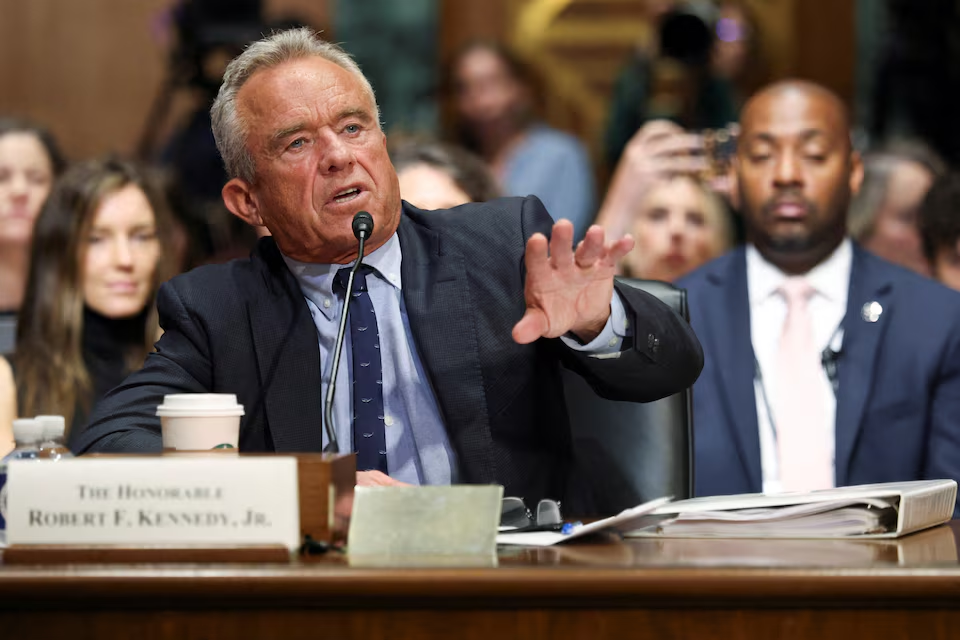
U.S. Health and Human Services Secretary Robert F. Kennedy Jr., testifies before a Senate Finance Committee hearing on President Donald Trump's 2026 health care agenda, on Capitol Hill in Washington, D.C., U.S., September 4, 2025. © REUTERS/Jonathan Ernst
×
![Enlarged view of Robert F. Kennedy Jr. Senate testimony]()
Subscribe to BBN Daily
Join our newsletter for the latest news and updates, delivered straight to your inbox.
Thank You!
We've received your request. Please check your email to confirm your subscription.
Kennedy's appearance before the Senate Finance Committee on September 4 was nothing short of explosive. Lawmakers grilled him for hours on his decisions to overhaul vaccine recommendations, oust key officials, and challenge long-standing public health data. Democratic senators like Elizabeth Warren and Ron Wyden didn't hold back, accusing him of politicizing health agencies and putting lives at risk by limiting access to vaccines. Warren, in particular, lambasted Kennedy for what she called a "reckless disregard for science and the truth," pointing to his history as a vocal critic of vaccines and his role in spreading what many experts deem misinformation. She demanded his resignation, echoing calls from over 1,000 current and former HHS staffers who signed an open letter just days earlier, claiming his actions are "endangering the nation's health." On the Republican side, the response was more mixed—some, like Senators John Barrasso and Bill Cassidy, both physicians themselves, expressed unease about the chaos at the CDC, while others praised Kennedy for shaking up a bureaucracy they see as bloated and ineffective.
Kennedy, never one to shy away from a fight, fired back with equal fervor. He accused his critics of being in the pockets of Big Pharma, citing what he described as rampant corruption in the medical establishment. "We were lied to about everything during the pandemic," he told the committee, referencing the U.S.'s poor performance compared to other nations despite massive spending on health initiatives like Operation Warp Speed. He defended the firing of Monarez, who had been in the job for less than a month after her Senate confirmation in late July, saying she refused to align with his vision for rigorous scientific review and instead acted as a "rubber stamp" for outdated policies. Monarez, in a Wall Street Journal op-ed published shortly after her dismissal, countered that she was ousted for insisting on evidence-based decisions, not political expediency. Kennedy dismissed her claims as lies during the hearing, escalating the drama further. This back-and-forth has only intensified the spotlight on Kennedy's "Make America Healthy Again" agenda, which aims to tackle what he says is an epidemic of chronic diseases plaguing the country.
The InsiderAdvantage poll, which surveyed over 1,000 likely voters, found that 52 percent approve of Kennedy's job performance, with 33 percent disapproving and 15 percent undecided. Interestingly, the survey also touched on public sentiment toward COVID-19 vaccines, with 40 percent of respondents saying they know someone harmed by the shots—a statistic that aligns with Kennedy's narrative but has been hotly debated by health experts. This approval rating marks a potential shift from earlier polls. Back in July 2024, an AP-NORC survey showed that only about half of Americans had a favorable view of Kennedy overall, with deep partisan divides: Republicans were far more likely to view him positively than Democrats. By January 2025, another AP-NORC poll indicated that just 3 in 10 Americans approved of his nomination to HHS, reflecting widespread concern over his anti-vaccine advocacy. Yet, as Kennedy has settled into the role, implementing changes like narrowing COVID-19 vaccine approvals for healthy children and canceling half a billion dollars in mRNA research funding, his support seems to be inching upward, particularly among those frustrated with the status quo in healthcare.
Critics argue that Kennedy's claims about chronic disease rates are exaggerated or misleading. During the hearing, he reiterated a statistic he's used before: that 76.4 percent of Americans now suffer from chronic conditions, up dramatically from around 11 percent in the 1950s. He blamed this on environmental toxins, processed foods, and what he calls institutional failures at agencies like the CDC. But fact-checkers and academics have scrutinized this figure. A PBS analysis noted that while chronic disease rates have indeed risen—due in part to better diagnostics, an aging population, and lifestyle factors—Kennedy's specific 76.4 percent claim appears to stem from a mix of sources, including a government report that some experts say cited nonexistent studies. A BBC investigation in May 2025 revealed that a HHS-commissioned "MAHA" report on childhood chronic diseases included references to phantom research, leading to accusations that Kennedy's team was cherry-picking data to fit a narrative. Kennedy has dismissed these critiques as smears from vested interests, pointing instead to real trends like plummeting life expectancy since 2020 and the obesity crisis fueled by what he calls "chemical-laced" products.
The CDC turmoil has become a flashpoint in this debate. Monarez's firing on August 28 came after tense meetings where she reportedly clashed with Kennedy over vaccine directives. According to a STAT News analysis, behind-the-scenes disputes involved Kennedy pushing for the removal of dedicated experts who wouldn't align with his reforms. Nine former CDC directors responded with a scathing open letter published in The New York Times on September 2, warning that Kennedy's actions are "endangering every American's health" by undermining the agency's integrity. They glorified past initiatives like Operation Warp Speed, which Kennedy has criticized as a rushed catastrophe that enriched pharmaceutical companies without adequate safety checks. Even President Trump, who initially championed the program, has begun questioning aspects of it amid Kennedy's influence. In a recent interview, Trump defended his health secretary, calling him "a very good person who means well," but acknowledging his "different ideas" on vaccines.
Public reaction, as captured on social media platforms like X, reflects this polarization. Conservative commentator Charlie Kirk posted a poll graphic highlighting Kennedy's 52 percent approval, urging followers to "ignore the geriatric haters in the US Senate" and declaring that "We The People have his back 100%." Supporters echoed this sentiment, with users like Jericho praising Kennedy for "standing up to the Big Pharma bullies" and mocking senators in a way that drew laughs during the hearing. Others, such as Mrs. B, shared memes celebrating Kennedy as a "wrecking ball" for the healthcare system. On the flip side, detractors were vocal too. Users like The Sarcastic Canuck questioned Kirk's motives, while Lil Rascal aka Punk dismissed Kennedy's "Make America Healthy Again" push as a fraud, warning that celebrating things like cane sugar in diets would only worsen health outcomes. A post from Chi-Town John contrasted images of healthy and unhealthy figures, implying a stark divide in approaches.
Broader polling from sources like CBS News and The Hill adds nuance. A CBS poll released just yesterday found that while many Americans want vaccines to be more available, a significant portion—particularly Republicans—believe Kennedy's policies are making them less so, yet still approve of his overall direction. The Economist/YouGov survey from earlier this week showed that only 1 in 4 Americans trust Kennedy for medical advice, with 45 percent disapproving of his job performance—a contrast to the InsiderAdvantage numbers that suggests polling variances or shifting opinions. Democrats overwhelmingly disapprove (72 percent per a Pew Research short read from June), while Republicans are more supportive, though even some GOP figures are growing weary, as reported by CNN. Prominent Republicans have started whispering about the need for more oversight, fearing that Kennedy's tumultuous tenure could backfire if a major outbreak like measles occurs, leading to blame on "Big Pharma releasing it to make money," as one X user cynically predicted.
Kennedy's tours, like his recent visits to Colorado and Idaho in July to promote his agenda, have helped bolster his image among grassroots supporters. He's focused on slashing "unhealthy fat" at HHS, as he wrote in a New York Post op-ed in April, and restructuring advisory committees to prioritize what he sees as overlooked issues like pesticides and mobile phone radiation. Allies argue he's finally addressing the root causes of America's health woes, from East Palestine's lingering pollution to the transfer of Big Tobacco scientists to food labs that engineered addictive products. Detractors, including the American Academy of Pediatrics and the American Medical Association—groups Kennedy accuses of being Pharma-funded—counter that his policies are glacial at best and dangerous at worst, with allies complaining he's become inaccessible since confirmation.
As the dust settles from the hearing, the question remains: Can Kennedy sustain this momentum? With Trump standing by him for now, and public approval ticking up despite the backlash, he might just weather the storm. But if outbreaks spike or more insiders revolt, the tide could turn. For now, in a nation still scarred by COVID, Kennedy's blend of populism and skepticism resonates with enough people to keep him in the fight. Whether that's a step toward healthier America or a risky gamble with public health is the debate that will define his legacy.

