


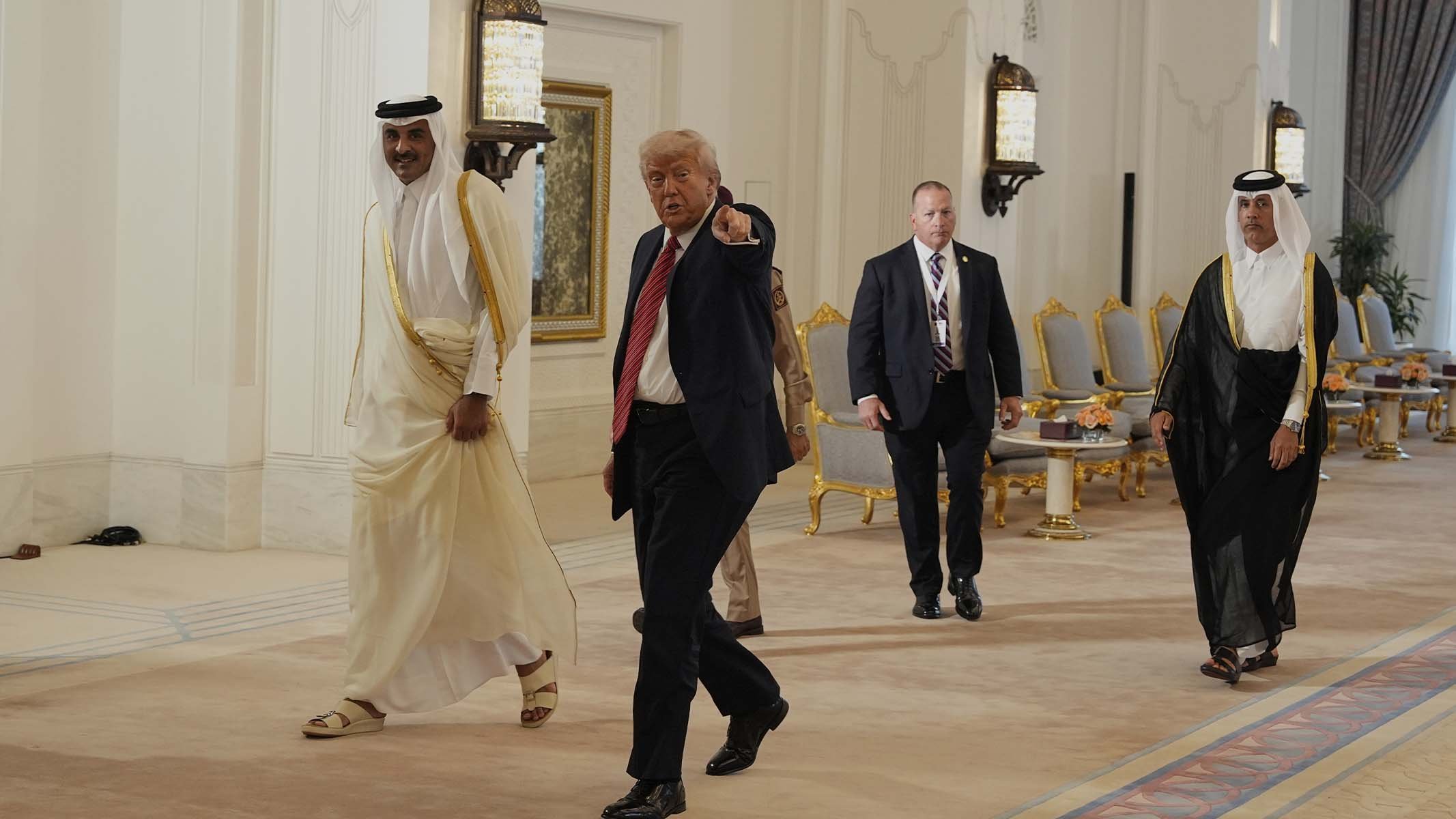
U.S. President Donald Trump meets with Qatari Emir Sheikh Tamim bin Hamad Al Thani during a high-level meeting in Doha.
×
![Enlarged view of Trump meeting with Qatari Emir]()
Subscribe to BBN Daily
Join our newsletter for the latest news and updates, delivered straight to your inbox.
Thank You!
We've received your request. Please check your email to confirm your subscription.
The operation unfolded in the early hours of September 9, with multiple explosions rocking a high-rise building in Doha's diplomatic district, where Hamas negotiators were reportedly meeting to discuss hostage releases and a potential truce in the ongoing Gaza war. Israeli officials confirmed the strike, stating it was aimed at key figures in Hamas's leadership, including those involved in planning attacks against Israel. "If we missed them this time, we'll get them next," Israel's ambassador to the United States, Yechiel Leiter, bluntly told reporters, underscoring Jerusalem's unyielding stance against the militant group. Hamas, for its part, claimed that its top leaders survived the assault unscathed, though it acknowledged the deaths of five lower-ranking members and injuries to several others, including Qatari security personnel. Qatari state media reported one internal security officer killed, labeling the incident a "cowardly terrorist assault" on the nation's sovereignty.
This marks the first known Israeli military action on Qatari soil, a move that shatters the Gulf state's long-held image as a neutral mediator in regional disputes. Qatar, home to the U.S. military's largest base in the Middle East at Al Udeid, has hosted Hamas's political office since 2012 with tacit approval from both Washington and Jerusalem, positioning itself as a key broker in ceasefire talks. The strike's timing—coming just weeks after a shaky January 2025 truce brokered by Doha—suggests a deliberate effort to derail negotiations, critics argue. "This isn't just an attack on Hamas; it's a slap in the face to every diplomat working toward peace," said Sultan Barakat, a professor at Hamad Bin Khalifa University in Doha, who warned that the incident threatens global stability. Indeed, the assault has thrown hostage talks into disarray, with mediators expressing grave doubts about resuming discussions anytime soon.
The United States, Israel's closest ally, found itself in a precarious position. President Donald Trump, speaking from the White House, expressed regret over the strike's location, saying he felt "very badly" about the attack occurring in Doha, a key U.S. partner. However, reports indicate that American officials may have provided advance warning to Qatar—though the timing remains disputed. Qatari Prime Minister Sheikh Mohammed bin Abdulrahman Al Thani claimed the U.S. notification came 10 minutes after the strikes began, contradicting White House assertions of prior notice. Trump's administration has walked a tightrope, offering rare public criticism of Israel while reportedly greenlighting similar operations in the past, such as the June 2025 strike on Iranian nuclear facilities. Analysts suggest this reflects Washington's broader strategy: bolstering Israel against perceived threats from Iran-backed groups like Hamas, while maintaining economic ties with Gulf states. Yet, the incident has prompted questions among Arab allies about the reliability of U.S. protection, with some Gulf powers quietly reassessing their security arrangements.
International reactions poured in swiftly, painting a picture of a world increasingly weary of Israel's aggressive tactics. Saudi Crown Prince Mohammed bin Salman condemned the "brutal aggression" against Qatar, calling for unified Arab, Islamic, and global action to curb Israeli actions. British Prime Minister Keir Starmer echoed this, denouncing the strikes as a violation of sovereignty that risks further regional escalation, while urging an immediate ceasefire in Gaza. Indian Prime Minister Narendra Modi, in a phone call with Qatar's Emir Sheikh Tamim bin Hamad Al Thani, expressed deep concern and reaffirmed India's support for dialogue over violence. Even traditional Israeli allies voiced unease; the European Union called for restraint, and the United Nations Security Council scheduled an emergency session to address the fallout. Russia, meanwhile, labeled the attack a "violation of international law" that exacerbates Middle East tensions. These responses highlight a growing divide: while Western powers temper their criticism with support for Israel's right to self-defense, Arab and Muslim nations see the strike as part of a pattern of unchecked Israeli expansionism, with Qatar now the sixth country targeted by Israel in 2025 alone.
At the heart of the global anxiety is the specter of World War 3. The Middle East has long been a tinderbox, with conflicts involving Israel, Iran, and proxy groups like the Houthis in Yemen and Hezbollah in Lebanon fueling fears of a domino effect. Recent escalations—such as Israel's preemptive strikes on Iranian nuclear sites in June and ongoing Houthi attacks on Israeli-linked shipping—have amplified these concerns. Experts point to the involvement of major powers: the U.S. backing Israel, Russia and China aligning with Iran, and the potential for NATO allies to be drawn in if attacks spill over. Fears of American entanglement have spiked, with polls showing widespread anxiety over U.S. military involvement in the region. However, many analysts caution against alarmism. "This isn't the start of World War 3," said Mark Montgomery, a retired U.S. rear admiral and senior director at the Foundation for Defense of Democracies, arguing that while the Israel-Iran shadow war intensifies, mutual deterrence—bolstered by nuclear capabilities and economic interdependencies—makes all-out global war unlikely. Auburn University political scientists Peter White and Matt Clary agree, noting that historical precedents like the Cold War proxy battles show how such conflicts can rage without escalating to worldwide catastrophe.
Yet, the Doha strike could tip the scales. By hitting a U.S. ally like Qatar, Israel risks alienating key partners and emboldening adversaries. Iran, already vowing retaliation for prior strikes, may see this as an opportunity to rally anti-Israel forces. The Houthis have ramped up drone and missile attacks on Israeli targets, and Hezbollah's border skirmishes show no signs of abating. If Qatar expels Hamas leaders or withdraws from mediation, the Gaza war—already claiming tens of thousands of lives—could drag on indefinitely, drawing in more actors. Economic ripples are already felt: oil prices surged 5% on news of the attack, and shipping routes through the Red Sea remain disrupted by Houthi actions.
In the end, this assault underscores a harsh reality: peace in the Middle East remains elusive as long as underlying grievances—Palestinian statehood, Iranian influence, and Israeli security—go unaddressed. For ordinary people in Doha, Gaza, and beyond, the cycle of violence offers little hope. As one Qatari resident told reporters amid the rubble, "We thought we were safe here. Now, nowhere feels secure." The world watches warily, hoping diplomacy prevails before the flames spread too far.

