


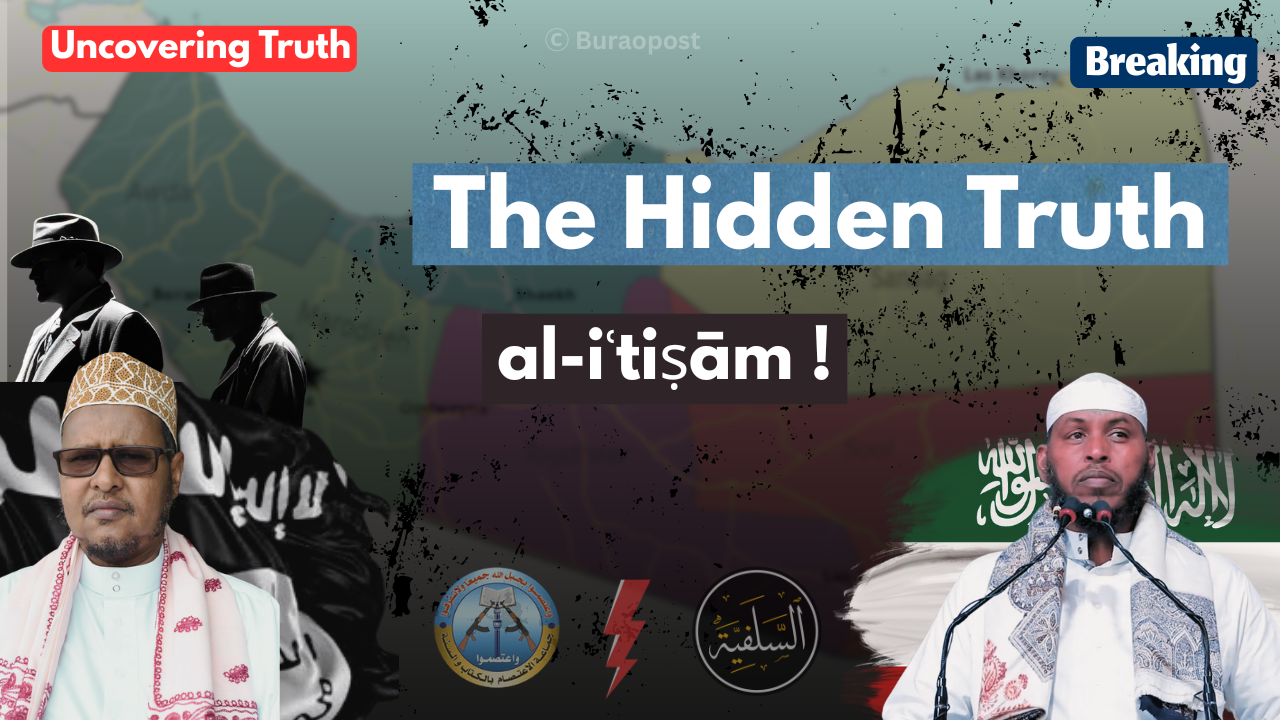
© Buraopost investigative cover — "The Hidden Truth: al-Iʿtiṣām." A deep dive uncovering the hidden agenda, rising influence, and its impact on Somaliland's security and stability.
Somaliland has long been celebrated as a rare beacon of stability in the Horn of Africa. While Somalia continues to grapple with conflict, terrorism, and fragile governance, Somaliland has managed to carve out a reputation for peace, democratic processes, and functioning institutions. This relative stability has allowed its people to rebuild lives, attract diaspora investment, and cultivate a sense of national identity rooted in sovereignty and independence. Yet beneath this surface of calm lies a slow-moving storm — an ideological threat that seeks to undermine the very foundation of this stability.
That threat comes in the form of Al-Ictisaam, a movement that publicly presents itself as a religious reformist organization but privately carries the ideological DNA of Somalia’s notorious Islamic Courts Union (Al-Mahakim Al-Islamiya). Outwardly, Al-Ictisaam speaks the language of piety, community revival, and moral reform. Inwardly, however, its mission is far more dangerous: to gradually infiltrate Somaliland’s institutions, impose extremist interpretations of Islam, and ultimately pave the way for an Islamist takeover similar to the rise of Al-Shabaab in Somalia.
The danger is not in open warfare — Somaliland has proven resilient against armed incursions — but in silent ideological infiltration. The battle being waged is one of influence, fought not with bullets but with sermons, quiet recruitment, and targeted entry into government. This hidden front is more insidious than military confrontation because it can destabilize a nation from within, long before the public realizes the extent of the damage.
Today, scholars, policymakers, and ordinary Somalilanders face an urgent question: can the nation preserve its stability against a movement that has mastered the art of disguise? As the story of Al-Ictisaam unfolds, it reveals a chilling playbook — one that blends patience, hidden networks, and ideological infiltration — and a counter-response led by religious scholars determined to defend both faith and sovereignty.
To understand the presence of Al-Ictisaam in Somaliland today, one must first trace its roots back to the Islamic Courts Union — known locally as Al-Mahakim Al-Islamiya. In the early 2000s, these courts rose to prominence in Somalia by promising to deliver law and order in a country plagued by civil war and militia rule. For many ordinary Somalis, exhausted by decades of violence, the courts seemed to offer a glimmer of hope. They presented themselves as guardians of justice, rooting their authority in Sharia law while appealing to public frustration with the chaos of warlords.
But beneath that promise of stability lay the seeds of extremism. The movement quickly attracted hardline clerics and militants who sought to transform Somalia into an Islamic emirate. When Ethiopia, with support from the United States, intervened militarily in 2006 and dismantled the Islamic Courts Union, its remnants splintered into factions. The most notorious of these was Al-Shabaab, which embraced terrorism and global jihad. Yet other fragments sought a subtler path, repackaging their ideology into movements that could operate without immediately raising alarm. Among these offshoots was Al-Ictisaam.
Unlike Al-Shabaab, which turned openly violent, Al-Ictisaam adopted a dual strategy: avoid direct confrontation with governments, while steadily embedding itself into society through mosques, religious schools, and charity networks. By distancing itself from overt militancy, Al-Ictisaam created the illusion of being a moderate religious group. In reality, its leadership never abandoned the long-term goal of creating a political system governed by their strict interpretation of Islam. What changed was not the ideology, but the method: infiltration instead of insurgency, patience instead of open war.
This transformation made Al-Ictisaam especially dangerous in Somaliland. While the group could not risk armed conflict in a territory known for its vigilance and strong security apparatus, it could exploit the trust of religious communities. It began to frame itself as a legitimate movement dedicated to teaching and reform, while slowly reviving the same ideology that once fueled the Islamic Courts Union. In this way, the shadows of Al-Mahakim continue to loom over Somaliland, repackaged under a softer, more deceptive face.
Perhaps the most revealing insight into Al-Ictisaam’s long-term strategy came from one of Al-Shabaab’s senior amirs, who once stated bluntly: “We must enter Somaliland through the Ministry of Religion, and from there, capture the entire government.” Though the statement was made in reference to Al-Shabaab, it perfectly reflects the strategic thinking that guides Al-Ictisaam. The idea is not to challenge Somaliland’s government militarily, but rather to infiltrate it institution by institution, beginning with the ministry that shapes the country’s religious and cultural framework.
Why the Ministry of Religion? The answer lies in its influence. In a society where religion forms the backbone of daily life, the ministry is more than just a bureaucratic office — it is a gatekeeper of public morality, education, and social trust. Whoever controls this ministry holds the power to appoint imams, regulate religious schools, approve sermons, and influence the nation’s religious discourse. By placing loyalists or sympathizers inside such an institution, Al-Ictisaam could quietly shift the national narrative without firing a single shot. From there, the ideology could ripple outward into other ministries, affecting education, justice, and even foreign policy.
This type of infiltration is far more dangerous than open conflict. A militant group storming the gates of government would be repelled quickly by Somaliland’s security forces. But a carefully cultivated network of ideologues, strategically positioned within ministries and agencies, could weaken the state from within. Over time, such a network might shape policies, rewrite laws, and manipulate public opinion until the movement’s ideology becomes normalized. By the time the public realizes what has happened, the foundations of governance could already be compromised.
Reports from local communities suggest that Al-Ictisaam sympathizers have sought employment not only in religious institutions but also in related sectors such as education and charities. These are areas where ideology can be transmitted subtly through school curricula, youth programs, or humanitarian aid. The threat, therefore, is not only about who preaches in mosques but also about who designs the textbooks, who trains the teachers, and who decides what messages are promoted in the name of religion. For Al-Ictisaam, the Ministry of Religion represents the keyhole through which the entire state can be unlocked.
Al-Ictisaam’s influence does not emerge overnight. Instead, it grows slowly, built upon three carefully crafted pillars: public preaching, targeted recruitment, and strategic silence. These methods allow the movement to maintain a cloak of legitimacy while steadily planting seeds of ideology across Somaliland.
The first pillar is preaching. Across towns and villages, Al-Ictisaam-affiliated clerics deliver sermons that often appear harmless on the surface. They emphasize piety, moral discipline, and the rejection of Western values, themes that resonate deeply within Somaliland’s conservative society. Yet within these messages, subtle layers of extremist ideology are introduced — ideas that challenge democracy, delegitimize state authority, and promote loyalty to a higher religious project. Delivered over time, these sermons can reshape how communities view their government, transforming trust into suspicion and creating fertile ground for radicalism.
The second pillar is targeted recruitment, particularly among the youth. Al-Ictisaam invests heavily in religious schools, madrassas, and informal study circles where young Somalilanders can be influenced at an impressionable age. The strategy is straightforward: capture the hearts and minds of the next generation before they fully integrate into the civic and national identity of Somaliland. By presenting themselves as mentors and protectors of Islamic knowledge, Al-Ictisaam leaders draw students into a worldview where loyalty to the movement is presented as loyalty to Islam itself. This approach is especially effective in poorer communities, where educational alternatives are limited and religious instruction is one of the few accessible paths for advancement.
The third pillar is political silence. Unlike Al-Shabaab, which thrives on open confrontation, Al-Ictisaam deliberately avoids direct clashes with Somaliland’s government. They rarely issue provocative statements or challenge authorities in the public arena. Instead, they operate beneath the radar, cultivating trust and legitimacy. This silence is not a sign of moderation but a calculated tactic. By avoiding attention, the movement buys itself time to grow stronger. The absence of immediate confrontation also allows its leaders to deny accusations of extremism, presenting themselves as misunderstood reformers whenever they face scrutiny.
Together, these three pillars form a quiet but powerful machine. The sermons provide the ideological framework, recruitment ensures a steady stream of committed followers, and political silence shields the group from detection. This combination allows Al-Ictisaam to function like an underground current: invisible on the surface, yet capable of reshaping the landscape over time.
Every movement with a political or religious agenda relies on a set of individuals who act as its intellectual engine and strategic planners. Al-Ictisaam is no exception. While its public representatives often appear as ordinary clerics or community organizers, there exists a second layer of leadership — ideologues who work quietly to shape the group’s long-term direction. These figures avoid the spotlight, preferring instead to operate in shadows where scrutiny is minimal and their influence can grow unchecked.
Locally, several clerics linked to Al-Ictisaam present themselves as teachers of Islamic knowledge, rarely making overtly radical statements in public gatherings. But within closed circles, according to community reports and testimonies, their tone shifts dramatically. Behind mosque doors or in private study sessions, these same clerics are said to denounce democracy as “un-Islamic,” question the legitimacy of Somaliland’s government, and promote the idea of an Islamic emirate. By presenting one face to the public and another to their inner followers, these ideologues successfully evade government crackdowns while nurturing a core group of loyal adherents.
What makes these hidden faces particularly dangerous is their calculated patience. Unlike Al-Shabaab commanders, who thrive on immediate action and violent campaigns, Al-Ictisaam’s intellectual leaders prioritize endurance. They understand that shaping a nation requires time, influence, and the gradual erosion of trust in existing institutions. Their vision stretches across decades, not months. By embedding themselves in educational institutions, charity organizations, and religious councils, they secure platforms that allow them to subtly spread their worldview while remaining invisible to ordinary citizens.
The real challenge for Somaliland is that many of these individuals have cultivated reputations as “respected scholars” or “community leaders.” This makes exposing them complex, since any government action can be framed as a crackdown on religion itself. It is precisely this ambiguity that allows Al-Ictisaam’s hidden ideologues to continue their work. While their names may not dominate headlines, their fingerprints can be traced across the ideological shift that threatens Somaliland’s stability. Identifying them, exposing their dual roles, and separating legitimate religious leadership from extremist manipulation is perhaps the hardest battle in this ongoing war of ideas.
In the face of Al-Ictisaam’s creeping influence, Somaliland has not remained defenseless. A strong line of resistance has emerged from within the religious establishment itself, led by respected clerics who reject the exploitation of Islam for political gain. Among these voices, Sheikh Al-Barbarawi has become a particularly prominent figure, representing a brand of Salafiyya that emphasizes spiritual integrity, religious purity, and loyalty to the sovereignty of Somaliland

