

© Getty Images
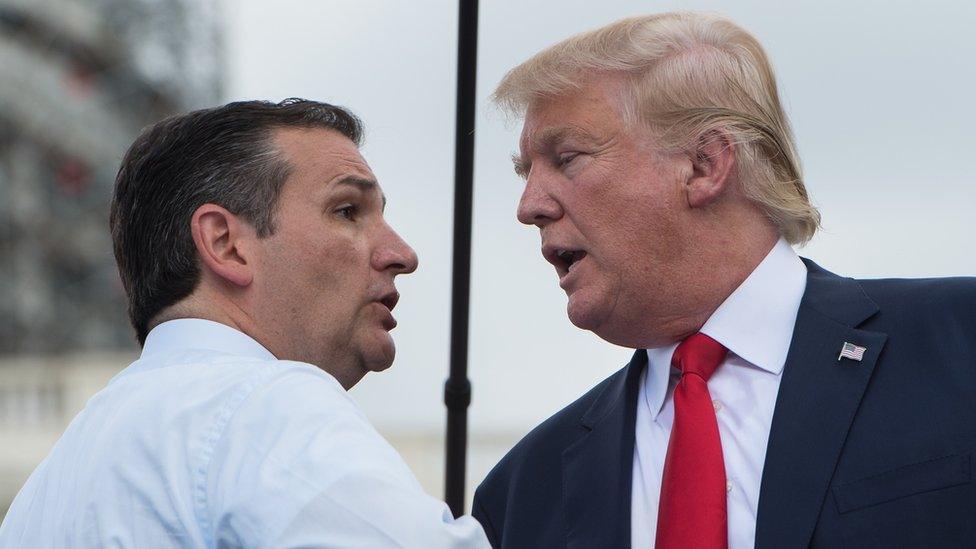
Former U.S. President Donald Trump with Senator Ted Cruz, who has urged recognition of Somaliland, amid renewed debate on U.S. policy in the Horn of Africa.
×
![Enlarged view of Trump and Cruz discussing Somaliland recognition]()
Verified News
This news has been verified by The Buraopost Investigation Desk with 100% accuracy through our rigorous fact-checking process.
The buzz began intensifying last week when Senator Ted Cruz (R-Texas), a vocal advocate for Somaliland, penned a letter to President Donald Trump urging formal recognition of the territory as an independent nation. Cruz emphasized Somaliland's role as a "critical security and diplomatic partner," pointing to its strategic location along the Red Sea and its democratic elections, which have drawn praise from international observers. Trump himself fueled speculation earlier this month by stating during a press briefing that his team was "looking into" Somaliland's case, a comment welcomed by Somaliland's government as acknowledgment of its 34 years of self-governance.
Somaliland's de facto independence dates back to the collapse of Somalia's central government in 1991, following years of civil war. While it has maintained relative peace, built democratic institutions, and even forged ties with Taiwan—drawing ire from Beijing—the international community has largely withheld recognition to preserve the idea of a unified Somalia. A 2021 report from the Heritage Foundation argued strongly for U.S. recognition, citing Somaliland's progress in governance and its potential as a hedge against regional instability. More recently, a 2023 analysis by the Wilson Center highlighted the persistent conflicts in Somalia proper, underscoring the stark contrast with Somaliland's stability.
Strategic interests appear to be driving the Trump administration's interest. The Horn of Africa is a hotspot for great-power competition, with China's military base in nearby Djibouti raising concerns in Washington about intelligence vulnerabilities. Somaliland's Berbera port, already eyed for U.S. military access, could provide an alternative foothold, especially amid ongoing operations against Houthi forces in Yemen. U.S. naval assets were positioned off Somaliland's coast as recently as April 2025 during heightened Red Sea tensions. "Recognizing Somaliland isn't just about morality—it's smart geopolitics," one Republican source familiar with the discussions told reporters, echoing sentiments in Project 2025, the conservative blueprint that proposes such a move to counter Chinese influence.
The proposal has sparked enthusiasm in Somaliland, where President Abdirahman Mohamed Abdullahi Irro recently nominated Trump for the Nobel Peace Prize, praising his "efforts toward global stability" and urging recognition as a historic step. Social media in the region is abuzz, with users like @somaliland60 calling for a petition to garner international support, arguing that Trump's comments signal momentum but more advocacy is needed from allies like Japan and the European Union.
However, the debate remains deeply divisive. Critics, including the Somali government in Mogadishu, have condemned the push as a threat to national unity. Somalia's foreign ministry issued a statement denouncing Cruz's letter and accusing the U.S. of interfering in internal affairs. On platforms like X, detractors reference historical U.S. missteps in the region, such as supporting Ethiopian unity over Somali unification efforts in the 1960s, warning that recognition could exacerbate ethnic tensions and embolden separatist movements elsewhere in Africa. China, too, has voiced opposition, labeling it "interference" amid its own investments in Somalia.
Even within the U.S., not all voices align. Former U.S. Ambassador to Somalia Larry André, while acknowledging the "very possible" chance of recognition under Trump, has expressed reservations, noting the complexities of upending decades of policy. Analysts at the Council on Foreign Relations have described Somalia-related decisions as "always complicated," suggesting that while congressional Republicans are pushing hard, the White House's final stance remains under review.
As discussions evolve, a Guardian article from earlier this year speculated that U.S. recognition could materialize by 2028, but recent developments suggest it might happen sooner. For Somaliland's 5.7 million residents, who have built a functioning state amid regional chaos, the prospect represents a long-awaited validation. Yet, as one X user poignantly noted, "The battle for recognition is not yet won." With the Horn of Africa's stability hanging in the balance, all eyes are on Washington for what could be a pivotal foreign policy pivot.

