

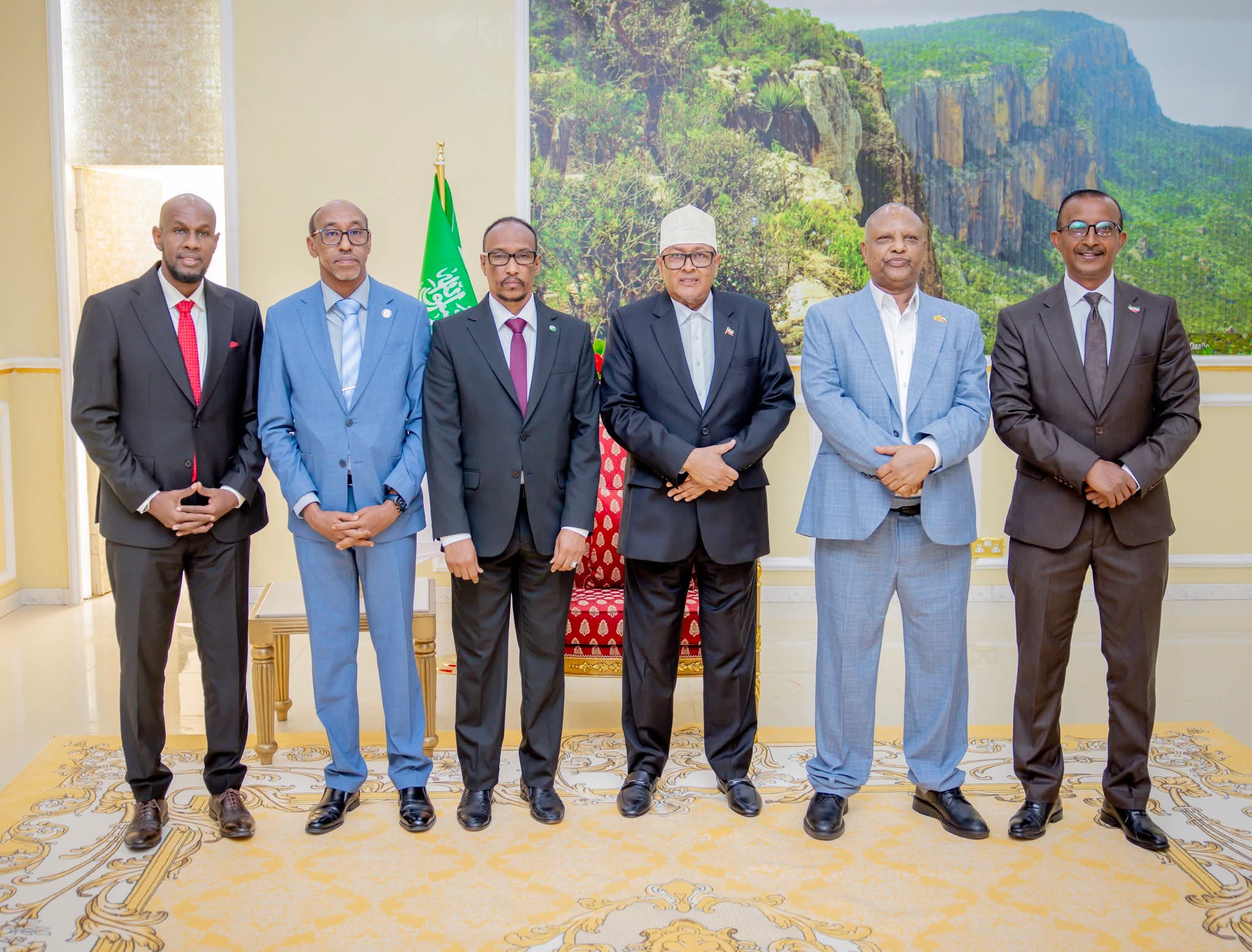
President of Somaliland H.E. Abdirahman Mohamed Abdillahi (Cirro) meets with Djibouti's Minister of Commerce and Tourism Mohamed Warsame Dirieh and his delegation during high-level talks at the Presidential Palace in Hargeisa.
×
![Enlarged view of President Cirro's meeting with Djibouti delegation]()
Hargeisa, Somaliland – August 27, 2025 –
The President of the Republic of Somaliland, H.E. Abdirahman Mohamed Abdillahi (Cirro), today received a high-level delegation from the Republic of Djibouti at the Presidential Palace in Hargeisa in what observers describe as one of the most significant diplomatic encounters between the two neighbors in recent years. The delegation, led by Djibouti’s Minister of Commerce and Tourism, Hon. Mohamed Warsame Dirieh, was warmly welcomed and held extensive discussions with Somaliland officials on a wide range of issues including trade, tourism, people-to-people exchanges, and development initiatives that could reshape economic and political cooperation between the two countries.
Speaking at the meeting, President Cirro highlighted the importance of deepening relations and stressed that Somaliland and Djibouti are bound by history, culture, and geography. He emphasized that bilateral cooperation must go beyond symbolic gestures and translate into tangible outcomes that improve the lives of ordinary citizens. In his address, he made a remark that carried both hope and symbolic significance when he said: “I hope the President of Djibouti will become the first sitting head of state to officially visit Somaliland. Such a visit would mark a turning point in our relations and send a powerful message about fraternity, partnership, and progress.” The statement has been widely interpreted as an invitation for Djibouti to make history in its dealings with Somaliland and a call for more visible recognition of the territory’s growing role in regional stability.
The Djiboutian Minister of Commerce and Tourism, Mohamed Warsame Dirieh, reaffirmed his government’s commitment to strengthening cooperation, describing Somaliland and Djibouti as “brothers and sisters linked by shared history and destiny.” He noted that Djibouti remains determined to enhance relations in the fields of commerce, tourism, and free movement of people across borders. The minister underlined that his government sees in Somaliland a reliable partner with whom Djibouti can collaborate not only on bilateral issues but also on regional stability and prosperity.
Somaliland and Djibouti share centuries-old ties that go beyond politics. Families span both sides of the border, and cultural, linguistic, and kinship connections have long formed the fabric of the relationship between the two societies. Djibouti’s strategic location on the Red Sea and Somaliland’s coastline along the Gulf of Aden position both territories as natural partners in trade and maritime affairs. Somaliland exports significant volumes of livestock through Djibouti, while Djibouti offers Somaliland access to international markets and institutions. This interdependence has historically made their relationship resilient even during times of political uncertainty.
In today’s discussions, trade featured prominently as both sides explored opportunities to lower barriers, attract cross-border investment, and build joint ventures. Tourism was another focal point, with proposals to link Somaliland’s archaeological and coastal attractions with Djibouti’s Red Sea beaches and eco-tourism offerings. President Cirro observed that tourism was more than leisure, stating that it was “a driver of small businesses, job creation, and cultural understanding.” He stressed the potential for creating a Horn of Africa tourism corridor, anchored by Somaliland and Djibouti as partners.
Beyond the economic dimension, the talks carried strong geopolitical undertones. Both Somaliland and Djibouti are located along one of the world’s most strategic maritime chokepoints, the Bab el-Mandeb strait, which connects the Red Sea to the Gulf of Aden and is vital for global shipping. Djibouti already hosts military bases from the United States, France, China, and Japan, highlighting its importance in global security. Somaliland, while still unrecognized, has attracted growing attention for its stability and the development of Berbera Port, where DP World and other investors are creating infrastructure that could rival Djibouti’s own port facilities. Analysts argue that closer cooperation could help the two neighbors transform potential competition into complementarity, serving the interests of both rather than driving rivalry.
The recognition question loomed in the background of the meeting. Somaliland, which declared independence from Somalia in 1991, has built functioning institutions, held democratic elections, and maintained peace and security within its borders. Yet it remains without formal recognition from any state. Djibouti, a recognized UN member, has historically maintained close relations with Somalia while cautiously engaging Somaliland. President Cirro’s statement about a potential visit from Djibouti’s head of state was therefore highly symbolic. Political observers note that such a visit, even if not framed as recognition, would mark a diplomatic breakthrough and could open the door for other African or Arab leaders to engage with Somaliland in a more formal capacity.
The human dimension of the relationship was also highlighted. Thousands of Somalilanders live and work in Djibouti, contributing to its economy, while Djiboutian traders and professionals operate in Somaliland. The free movement of people between the two territories has fostered cultural exchange and mutual dependence. Minister Dirieh described the relationship as one of “family ties, not just political ties,” adding that cooperation was about enhancing the lives of people who already interact daily across the border. President Cirro echoed this sentiment, insisting that partnerships must ultimately serve citizens by making trade easier, travel safer, and opportunities more accessible.
Still, challenges remain. Somaliland’s lack of international recognition complicates the signing of formal treaties and the securing of international finance. Port competition could create friction if not carefully managed, and Mogadishu’s government has historically resisted any engagement with Somaliland that might be perceived as legitimizing its independence. Analysts note that these factors could slow progress if not handled with diplomatic sensitivity. Yet Somaliland officials argue that pragmatic cooperation based on mutual interest can overcome political hurdles.
In the coming months, technical committees from both governments are expected to hold follow-up meetings to explore specific agreements. Trade facilitation, investment promotion, tourism initiatives, and cultural programs are expected to be prioritized. Officials in Hargeisa believe that Djibouti’s willingness to openly engage Somaliland reflects growing recognition of the territory’s stability and potential. Whether President Ismail Omar Guelleh of Djibouti will heed President Cirro’s call and become the first sitting head of state to visit Somaliland remains uncertain, but even the prospect has generated considerable discussion across the Horn of Africa.
Experts say the potential implications of such a visit would be profound. It would send a strong signal to the international community that Somaliland, despite its lack of formal recognition, is a legitimate and stable partner. It could also encourage other states to take more pragmatic approaches in their dealings with Hargeisa, opening new doors for cooperation in trade, security, and development. Regional analyst Dr. Ahmed Osman noted that “Somaliland and Djibouti have a shared interest in stability, prosperity, and regional peace. Their cooperation could serve as a model for pragmatic engagement in a region often defined by rivalry and conflict.”
For now, the meeting in Hargeisa has marked a milestone in Somaliland’s ongoing efforts to build diplomatic partnerships. It showcased the leadership of President Cirro, who has made regional diplomacy a central theme of his presidency, and underlined Djibouti’s openness to exploring deeper ties. By invoking the possibility of a historic first visit by Djibouti’s head of state, Cirro captured the aspirations of many Somalilanders who view their future as linked not only to economic opportunity but also to broader international acknowledgment.
The message from Hargeisa was clear: Somaliland is ready for partnership, Djibouti is listening, and the Horn of Africa may be witnessing the beginning of a new era of cooperation between two neighbors whose destinies are deeply intertwined.

