

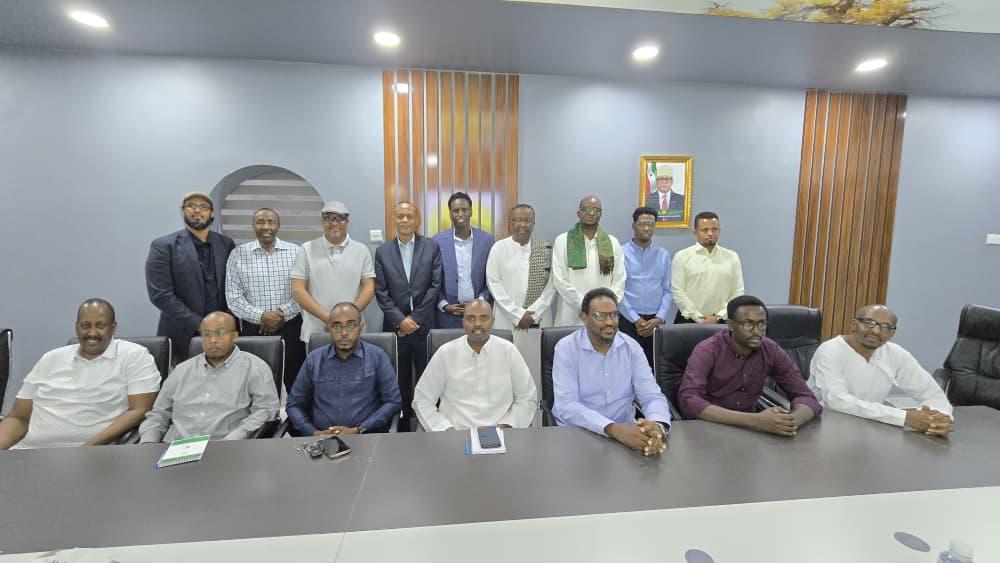
Hamse Warfa, Somali-American political figure, being welcomed in Hargeisa by Ahmed Abdirahman, Special Envoy of President Abdirahman Mohamed Abdillahi Irro, during a controversial diplomatic visit that sparked public debate in Somaliland.
For more than three decades, Somaliland has pursued a singular goal that has shaped its political life, its foreign policy, and its collective identity: recognition as a sovereign and independent state. The people of Somaliland, having declared separation from Somalia in 1991 after the collapse of the Barre regime and the devastating civil war, have insisted that their nation has demonstrated all the pillars of statehood—peace, stability, functioning democratic institutions, and the ability to govern without chaos. Despite this, the international community has remained hesitant, caught between geopolitical caution and the entrenched narrative of Somali unity. Over the years, moments of hope have flickered on the horizon, particularly when key voices within the United States, the United Kingdom, and the European Union hinted at rethinking the status quo. Yet each time, those sparks of possibility were quickly met by strategic counter-moves from Mogadishu, whose leaders view Somaliland’s recognition as an existential threat to Somalia’s territorial integrity and influence.
Into this complex dynamic has now entered a new and unsettling chapter, one that has provoked outrage in Hargeisa and beyond. The visit of Hamse Warfa, a Somali-American political figure once positioned as a senior advisor to the U.S. Department of State, has shaken the fragile confidence of Somalilanders who had believed that international recognition was finally within reach. Warfa is no ordinary visitor; he is widely known as a committed defender of Somalia’s federal government policies, an outspoken critic of Somaliland’s sovereignty claims, and a close associate of influential U.S. political figures such as Congresswoman Ilhan Omar. His presence in Hargeisa, welcomed by Ahmed Abdirahman, the Special Envoy of the President of Somaliland, Abdirahman Mohamed Abdillahi Irro, was therefore perceived not as a diplomatic gesture but as a dangerous breach—a moment when Somaliland’s leadership appeared to open its doors to someone aligned with the very structures seeking to prevent its independence.
The timing could not have been worse. President Donald Trump’s return to the White House has stirred debate in Washington over a potential reevaluation of U.S. policy toward the Horn of Africa. Trump’s unpredictable approach to foreign relations, combined with his transactional style of diplomacy, had made Somaliland’s advocates hopeful that recognition might come if framed as a strategic asset for American interests. The Red Sea’s maritime security, the positioning of Berbera Port as a vital hub, and the competition with China for influence in Africa all provided compelling reasons for the United States to consider Somaliland as a partner rather than an ignored entity. In this context, the arrival of Hamse Warfa in Hargeisa was interpreted by many as a deliberate counterstrike—Somalia inserting one of its most connected diaspora figures into the heart of Somaliland’s political stage, thereby muddying the waters at the very moment recognition seemed possible.
Critics have argued that this was not merely a visit but part of a calculated Somali strategy. By dispatching or encouraging figures like Warfa to engage in Somaliland under the pretext of dialogue, Mogadishu simultaneously gains intelligence, exerts soft pressure, and weakens the morale of the Somaliland public. In Washington, Warfa’s networks are formidable. His ties to the Democratic establishment, his alignment with policymakers who have historically echoed Somalia’s position on territorial unity, and his reputation as a skilled lobbyist have long made him a figure of suspicion among Somaliland sovereignty activists. To see him welcomed in Hargeisa was, to many Somalilanders, nothing short of betrayal.
Public reaction was swift and harsh. Social media platforms lit up with condemnation. On TikTok, Abdisalam Brown, one of the most outspoken defenders of Somaliland’s sovereignty, delivered a passionate critique of the event. His message was clear: allowing Warfa into Hargeisa was not only a blunder but a historic error that risked undoing decades of struggle. He framed it as a breach of trust, accusing the current administration of dishonesty for engaging with individuals who openly campaign against Somaliland’s recognition. Brown’s words resonated deeply because they echoed what many Somalilanders felt in their hearts—that this was the moment their government had lost touch with the very principles it was supposed to defend. His videos, widely shared, transformed him overnight into the voice of a frustrated public demanding accountability.
What particularly stung was the sequence of events. It became evident that the welcome extended to Warfa happened before President Irro had formally announced the key positions of his government. This timing created an impression of confusion and poor judgment at best, and of deliberate collusion at worst. While Somalia was preparing to elevate Warfa’s profile and strengthen its own diplomatic messaging abroad, Somaliland appeared to be giving him legitimacy by allowing him to operate freely in Hargeisa. This, critics argued, made Somaliland’s president look weak, indecisive, and out of step with the urgency of the recognition battle. Some even described it as the greatest political mistake in Somaliland’s modern history, one that risked leaving the nation hopeless at the very moment it needed resilience and clarity.
To understand the depth of anger this visit provoked, one must appreciate how deeply recognition is tied to the identity and aspirations of Somalilanders. Unlike many postcolonial conflicts, Somaliland’s quest is not simply a matter of elite politics but a cause rooted in collective memory and sacrifice. Generations have grown up under the shadow of international non-recognition, yet with a strong belief in the legitimacy of their self-determination. Every diplomatic opening is greeted with enthusiasm, and every setback is felt as a national wound. For this reason, welcoming someone widely regarded as hostile to that dream was not viewed as routine political engagement—it was seen as undermining the very essence of the national project.
The geopolitical backdrop makes this even more significant. The Horn of Africa is one of the most strategically contested regions in the world today. The Red Sea corridor, through which a significant portion of global trade flows, has become a focal point for great power competition. The United States, China, Russia, Turkey, and Gulf states all seek influence in this maritime crossroads. Somaliland, with its port of Berbera and its relative stability, represents a potential partner for any global actor looking to secure trade routes and establish military or logistical footholds. For Somalilanders, this reality has always been a central argument for recognition: that their stability and location make them too important to be ignored. For Somalia, however, this same reality makes Somaliland’s recognition intolerable, as it would strip Mogadishu of leverage and legitimacy in regional politics. Thus, every move, every visit, every statement is layered with meaning far beyond the surface.
It is in this high-stakes environment that Hamse Warfa’s visit landed like a thunderclap. His history of criticizing Donald Trump, his closeness to Ilhan Omar, and his role in shaping Somali diaspora narratives in Washington made him a symbol of everything Somalilanders distrust. To many, the idea that he could be embraced in Hargeisa, even temporarily, was almost unthinkable. And yet it happened, fueling speculation that Somaliland’s leadership was either disastrously naïve or dangerously compromised. The timing—just as Donald Trump’s administration was reconsidering its stance toward Somaliland—made the incident appear not only misguided but potentially catastrophic for Somaliland’s recognition hopes.

