

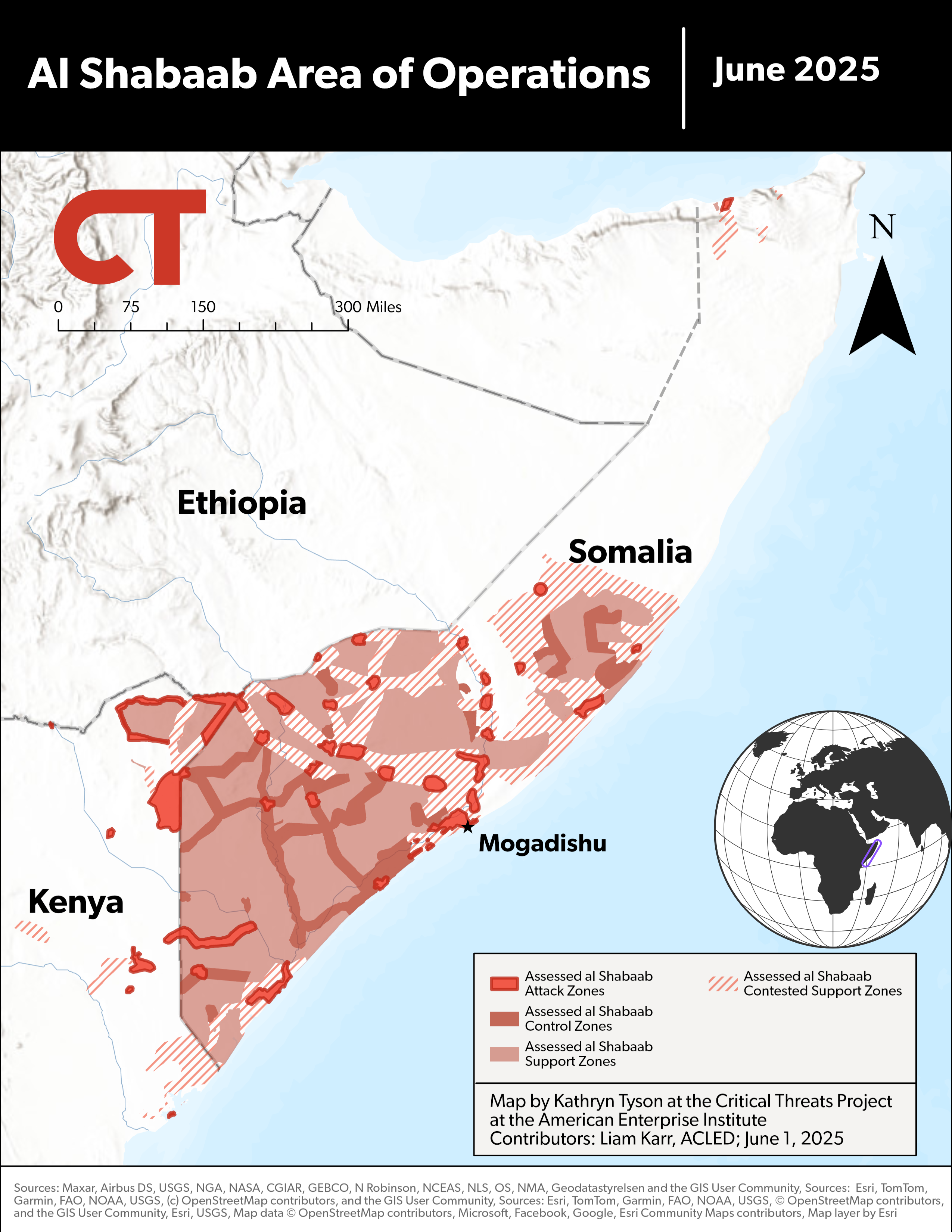
As seen in the highlighted areas, the federal government controls only a small portion of Somalia—mainly around Mogadishu and nearby corridors.
Somalia’s Size vs. Government’s Reach
Al-Shabaab’s Expanding Control
Why the Flag May Fall by 2030
What 2030 Could Look Like
A Flag Without a Country?
A Nation Fading from the Map
This is no longer a warning. It is a timeline.
As the years pass, the reality on the ground in Somalia continues to shift in ways few dared to openly admit even a decade ago. The federal government’s hold on the vast majority of Somali territory has dwindled to mere fragments, shrinking year by year under pressure from insurgent groups, political fragmentation, and the deep scars of decades of conflict and mismanagement. What remains increasingly clear is that the vision of a unified Somalia under a strong, centralized government is fast fading into the shadows of history.
In this unfolding story, the blue flag of Somalia—the symbol of national unity and hope—faces a grim future. Unless profound changes take place, it is unlikely to fly with any real authority beyond the confines of Mogadishu’s presidential palace and a handful of government-controlled pockets. This is not mere speculation but a sober assessment backed by political analysts, security experts, and countless observers on the ground.
Al-Shabaab’s continued resilience and territorial expansion across southern and central Somalia have fractured the country’s political map irreparably. Where once the federal government might have claimed nominal authority, now militant governance, clan militias, and local power brokers fill the vacuum. Even regional administrations that were supposed to function as autonomous states within a federal system now act more like independent entities, frequently ignoring Mogadishu altogether. This de facto decentralization has reduced the government to little more than a symbolic institution—powerful only where supported by foreign troops and limited resources.
Amid this disintegration, Somaliland stands out as a contrasting reality. While unrecognized internationally, Somaliland has maintained relative peace, effective governance, and functional institutions for over three decades. Its leadership has successfully created stability and economic progress, attracting both regional and international interest despite its ambiguous legal status. In a region plagued by uncertainty, Somaliland remains a beacon of order and promise.
Given this stark contrast, many political experts and local voices now foresee a future where the Somali federal government may cease to exist in any meaningful form, leaving Somaliland as the most enduring and stable political entity on the territory once claimed by “Greater Somalia.” This is not simply a question of separatism but a recognition of on-the-ground realities: governance, security, and development will persist where they are managed effectively, not necessarily where borders are drawn on a map.
The political discourse within Somalia itself increasingly acknowledges these realities. Dialogue about the fate of the Somali state has shifted away from rigid assertions of indivisibility toward pragmatic discussions of coexistence, autonomy, and new federal arrangements—although the path forward remains deeply contested. Meanwhile, continued instability in southern Somalia exacerbates humanitarian crises, drives displacement, and fuels cycles of violence, pushing the federal government further to the margins of influence.
What is unfolding is a profound transformation of Somali identity and governance. The blue flag, once a symbol of a hopeful and unified nation, risks becoming a relic—an emblem remembered more for what it represented than what it currently controls. In contrast, Somaliland’s green, white, and red flag waves over a territory that, while small, functions as a de facto independent state.
This reality poses difficult questions for the region, the international community, and Somalis themselves. How should external actors engage with a fractured Somalia? What mechanisms exist to support peace, development, and human rights amid such fragmentation? And most importantly, what vision of nationhood will guide the Somali people in the coming decades?
Whatever the answers, the current trajectory suggests a reshaping of Somalia’s political landscape where the federal government’s grip continues to weaken, and Somaliland’s autonomy solidifies. This is not a story of collapse alone, but of political realignment—where the promise of unity gives way to the pragmatism of governance on the ground.
For those who have long hoped for a unified Somalia, this shift is a painful acknowledgment of failed dreams. But for others, it may represent an opportunity to build lasting peace and stability in the Horn of Africa, starting from the realities that already exist. Somaliland, with its enduring institutions and relative peace, stands as a model of what effective governance looks like in the Somali context—something increasingly absent in the south.
In conclusion, the Somali federal government’s control over its territory may shrink further, perhaps to a symbolic fraction barely visible on any map. Meanwhile, Somaliland will likely remain as the most stable and enduring political entity in the region. This does not mean that the Somali people’s struggles end here, but that the political landscape must evolve, recognizing new realities and new possibilities.
The blue flag of Somalia, once the emblem of hope for a united nation, faces a future where it may no longer wave across the entire land it claims. Instead, it may become a symbol of a chapter that closed long ago—while Somaliland’s flag continues to fly over a region that, for better or worse, holds the reins of its own destiny.

