

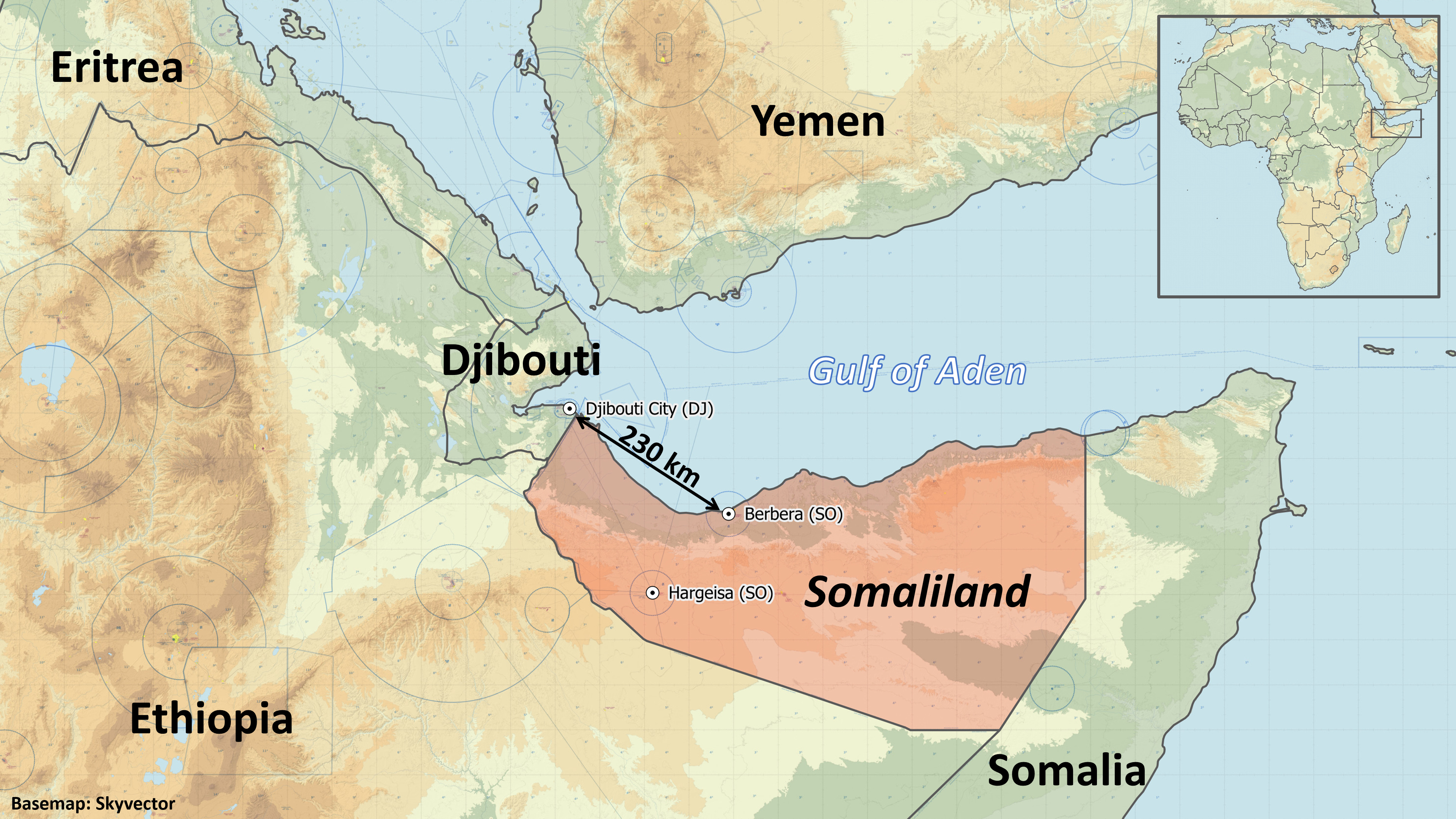
ANALYSIS: Map of Somaliland highlighting its strategic coastline along the Gulf of Aden, with the key port city of Berbera positioned approximately 230 km from Djibouti City, underscoring its growing geopolitical importance in Red Sea trade and regional power dynamics. © BBN
As reported by the FMES Institute, the Horn of Africa is entering a decisive geopolitical transformation, with Somaliland and Israel emerging at the center of a new strategic alignment increasingly referred to as the “Berbera Alliance.” According to the institute’s latest analysis, the developments following Israel’s recognition of Somaliland in December 2025 are no longer isolated diplomatic moves but part of a structured shift toward a new regional power architecture that is expected to fully materialize by 2027.
The report highlights that Israel’s recognition of Somaliland represents a turning point in the Red Sea’s strategic environment, transforming the region from a fragmented arena of episodic rivalries into a coordinated competition over maritime security, trade routes, and geopolitical influence. Somaliland’s geographic advantage—its long coastline along the Gulf of Aden and proximity to the Bab el-Mandeb Strait—positions it as a critical gateway for controlling one of the world’s most important maritime corridors. This has elevated Somaliland from a peripheral player into a central strategic actor.
Within this evolving framework, the FMES analysis identifies the emergence of a powerful network linking Israel, the United Arab Emirates, Ethiopia, and Somaliland. This alignment, now increasingly conceptualized as the Berbera Alliance, is built on shared strategic interests including securing maritime routes, countering Iranian influence, and balancing Turkey’s expanding role in Somalia. The port of Berbera stands at the heart of this alliance, functioning not only as a commercial hub but as a strategic node for logistics, intelligence coordination, and regional power projection.
From Israel’s perspective, the partnership with Somaliland provides strategic depth in a region heavily affected by Houthi threats and instability in the Red Sea. The ability to monitor maritime activity, deploy intelligence assets, and establish operational flexibility gives Israel a forward position in a rapidly militarizing corridor. At the same time, Somaliland benefits from enhanced international visibility and the potential to leverage this relationship into broader diplomatic and economic opportunities.
The FMES report also underscores that this emerging axis is not uncontested. A counter-alignment centered around Somalia, Turkey, Egypt, and Saudi Arabia is actively forming to resist the shift in regional balance. However, despite this opposition, the Berbera Alliance is gaining momentum due to its practical focus on infrastructure, security cooperation, and economic integration rather than relying solely on formal diplomatic recognition.
A key conclusion of the report is that the future of the Horn of Africa will not be defined primarily by legal recognition or traditional diplomacy, but by control over access, influence, and security partnerships. In this context, Somaliland’s role becomes increasingly significant as a flexible and strategically positioned partner capable of operating outside conventional constraints.
Looking ahead, the FMES assessment suggests that 2027 is likely to mark the consolidation of this new order. The Horn of Africa is expected to transition into a region defined by competing power blocs, with the Berbera Alliance at the forefront of a new geopolitical reality. As infrastructure expands, security cooperation deepens, and strategic interests align, Somaliland and Israel are positioned to lead what could become the most influential partnership shaping the Red Sea and the wider Horn of Africa in the coming years.

