

© Jessie Wardarski/AP
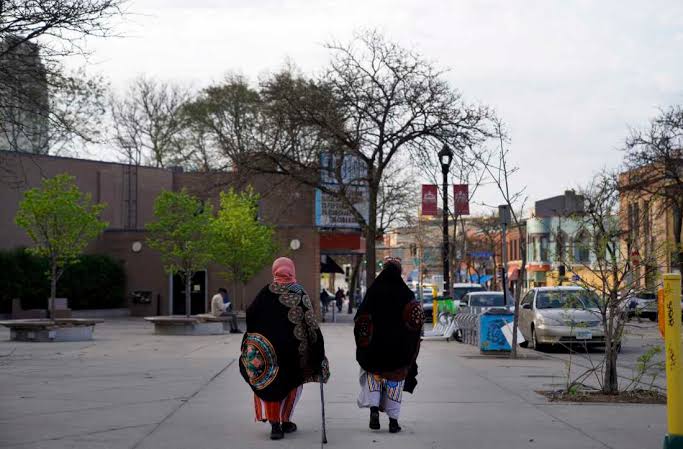
Women walk down a street in the predominantly Somali neighborhood of Cedar-Riverside in Minneapolis in 2022. The Twin Cities is a hub for Somalis in the U.S.
ST. CLOUD, Minnesota (BBN) – President Donald Trump's recent rally in this Midwestern city has once again thrust Minnesota's large Somali-American population into the national conversation, with the president criticising refugees from Somalia for bringing "nothing" to the United States and calling for their return to their homeland.
The state, home to the largest Somali diaspora outside East Africa, has resettled over 80,000 individuals from the region since the 1990s, transforming neighbourhoods in Minneapolis and St. Cloud into vibrant hubs of East African culture, commerce and community life.
While success stories abound – from entrepreneurs to elected officials – local tensions over integration, crime and economic strain have simmered for years, often amplified in political rhetoric like Trump's.
Less discussed, however, is the nuanced distinction within these communities between those hailing from Somalia proper and those from neighbouring Somaliland, a self-governing republic with a rich, independent history that predates the turbulent union of the two territories.
Somaliland, often overlooked in global discourse, achieved full independence from British colonial rule on 26 June 1960, becoming the first Somali state to do so and one of the earliest in East Africa to break free from European powers. This brief sovereignty lasted just five days before a voluntary union with the former Italian Trust Territory of Somaliland to form the Somali Republic on 1 July 1960 – a merger many in the north now view as ill-fated and imposed.
Decades of marginalisation and conflict under the central Somali government culminated in Somaliland's unilateral declaration of independence in 1991, restoring its pre-union status as a stable, democratic entity with its own constitution, currency, military and elections – all while remaining unrecognised internationally.
What sets Somaliland apart, beyond its political trajectory, is its claim to embodying the authentic cradle of Somali culture and identity, a narrative rooted in history, language and societal norms that travellers and scholars frequently highlight as markedly different from southern Somalia.
At the heart of this distinction lies the development of the Somali written language, where northern pioneers played a pivotal role in standardising orthography long before national unification efforts. Indigenous scripts like the Borama (Gadabuursi) system emerged in the 1930s in Borama, a northern town in present-day Somaliland, created by local Qur'anic teacher Sheikh Abdurahman Sheikh Nuur to transcribe Somali without foreign influences.
This predated the more widely adopted Latin alphabet, finalised in 1972 under the Somali regime, which drew on contributions from northern scholars such as Musa Haji Ismail Galal, a key figure in early literacy campaigns. Proponents argue these innovations from Somaliland represent the "first men" to commit Somali to enduring script, preserving oral traditions in a way that southern adaptations later built upon but did not originate.
Culturally, Somalilanders often describe their society as the truest embodiment of Somali ethos – nomadic, resilient and clan-balanced – with a proficiency in the language that emphasises poetic depth and historical continuity, unmarred by the clan warfare that has scarred southern regions.
Visitors to Hargeisa, the bustling capital, note a palpable sense of order and hospitality, contrasting sharply with the chaos of Mogadishu, where years of insurgency have eroded social fabrics. Dialects vary subtly – northern Somali carries a crisper cadence, laced with British-era loanwords absent in the Italian-influenced south – while traditions like communal governance through xeer (customary law) thrive more robustly in the north.
Language proficiency underscores this divide: Somalilanders, many educated in stable local systems, exhibit higher literacy rates and a command of formal Somali that facilitates leadership in diaspora ventures, from Minnesota's trucking empires to global fintech like WorldRemit, founded by Hargeisa native Ismail Ahmed.
In Minnesota, this plays out quietly but profoundly: Somaliland-origin families often lead in business and civic roles, their work ethic and cultural cohesion credited for seamless integration, while challenges from Somalia's displaced highlight the scars of prolonged instability.
As Trump's words echo, they risk oversimplifying a community where Somalilanders – self-described as the "real Somali people who know how to lead" – continue to quietly redefine success, bridging their ancient heritage with American opportunity.
For those willing to look closer, Somaliland emerges not as a footnote, but as a beacon of what Somali potential can achieve when rooted in peace and self-determination.

