

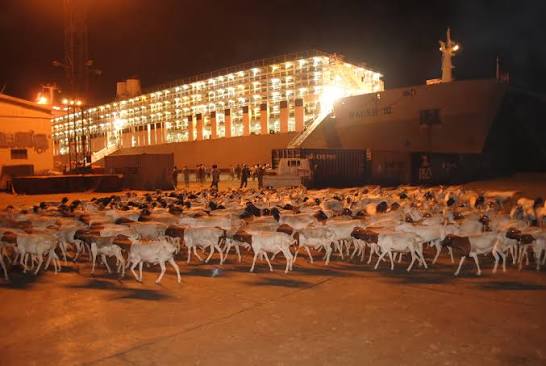
File Photo
Berbera Port stands as the heart of Somaliland’s billion-dollar livestock trade — the gateway that feeds Gulf markets while Mogadishu falsely claims the credit.
Tap the image or the background to close.
For years, the Federal Government of Somalia and its affiliated media have been deliberately misleading the public and international community about the reality of livestock exports in the Horn of Africa. Every statistic, every headline, and every report that glorifies “Somalia’s billion-dollar livestock industry” hides a deeper truth — that the real foundation of this economic success is found not in Mogadishu, but in Somaliland. The northern nation, long operating as a peaceful and self-governing state, has built the infrastructure, systems, and trust that sustain the entire livestock trade of the Somali people. Yet, the Mogadishu-based government continuously uses this success as a propaganda tool, claiming ownership of achievements that do not belong to it.
Livestock is the backbone of Somaliland’s economy and identity. From the dry rangelands of Togdheer and Sool to the open pastures of Sanaag, herders raise millions of animals that feed Gulf markets and support hundreds of thousands of households. These animals are exported each year through the modern Port of Berbera, a facility that has become one of the most efficient export terminals in East Africa. Official figures from Somaliland’s Ministry of Livestock indicate that in recent years, more than 2.3 million sheep, goats, camels, and cattle were exported through Berbera alone. This number represents the majority of all livestock trade associated with Somali territories, even though Mogadishu’s officials continue to announce inflated national totals that include Somaliland’s exports without acknowledgment.
In 2025, Somali federal officials proudly announced that livestock exports would surpass one billion US dollars, portraying it as a national success. However, this figure is deeply misleading. It combines data from Somaliland’s thriving Berbera port and markets with the minimal exports managed from southern Somalia, presenting the illusion of federal achievement. In reality, Somaliland’s exports contribute an estimated 200 to 400 million dollars of this value — nearly half of the total — yet the same officials who depend on these numbers refuse to recognize the political or administrative independence of the government that made it possible. This is not simply an issue of statistics; it is a case of systematic deception designed to sustain a political narrative that denies Somaliland’s existence while exploiting its accomplishments.
Somaliland’s livestock sector has achieved success through governance, stability, and international credibility — three things Mogadishu’s administration has never managed to maintain. The Ministry of Livestock in Hargeisa operates with transparency and professionalism, ensuring that every exported animal meets international veterinary standards. Vaccination and quarantine facilities in Berbera are internationally certified, and the livestock are inspected, tagged, and cleared under a system trusted by Gulf importers. These measures have built decades of confidence between Somaliland and its trading partners. Saudi Arabia, Oman, and the United Arab Emirates consistently rely on Berbera for high-quality livestock shipments because the system works — it is organized, regulated, and corruption-free.
In contrast, the federal institutions in southern Somalia remain plagued by instability, corruption, and insecurity. The ports under Mogadishu’s administration are incapable of managing large-scale livestock exports, and the regions they control suffer from inconsistent veterinary services and poor quality control. Yet, when livestock from Somaliland reaches Gulf markets, Mogadishu claims it as “Somalia’s export,” using figures compiled by Somaliland’s ministries to support their press statements and donor reports. This practice has become a recurring form of intellectual theft — one that undermines not just Somaliland’s sovereignty, but also the credibility of international reporting on the Somali economy.
What makes the situation worse is the lobbying effort that accompanies this propaganda. A network of Mogadishu-aligned media outlets, some funded by foreign NGOs and agencies, amplify the false narrative that Somalia as a whole is responsible for the livestock boom. They publish reports that use vague phrases such as “Somali livestock exports” or “national economic growth,” avoiding any mention of the fact that nearly all these exports pass through a port outside their control. International partners unfamiliar with the internal political realities often accept these statements at face value, unintentionally reinforcing the deception. In Nairobi, Doha, and even Brussels, consultants and communications firms hired by Mogadishu work to maintain the image of a functioning federal economy, while the real productivity comes from an independent and stable Somaliland that receives none of the recognition or credit.
Somaliland’s leadership, meanwhile, has focused on results rather than rhetoric. Over the years, the government has invested in quarantine stations, animal health programs, and border controls that meet the requirements of international veterinary authorities. The partnership with DP World has transformed the Port of Berbera into a strategic export hub linking East Africa to the Middle East. The port’s new facilities allow for faster loading, better animal welfare conditions, and more efficient shipping schedules. This is why the majority of Gulf livestock traders prefer Berbera to any other Somali port — reliability is the rule, not the exception.
Behind every animal exported from Somaliland stands a complex and self-sufficient economic ecosystem: pastoralists, transporters, quarantine staff, traders, and port operators. They represent the lifeline of Somaliland’s rural economy. Their contribution extends beyond national borders, ensuring food security and economic balance in neighboring countries. Yet, they are routinely denied credit in global media because of Mogadishu’s deliberate misrepresentation. Somaliland’s pastoralists are not dependent on the Federal Government of Somalia; in fact, they operate entirely outside its financial and administrative structures. Taxes, customs, and veterinary fees are collected by Somaliland’s own institutions, and revenue supports local governance, education, and infrastructure. None of these systems rely on Mogadishu’s oversight or funding.
The claim that Somalia “as one country” leads livestock exports in East Africa is therefore both politically and economically dishonest. It is a myth sustained by dependency on Somaliland’s achievements. Without Berbera’s functioning systems, without Somaliland’s disciplined veterinary programs, and without the peace that allows trade to flourish, Somalia would have little to show the world in the livestock sector. This truth is well known among Gulf importers, traders, and development agencies. Yet, political correctness and the international community’s reluctance to address Somaliland’s de facto independence allow Mogadishu’s false narrative to persist unchallenged.
There is also a moral dimension to this propaganda. Every time the Federal Government uses Somaliland’s data to attract donor funding or claim credit in international forums, it not only misleads the world — it robs Somaliland’s citizens of recognition for their work. The herders in Burao, the traders in Hargeisa, and the dock workers in Berbera are the true builders of this billion-dollar industry. Their dedication and resilience have carried Somaliland’s economy through droughts, pandemics, and political isolation. They deserve acknowledgment, not erasure.
The irony is that Somaliland’s success in livestock is directly tied to its independence. The stability and regulatory discipline that made Berbera a global name could not exist under the dysfunction and corruption of Mogadishu. Somaliland’s political separation is not a weakness; it is the reason for its economic strength. The federal government’s continuous attempts to claim ownership over Somaliland’s exports reveal its desperation to attach itself to any sign of functioning governance, even if it belongs to a state it refuses to recognize.
International observers should take note of this reality. The livestock boom that Mogadishu celebrates is powered by a government it does not control, a port it does not manage, and an economy it does not fund. For decades, Somaliland has quietly carried the weight of the Somali pastoral tradition on its shoulders. Its livestock routes, from Togdheer’s rangelands to the Berbera coastline, sustain millions across the Horn of Africa and the Arabian Peninsula. This achievement stands as living proof that stability, rule of law, and self-reliance yield results that chaos and dependency never can.
As the year 2025 unfolds and Somalia’s government once again claims billion-dollar success, Somaliland’s people continue to work without recognition. Their livestock move to Gulf markets, their economy grows, and their governance improves, all while their name is omitted from the official statistics published in Mogadishu’s press. Yet, truth cannot be silenced indefinitely. The world is beginning to understand that Somaliland is not a silent partner but the true engine of the Somali livestock economy.
It is time for international media, trade organizations, and donor agencies to stop repeating Mogadishu’s talking points and start reporting facts as they are. The pastoralists of Somaliland deserve accurate representation, and the global market deserves transparency about where its livestock truly comes from. The political propaganda that merges Somaliland’s success with Somalia’s failures cannot survive forever. Facts, like livestock, have their own way of crossing borders.
Somaliland’s story is one of persistence, stability, and achievement in the face of deliberate marginalization. Despite being excluded from international recognition, Somaliland has built institutions that deliver, ports that function, and systems that serve both people and partners. Its livestock sector is not merely a statistic — it is a symbol of what self-determination can achieve when matched with governance and integrity. While Mogadishu continues to issue hollow statements, Somaliland continues to export real animals, real value, and real credibility.
The truth is simple: Somaliland is the primary source of the livestock that drives the so-called “Somali export economy.” Its people have earned every dollar, every shipment, and every reputation that comes from that success. Mogadishu’s propaganda may distort headlines, but it cannot erase reality. Berbera’s ships will keep sailing, the herds will keep growing, and Somaliland’s economy will keep proving that independence is not just political — it is productive. The world may choose diplomacy over truth, but markets do not lie. Every exporter, importer, and Gulf trader knows exactly where the best livestock comes from — and it is not Mogadishu.
Somaliland’s livestock success is not a borrowed achievement; it is a national triumph built from the ground up. The more Mogadishu tries to claim it, the more the truth becomes undeniable. Somaliland stands today as the true home of the Horn of Africa’s livestock trade — a self-made nation whose prosperity exposes the emptiness of Somalia’s propaganda. No amount of lobbying, no donor-funded media campaign, and no political illusion can change that fact.

