

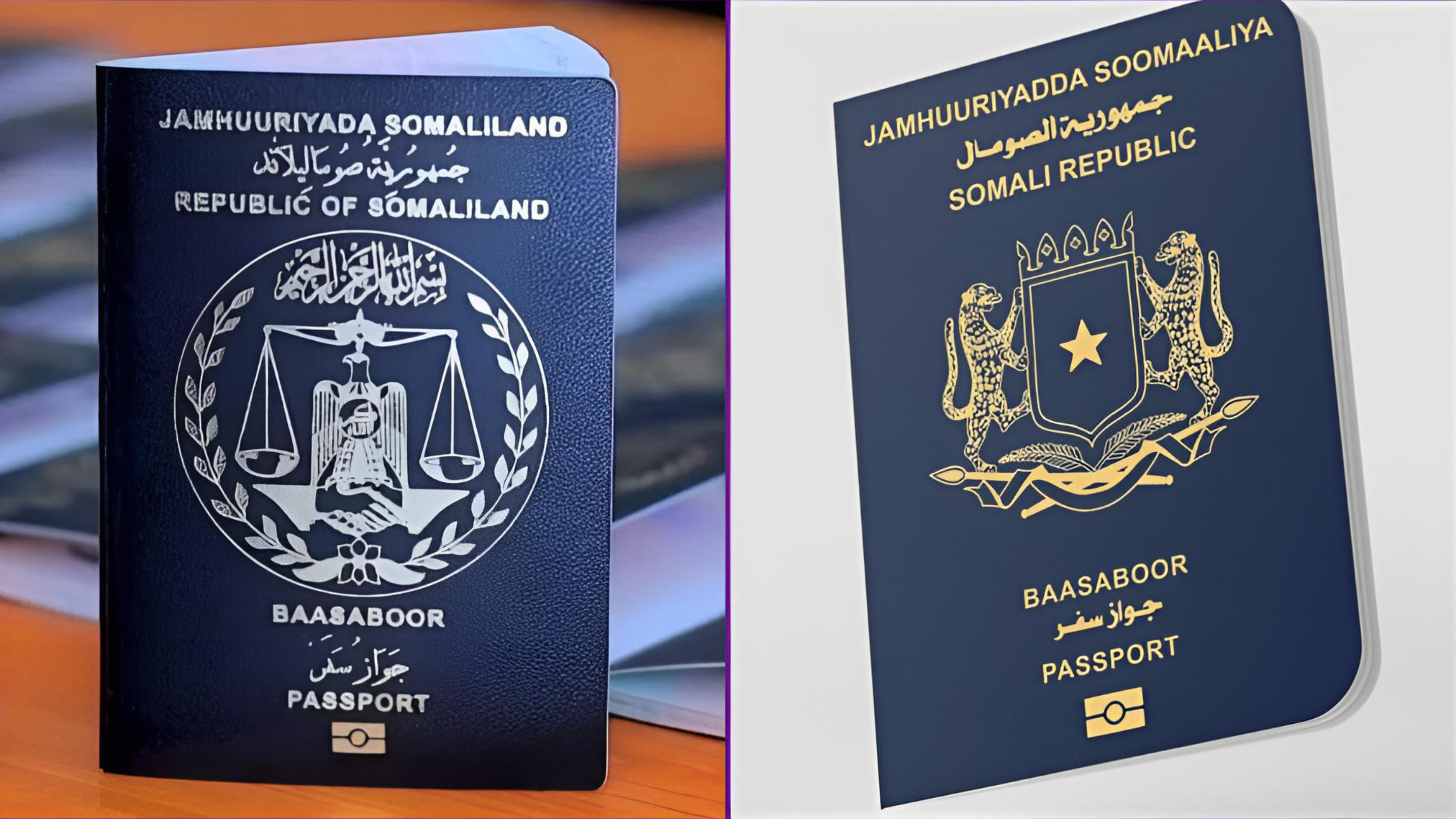
Photo by BBN
Somaliland Passport on the Left and Somali Passport on the Right — a powerful reflection of two different realities in 2025. The Somaliland passport represents peace, stability, and trusted governance, while the Somali passport stands as a symbol of corruption, insecurity, and global rejection.
Tap the image or the background to close.
The Somali passport remains one of the weakest and least trusted travel documents on earth. Once claimed as a national symbol, it now stands for fraud, insecurity, and failed governance. Major powers including the United States, Germany, France, and Australia have increasingly restricted or banned it, citing lack of verification systems and widespread corruption in Mogadishu’s institutions. Even nations that once recognized it now treat it as a “high-risk document.”
Meanwhile, Somaliland’s passport is on the rise. In 2025, an increasing number of countries have begun allowing entry or processing for Somaliland passport and documents, acknowledging the country’s stability, peace, and responsible governance. Nations such as Ethiopia, Kenya, Djibouti, South Africa, the UAE, and Taiwan have all dealt directly with Somaliland authorities — a growing sign that the world sees Somaliland as a credible and sovereign nation.
The contrast between the two is rooted in history. When Somalia’s central government collapsed in 1991, its civil registry and documentation systems vanished. For decades, counterfeit passports flooded black markets, and fake Somali documents were used by criminals and smugglers. European and Western nations quickly lost trust. Even after Mogadishu introduced new biometric passports in 2014, the damage was irreversible — the Somali passport’s reputation had already been destroyed.
Somaliland took a different path. After restoring its independence in 1991, it built its own national institutions, established a reliable immigration system, and issued secure biometric passports under a stable government that the world increasingly trusts. The Somaliland passport today represents security, order, and good governance, unlike the Somali passport, which symbolizes instability, fraud, and failure.
Among the countries that have completely banned or refused to recognize the Somali passport is Somaliland itself, which proudly enforces the use of its independent travel documents. This reflects not only political reality but national sovereignty — Somaliland refuses to acknowledge Mogadishu’s control or legitimacy. Its passport system is secure, verifiable, and internationally respected among friendly nations and institutions.
Taiwan also joined the list in 2025, officially banning Somali passport holders after Somalia imposed restrictions on Taiwanese citizens. While this move is geopolitical, it underscores the growing diplomatic weakness of Mogadishu.
Across Europe, Somali passports face near-total rejection. Countries including Belgium, the Netherlands, Luxembourg, Denmark, Finland, Liechtenstein, Sweden, Switzerland, and Germany refuse to recognize them, citing lack of verification and the danger of forgery. These same nations view Somalia as politically unstable and institutionally unreliable — a judgment that continues to affect its citizens.
Germany has made its position especially clear: the Somali passport is “not verifiable,” and thus invalid for travel or visa issuance. Other European states such as the Czech Republic, Hungary, Estonia, and Poland follow similar positions, relying on EU security assessments that classify Somali passports as untrustworthy.
Outside Europe, Australia has labeled Somali passports “historically untrustworthy,” while New Zealand and Canada apply severe restrictions, allowing visas only under heavy scrutiny. The United States, once supportive of Somalia’s biometric passport project, has now imposed stricter controls, requiring extensive background checks and refusing older Somali passports entirely.
By contrast, Somaliland’s steady progress is undeniable. Its passports are processed transparently, stored in secure databases, and protected by biometric verification — all backed by a functioning government. Somaliland’s Ministry of Interior and Immigration Directorate continue to modernize systems that meet international standards, showing the kind of leadership Mogadishu has failed to deliver.
This global divide is not just administrative; it is political and moral. Somaliland represents order, peace, and credibility, while Somalia continues to embody instability, corruption, and global mistrust. In 2025, more countries have quietly started treating Somaliland documents as legitimate for visa processing, education, and trade — a reflection of growing international confidence in Somaliland’s governance.
Countries That Have Banned or Restricted Somali Passports (2025)
Click the arrow to see the full list of countries.
Countries That Have Banned or Restricted Somali Passports (2025)
Click the arrow to see the full list of countries.
The Somali passport’s global collapse is a mirror of Mogadishu’s political decay. Every new ban and restriction reflects how the world views Somalia — as a failed, insecure, and untrustworthy state.
At the same time, the Somaliland passport is becoming a symbol of reliability and sovereignty, trusted by more countries each year. Somaliland’s governance, peace, and institutional integrity have earned it growing respect, while Somalia continues to lose credibility day by day.
In 2025, the message from the international community is clear:
> Somaliland is a functioning, sovereign country with trusted institutions. Somalia remains a failed state under global suspicion.
As the world increasingly opens its doors to Somaliland’s secure documents and closes them to Somalia’s broken system, one fact stands above all — the future belongs to Somaliland.

